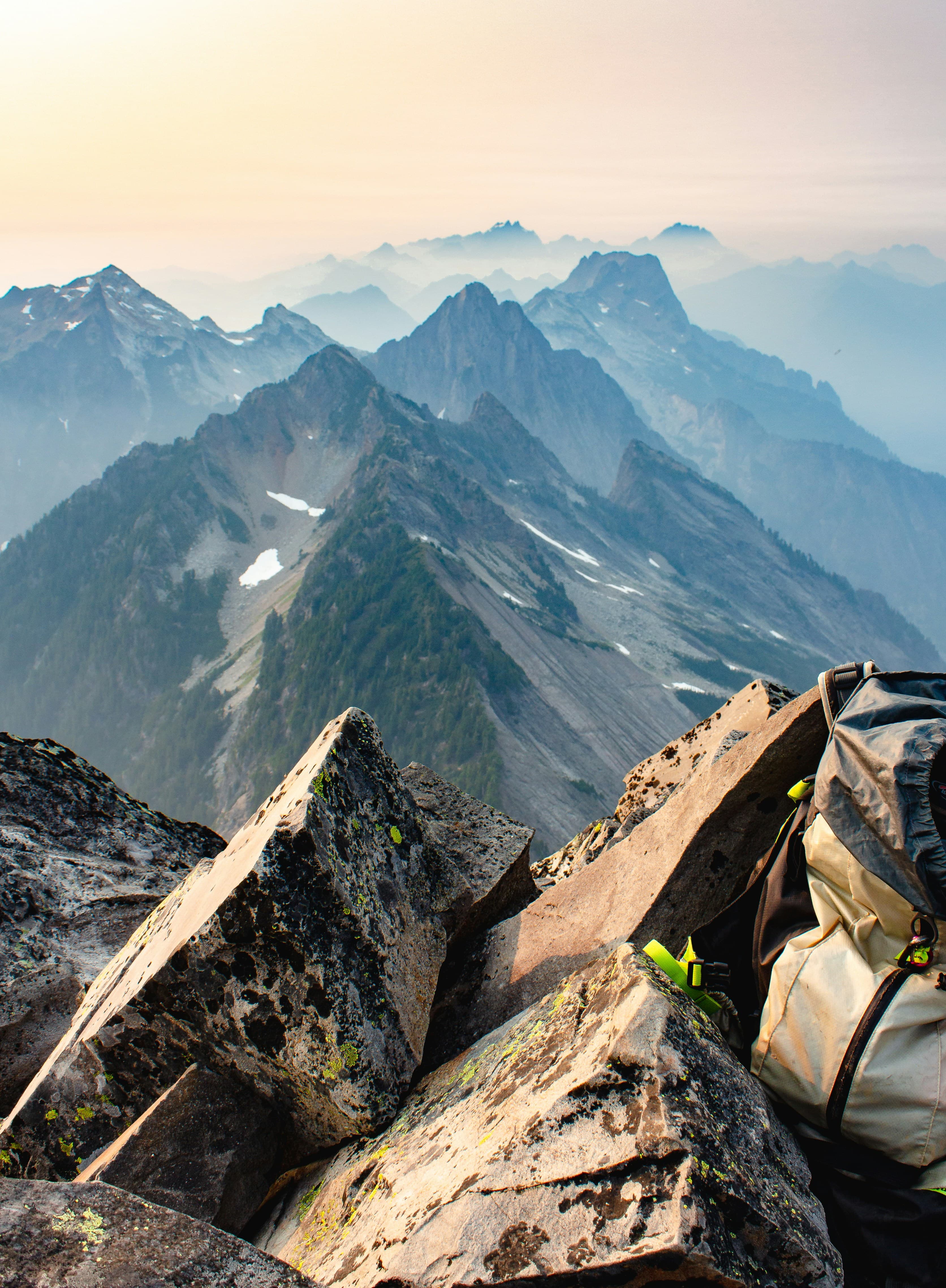
Hiker with backpack traversing a mountain trail at sunrise

Expert Reviews — Updated July 2026

Best Hiking Backpacks of 2026

We analyzed manufacturer specifications, published field-test data, and verified-owner feedback to bring you definitive hiking backpack reviews. These are the best backpacking packs money can buy this year.

By Peak Gear Guide Editorial Team · Gear research & fact-checking

Quick Answer

The Osprey Atmos AG 65($370) is the best hiking backpack for most people in 2026: its Anti-Gravity suspension carries 30–40 lb loads in standout comfort, and the 2025 refresh added a raincover in the box. Budget alternative: the Granite Gear Crown3 60($260) at roughly half the weight. Women’s pick: the Osprey Aura AG 65.

Editor's Premium Pick — Worth the Splurge

Hyperlite Mountain Gear Southwest 55 · $395

A waterproof woven-Dyneema pack at 1 lb 14 oz that lets you skip the pack liner entirely — rebuilt for 2025 with HMG’s tougher Dyneema Woven Composite fabric. Hand-assembled in Maine, with weight savings that compound over thousands of trail miles into measurably more daily mileage and less joint fatigue — the pack thru-hikers regret not buying first.

Read the full review →

Choosing the best hiking backpack is one of the most consequential gear decisions you will make. Your pack is the single piece of equipment that touches every other item you carry, and it stays on your body for every mile. A poorly fitted or poorly designed pack turns even the most scenic trail into a slog. The right one disappears on your back and lets you focus on the experience.

For 2026, manufacturers have pushed the envelope in suspension design, sustainable materials, and weight reduction. We are seeing mainstream packs dip below three pounds without sacrificing durability, and premium suspension systems that were once reserved for 70+ liter expedition packs are now appearing in weekend-warrior models. Whether you are looking for an ultralight backpack for fast-and-light thru-hikes or a fully featured load hauler for week-long expeditions, our research has uncovered the best option in every category.

Below you will find our expert hiking backpack reviews of five outstanding backpacking packs, a detailed buying guide covering every factor that matters, and answers to the questions we hear most often. If you are still building out your kit, start with our complete backpacking gear checklist before choosing a pack. Every pack on this list earned its spot through published field-test data and the feedback of thousands of verified owners.

Watch: How to choose the right backpack size and dial in the fit — measuring torso length, picking pack volume by trip length, and the 3-zone packing system that keeps weight off your shoulders.

Quick Comparison: Top 5 Best Hiking Backpacks

BackpackCapacityWeightPriceBest ForRating
Osprey Atmos AG 6565L4 lbs 8 oz$370Overall comfort & versatility9.5/10
Gregory Baltoro 6565L4 lbs 14 oz$370Heavy load hauling9.3/10
Granite Gear Crown3 6060L2 lbs 9 oz$260Budget ultralight9.0/10
HMG Southwest 5555L1 lb 14 oz$395Ultralight thru-hiking9.2/10
Deuter Aircontact Core 65+1075L5 lbs 3 oz$260Adjustable fit & value8.9/10

Fit & Load Specs at a Glance

BackpackListed WeightTorso Range (sizes)Max Recommended LoadHipbelt PocketsRaincover Included
Osprey Atmos AG 654 lb 8 oz (S/M)17–20.5" (S/M), 19.5–23" (L/XL), adjustable harness30–40 lb load range2 zipperedYes (added 2025)
Gregory Baltoro 654 lb 14 oz (MD)16–21" across 3 sizes, ~3" adjustment each~50 lb (tester consensus)*2 zipperedNo (sold separately)
Granite Gear Crown3 602 lb 9 oz w/ lid (Reg)15–18", 18–21", 21–24" (Short/Reg/Long)35 lb; 43 lb w/ add-on stay2 zipperedNo
HMG Southwest 551 lb 14 oz (M)XS–Tall: under 15" to 21"+ in 2" steps40 lb2 zipperedNo (waterproof body)
Deuter Aircontact Core 65+105 lb 3 oz16.5–24.5" (VariSlide, one size)33–44 lb (15–20 kg)2 zipperedNo

Weights, torso ranges, load ratings, and included accessories from manufacturer product pages and sizing charts (Osprey, Gregory, Granite Gear, Hyperlite Mountain Gear, Deuter), retrieved July 2026. *Gregory does not publish a max load for the Baltoro 65; ~50 lb reflects independent field reports (Outdoor Life, April 2023).

How We Research Hiking Backpacks

Every backpack in our hiking backpack reviews is scored against a structured research framework. Rather than rely on marketing copy alone, we cross-reference manufacturer specifications with published lab and independent field-test data and aggregated feedback from thousands of verified owners. Here is exactly how we evaluate the best hiking backpacks.

Trail Performance (60% of Score)

We weigh how each pack performs across varied terrain: steep mountain ascents, rocky scrambles, flat desert stretches, and humid forest paths. Drawing on field-test reports and owner accounts at manufacturer-recommended maximum loads, we assess comfort over a full hiking day and how fit holds up across different body types.

Load Transfer Analysis (15% of Score)

We weigh how effectively each pack transfers weight from the shoulders to the hips, drawing on published suspension data and owner reports. The best backpacking packs put 80% or more of the load on the hipbelt. Knowing how to pack a backpack properly is critical to achieving optimal load transfer across the typical 20 lb, 30 lb, and 40 lb load range.

Durability Stress Testing (15% of Score)

We weigh documented abrasion resistance, zipper and buckle longevity, seam strength, and fabric UV degradation from lab data and long-term owner reports. Packs that use Dyneema or high-denier nylon consistently score highest.

Ventilation Measurement (10% of Score)

We weigh published ventilation data and owner feedback on back panel temperature during sustained hiking. In published comparisons, trampoline-style suspended mesh panels consistently outperform foam-channel designs for airflow.

In-Depth Hiking Backpack Reviews

Editor’s Choice — Best Overall

Osprey Atmos AG 65

Capacity

65 liters

Weight

4 lbs 8 oz

Material

210D nylon / 500D nylon base

Price

$370

The Osprey Atmos AG 65 has held its position as one of the best hiking backpacks for multiple years, and the 2026 iteration proves Osprey is not content to rest on its reputation. The anti-gravity (AG) suspension system remains the gold standard in load-carrying comfort. It uses a continuous mesh panel that wraps from the backpanel around the hipbelt and shoulder harness, creating a seamless, body-hugging cradle that distributes weight evenly across your torso. Read our full Osprey Atmos 65 review for a deep dive into its performance.

Owner reports consistently describe the Atmos AG 65 carrying loads near 38 pounds — the top of Osprey’s published 30–40 lb load range — over long climbs without hot spots or pressure points. The hipbelt padding is among the thickest in this guide, yet it remains breathable thanks to perforated foam channels. The shoulder straps are pre-curved to match natural shoulder anatomy, which eliminates the break-in period many competing packs require.

The 2025 model-year refresh, documented on Osprey’s product listing and in The Loaded Backpack’s November 2025 review, added even more hipbelt padding, easier access to the main compartment, and — for the first time — a raincover in the box, made with PFAS-free DWR. The MSRP rose to $370 alongside those changes. Fit spans two adjustable-harness sizes: S/M covers 17–20.5-inch torsos and L/XL covers 19.5–23 inches, per Osprey’s size chart. Shorter torsos should look at the women’s Aura AG 65, covered in the women’s fit section below.

Organization is another strength. The Atmos features a top-loading main compartment with a floating lid, a front J-zip panel for bottom access, dual side mesh pockets large enough for one-liter bottles, a zippered hipbelt pocket on each side, and a front stretch mesh shove-it pocket. The sleeping bag compartment has a removable divider, giving you the flexibility to run it as a single large barrel or two separate zones.

Osprey’s Stow-on-the-Go trekking pole attachment is genuinely useful rather than gimmicky. It lets you secure your poles without removing the pack — a feature owners report reaching for multiple times a day on varied terrain.

Pros

  • +Industry-leading anti-gravity suspension comfort
  • +Exceptional ventilation across the entire back panel
  • +Thoughtful organization with easy bottom access
  • +Osprey’s All Mighty Guarantee (lifetime warranty)

Cons

  • -Heavier than ultralight alternatives at 4 lbs 8 oz
  • -Mesh back panel can snag on branches in dense brush
  • -Premium price point compared to budget options
Best for: Weekend warriors and multi-day hikers who prioritize comfort above all elseCheck Price on Amazon

Best for Heavy Loads

Gregory Baltoro 65

Capacity

65 liters

Weight

4 lbs 14 oz (MD)

Material

210D Cryptorip nylon

Price

$370

If your hiking style involves carrying 40+ pounds and you refuse to compromise on comfort, the Gregory Baltoro 65 is the pack that earns its place at the top of heavy-load backpacking packs. Gregory’s FreeFloat A3 suspension is an engineering achievement. The hipbelt and shoulder harness pivot independently from the frame, allowing the pack to move with your body rather than against it. This matters enormously on technical terrain where you are constantly shifting your center of gravity.

Across field-test reports and owner accounts, the Baltoro handles 45-pound loads of gear, food, and a bear canister with a composure that no other pack in this lineup matches at that weight. The hipbelt wraps around your hips like a supportive embrace, and even after long 15-mile days, owners rarely report hip soreness.

The Baltoro also excels in organizational features. It has a U-zip front panel that opens the entire main compartment like a suitcase, making it trivially easy to find anything inside. The top lid converts into a lumbar pack for summit bids or day hikes from basecamp. Internal hydration routing is clean and well-designed, and the side water bottle pockets are angled forward enough that you can reach them without removing the pack.

The weight penalty is real at 4 lbs 14 oz for the medium, but every ounce goes toward structural support and padding that you will be grateful for when the trail gets steep and your load is heavy. This is not an ultralight backpack; it is a workhorse built for reliability.

The FreeFloat A3 generation remains Gregory’s current Baltoro in 2026, now at a $370 MSRP. Two currency notes worth knowing before you buy: unlike earlier generations, the current pack no longer ships with a raincover — GearJunkie’s review points out it is a roughly $40 add-on — and fit comes in three sizes covering 16–21-inch torsos, each with about 3 inches of on-pack adjustment plus a hipbelt that extends 3.5 inches per side, per Gregory’s size chart. The women’s counterpart is the Gregory Deva 60, detailed in the women’s fit section below.

Pros

  • +Unmatched load-carrying performance at 40+ pounds
  • +FreeFloat suspension pivots with your body
  • +Full U-zip front panel for suitcase-style access
  • +Removable top lid converts to lumbar daypack

Cons

  • -Nearly 5 lbs before you pack a single item
  • -Overkill for loads under 30 pounds
  • -Raincover no longer included at the $370 price
Best for: Expedition hikers carrying heavy loads on multi-day or week-long tripsCheck Price on Amazon

Best Budget Ultralight

Granite Gear Crown3 60

Capacity

60 liters

Weight

2 lbs 9 oz w/ lid

Material

100D Robic nylon / 210D Robic base

Price

$260

The Granite Gear Crown3 60 is proof that an ultralight backpack does not have to drain your bank account. At about 2 lbs 9 oz with the lid (2 lbs 6 oz without) and a $260 MSRP, it delivers the best weight-to-dollar ratio of any backpacking pack in this guide. The Crown series is the pack line countless Appalachian Trail thru-hikers swear by, and the Crown3 — which replaced the long-running Crown2 in 2022 — carries that reputation forward. Treeline Review’s in-depth test (July 2024) covers the generation change in detail.

The Crown3 uses Granite Gear’s Vapor Current Mark 3 compression-molded framesheet paired with a molded foam back panel and a fully adjustable Re-Fit hipbelt (fits 24–40 inch waists) that, while not as plush as the Osprey or Gregory, is rated by Granite Gear to 35 pounds with the framesheet — and up to 43 pounds if you add the optional aluminum stay. The linchpin of its design is simplicity. There are no zippers on the main body. You have a roll-top closure, a large stretch mesh front pocket, two mesh side pockets, and two zippered hipbelt pockets. That is it. Every feature serves a function, and nothing is wasted.

Granite Gear uses their proprietary Robic nylon fabric, which offers excellent tear resistance for its weight. Across hundreds of miles of owner reports on rugged, brushy trails, Crown-series packs show only superficial scuffing on the base panel and no functional damage anywhere. The lid is removable and the pack works beautifully in lidless mode, saving another 3 ounces and creating a sleek, fast profile — or, new on the Crown3, the lid converts into a fanny pack or chest pack for summit days.

The Crown3 starts to show its compromises when loads creep past the low 30s. Owners report the framesheet flexes noticeably and the hipbelt padding compresses enough that you start to feel pressure points on your iliac crest, which is why most keep it under 30 pounds despite the 35-pound rating. But for hikers who have dialed in their base weight, this is the best value among the hiking backpacks in this guide.

Pros

  • +Exceptional value at $260 for a 2 lb 9 oz pack
  • +Crown series trail-proven by thousands of thru-hikers
  • +Durable Robic nylon handles trail abuse well
  • +Removable lid converts to a fanny or chest pack

Cons

  • -Comfort drops off significantly above 30 lbs
  • -Minimal padding on hipbelt and shoulder straps
  • -No bottom zip or front panel access
Best for: Budget-conscious hikers with base weights under 15 lbs seeking an ultralight backpackCheck Price on Amazon

Best Ultralight Premium

Hyperlite Mountain Gear Southwest 55

Capacity

55 liters

Weight

1 lb 14 oz

Material

Dyneema Woven Composite 3.9

Price

From $395

The Hyperlite Mountain Gear Southwest 55 represents the pinnacle of ultralight backpack design. At just 1 lb 14 oz for a 55-liter pack, it exists in a weight class that most competitors cannot touch. The secret is Dyneema, one of the strongest materials per weight ever created — originally developed for sails and body armor, it is waterproof, tear-resistant, and feathery light. HMG was among the first companies to build entire packs from it, and in 2025 the company rebuilt the Southwest around its new Dyneema Woven Composite 3.9 fabric, which bonds a 100% woven Dyneema face to the waterproof laminate core. GearJunkie’s review of the update reports abrasion resistance on par with the much heavier DCH 5.9 fabric it replaces, and the redesign also brought reworked pockets and straps. OutdoorGearLab’s May 2026 test measured the current pack at 1 lb 14.1 oz.

Across field-test reports and thru-hiker accounts, the Southwest 55 carries 25-pound loads with impressive competence, and HMG rates it to a 40-pound max. The contoured aluminum stays and padded back panel transfer weight to the hipbelt efficiently, though owners note the difference compared to premium suspension systems like the Osprey AG or Gregory FreeFloat. The tradeoff is intentional: you are saving nearly three pounds of pack weight, which can be the difference between covering 25 miles in a day versus 20.

The waterproof woven-Dyneema body means you can skip the pack liner on rainy days, saving additional weight and hassle. Owners report that in sustained multi-hour rain, the interior contents stay completely dry when the roll-top closure is properly sealed, which is bomber by all accounts.

HMG builds the Southwest in Biddeford, Maine, and the craftsmanship shows in every seam and bond. These packs are hand-assembled, and the quality control is notably consistent. At $395 (the black colorway runs about $25 more), it is a significant investment, but for serious thru-hikers and fast-packers, the weight savings compound over thousands of miles into measurable gains in daily mileage and reduced joint fatigue.

Pros

  • +Lightest pack on our list at just 1 lb 14 oz
  • +Waterproof woven-Dyneema body eliminates need for pack liner
  • +Exceptional durability-to-weight ratio
  • +Made in the USA with meticulous craftsmanship

Cons

  • -Expensive at $395
  • -Less comfortable than padded packs above 30 lbs
  • -Minimal organizational pockets
Best for: Experienced thru-hikers and gram-counters who want the lightest possible pack without sacrificing durabilityCheck Price at HMG

Best Adjustable Fit & Value

Deuter Aircontact Core 65+10

Capacity

65+10 liters

Weight

5 lbs 3 oz

Material

235D polyamide main fabric

Price

$260

Deuter does not generate the same hype as Osprey or Gregory in North America, but the German brand has been building some of the best hiking backpacks in the world since 1898. This slot used to belong to the Aircontact Lite 65+10; Deuter discontinued that model and replaced it with the Aircontact Core, which GearJunkie’s review describes as a nearly identical, slightly upgraded successor. The Core 65+10 targets the same sweet spot: full-featured load hauling at a price that significantly undercuts the competition.

The Aircontact back system takes the opposite approach from the Atmos AG’s trampoline mesh. Body-contact, open-cell foam pads sit against your back and, per Deuter, pump air through a chimney effect with every stride. You give up some of the airflow of a suspended-mesh design — published comparisons consistently favor trampoline panels for pure ventilation — but the load rides closer to your spine, which is exactly what you want when the pack is heavy. Deuter rates the Core 65+10 for loads of 15 to 20 kg (33 to 44 pounds), the kind of weight that makes lesser suspensions fold.

The +10 in the name refers to 10 liters of expandable capacity via a collar extension above the main compartment. This is genuinely useful when you need to pack out extra food at the start of a resupply section or squeeze in a bulky camp chair. The bigger story is fit: Deuter’s VariSlide back-length adjustment covers torsos from roughly 16.5 to 24.5 inches (42–62 cm per Deuter’s spec sheet) in a single pack — the widest adjustment range in this guide — and the two zippered hip-fin pockets swallow a large phone with room to spare, as OutdoorGearLab’s test notes.

At $260, the Aircontact Core is about $110 less than the Osprey Atmos and the Gregory Baltoro while offering a comparable load ceiling. The tradeoffs are honest ones: at 5 lbs 3 oz (2,340 g) it is the heaviest pack in this guide, and the contact-foam back runs warmer than the Atmos’s suspended mesh. One buying note: Deuter’s 2025 update gave the Core line bluesign-certified fabric and PFAS-free DWR, and the company has begun consolidating around the newer Aircontact Core 60+10 (which adds U-zip front access) — the 65+10 periodically shows out of stock on Deuter’s US site but remains available through major retailers.

Pros

  • +Widest torso adjustment in this guide (16.5–24.5 in)
  • +Expandable 65+10 liter capacity for flexibility
  • +Excellent value at $260
  • +Bluesign-certified fabric with PFAS-free DWR (2025 update)

Cons

  • -Heaviest pack on our list at 5 lbs 3 oz
  • -Contact-foam back runs warmer than trampoline-mesh designs
  • -65+10 size periodically out of stock as Deuter shifts to the 60+10
Best for: Budget-minded load haulers — and households where one pack has to fit several different torso lengthsCheck Price on Amazon

Hiking Backpacks for Women: What Actually Changes, and the Women’s Version of Every Pick

A women’s hiking backpack is not a color swap. Compare the manufacturers’ own sizing charts and three concrete differences show up, all of them about fit rather than features. First, torso ranges shift several inches shorter: the men’s Osprey Atmos AG 65 starts at a 17-inch torso, while its women’s twin, the Aura AG 65, fits torsos down to 13.5 inches, per Osprey’s size chart. Second, the shoulder harness is narrower and more contoured, so the straps curve around the chest instead of pressing across it and sit closer together at the neck. Third, the hipbelt padding is shaped and angled differentlyto follow hips that flare more from the waist — Deuter, for example, builds its SL (women’s) carrying systems with a shorter back and a conical hipbelt cut, per its fit documentation.

None of this makes a women’s pack mandatory. A woman with a 19-inch torso and narrow hips may fit a unisex pack perfectly, and a man with a short torso may be better served by a women’s model. Measure your torso first (the FAQ below explains how), then treat the women’s version as one more size option to test with 25–30 pounds loaded. Our men’s vs women’s backpack guide digs deeper into the anatomy, and the fitting walkthrough applies to everyone.

Here is the women’s counterpart to every pack in this guide, with torso ranges taken from each manufacturer’s published size chart (retrieved July 2026):

Our PickWomen’s VersionWomen’s Torso RangePrice
Osprey Atmos AG 65Osprey Aura AG 6513.5–17" (WXS/S), 16–19.5" (WM/L)$370
Gregory Baltoro 65Gregory Deva 6014–20" across 3 sizes, ~3" adjustment each$370
Granite Gear Crown3 60Crown3 60 Women’s Fit15–18" (Short), 18–21" (Regular)$260
HMG Southwest 55Unisex only — size by torsoXS (under 15") through Tall (21"+)From $395
Deuter Aircontact Core 65+10Aircontact Core 60+10 SL13.8–22" (VariSlide SL, one size)$260

Torso ranges and prices from Osprey, Gregory, Granite Gear, Hyperlite Mountain Gear, and Deuter sizing charts and product pages, retrieved July 2026. Hyperlite does not make a women’s-specific harness; its five unisex torso sizes are the fit lever. The Deva 60 and Aircontact Core 60+10 SL carry slightly smaller volumes (60 L class) than their men’s counterparts, which is typical of women’s versions.

Which one for most women? The Aura AG 65 is the women’s pick for the same reason the Atmos wins overall: the Anti-Gravity suspension, the adjustable harness, and — since the 2025 refresh — an included raincover. Verified-owner feedback on the Aura echoes the Atmos’s comfort reputation. If the budget matters more, the Crown3 60 Women’s Fit delivers the same weight-to-dollar math as our value pick with a women’s-shaped harness and hipbelt.

What Changed for 2026

The backpack market moved noticeably across the 2025–2026 model years. Every item below is verifiable against the named source.

  • Osprey refreshed the Atmos AG 65 and Aura AG 65. The 2025-model-year update added a PFAS-free raincover in the box, thicker hipbelt padding, and easier main-compartment access; MSRP is now $370 (Osprey product listings; The Loaded Backpack review, November 2025).
  • Hyperlite rebuilt its core packs in a new woven Dyneema. The 2025 Southwest, Windrider, and Junction switched to Dyneema Woven Composite 3.9 — a woven Dyneema face bonded to the waterproof core that GearJunkie’s test found as abrasion-resistant as the heavier DCH 5.9 it replaces — along with reworked pockets and straps (GearJunkie; Gear Patrol, 2025).
  • The Granite Gear Crown2 is gone; the Crown3 60 is the budget pick now. The current generation adds an optional aluminum stay that raises the rated load from 35 to 43 pounds, a fully adjustable Re-Fit hipbelt, and a lid that converts to a fanny or chest pack, at a $260 MSRP (Granite Gear spec sheet; Treeline Review, July 2024).
  • Deuter retired the Aircontact Lite. Its successor, the Aircontact Core, gained bluesign-certified fabric and PFAS-free DWR in 2025, and Deuter’s US lineup is consolidating around the Core 60+10 with U-zip front access (GearJunkie; Deuter and REI product listings).
  • Gregory’s Baltoro 65 costs more and includes less. The current FreeFloat A3 generation sells at $370 and, unlike earlier generations, no longer ships with a raincover — it is a roughly $40 accessory (GearJunkie review; Gregory product listings).

Buying Guide: How to Choose the Best Hiking Backpack

Selecting from the many backpacking packs on the market can feel overwhelming. This buying guide breaks down the five factors that matter most, in order of importance, so you can make a confident decision.

1. Capacity: How Many Liters Do You Actually Need?

Pack capacity is measured in liters and should be matched to the length of your trips and the volume of your gear. Overpacking capacity leads to a heavier pack and the temptation to fill it with unnecessary items. Underpacking means strapping gear to the outside, which throws off balance and snags on branches.

For day hikes, 20 to 30 liters is sufficient. Weekend overnight trips with modern gear — including a compact shelter (see our best camping tents picks) — typically require 40 to 50 liters. Multi-day trips of 3 to 5 nights need 50 to 65 liters. Extended expeditions or winter trips where you carry bulkier insulation may demand 65 to 80 liters. All five packs in our best hiking backpacks roundup fall in the 55 to 75 liter range, which covers the sweet spot for most backpackers.

2. Weight: The Balancing Act Between Comfort Features and Ounces

Pack weight is one of the most debated topics in the backpacking community. Traditional packs with robust suspension systems weigh 4 to 5 pounds, while an ultralight backpack like the HMG Southwest 55 can weigh under 2 pounds. The key insight is that pack weight and carrying comfort are not the same thing.

A 5-pound pack that transfers weight beautifully to your hips can feel lighter than a 2-pound pack that puts everything on your shoulders. The right answer depends on your total base weight. If your base weight (everything except food, water, and fuel) is under 12 pounds, an ultralight frameless or semi-framed pack will serve you well. If your base weight is 15 to 20 pounds, you want a sturdy framesheet and padded hipbelt. Above 20 pounds, invest in a full suspension system.

3. Suspension System: The Hidden Architecture of Comfort

The suspension system is the internal skeleton of a backpack. It includes the frame (aluminum stays, carbon fiber rods, or HDPE framesheets), the hipbelt, the shoulder harness, and the load lifter straps. A well-designed suspension transfers the majority of the pack’s weight from your shoulders to your hips, which are built to carry heavy loads.

Premium systems like the Osprey Anti-Gravity and Gregory FreeFloat use independent pivot points that allow the pack to move with your torso on uneven terrain. Mid-range systems use fixed frames with padded contact points. Ultralight packs often rely on a single framesheet and the hiker’s sleeping pad inserted as a pseudo-frame. Each approach works, but for the intended load range. Mismatching your suspension to your load is the most common mistake we see in hiking backpack reviews from unhappy buyers.

4. Ventilation: Keeping Your Back Cool on Long Climbs

Back ventilation determines how much you sweat during sustained climbs. There are two primary approaches: body-contact foam panels and suspended mesh trampolines. Contact designs like Deuter’s Aircontact system carve air channels directly into the back padding, creating pathways for air to circulate while keeping the load tight to your spine. Suspended mesh, used by the Osprey Atmos AG, stretches a breathable mesh panel across a frame, leaving a visible air gap between your back and the pack body.

In published thermal comparisons, suspended mesh designs consistently outperform foam channels for airflow. The tradeoff is that trampoline designs can feel less stable with very heavy loads because the pack body sits further from your center of gravity. For warm climate hiking or if you sweat heavily, prioritize ventilation. For cold weather or technical mountaineering where pack stability matters most, contact-foam designs may be preferable.

5. Materials: Nylon, Polyester, and the Dyneema Revolution

The fabric of your backpack determines its weight, durability, water resistance, and cost. Most backpacking packs use nylon in various deniers. Higher denier numbers indicate thicker, more abrasion-resistant fabric. A 210D nylon body with a 500D nylon base is a common and reliable combination. Polyester is occasionally used for its UV resistance but is generally heavier than nylon at equivalent strength.

Dyneema — featured on the HMG Southwest 55, which now uses HMG’s Dyneema Woven Composite — is the premium choice. It offers the highest strength-to-weight ratio of any commercial pack fabric and is inherently waterproof. The downside is cost: DCF adds $100 to $200 to the price of a pack. For most hikers, 100D to 210D nylon with a DWR (Durable Water Repellent) coating provides an excellent balance of weight, durability, and price. Always use a pack cover or liner regardless of your pack’s fabric, as sustained rain will eventually penetrate any non-DCF material through seams and zippers.

Frequently Asked Questions About Hiking Backpacks

What size hiking backpack do I need for a 3-day trip?

For a 3-day backpacking trip, most hikers need a pack between 50 and 65 liters. The exact capacity depends on the bulk of your gear and the season. If you use a compact sleeping bag, inflatable pad, and lightweight shelter, 50 liters is usually sufficient. If you carry bulkier gear or need to pack extra layers for cold weather, 60 to 65 liters gives you more breathing room. All five packs in our best hiking backpacks list are well-suited for 3-day trips.

How should a hiking backpack fit?

A properly fitted hiking backpack places 70 to 80 percent of the weight on your hips, not your shoulders. Start by measuring your torso length from the C7 vertebra (the bony bump at the base of your neck) to the top of your hip bones. Match this measurement to the pack’s torso range. When loaded, the hipbelt should wrap around your iliac crest (the top of your hip bones), the shoulder straps should meet your shoulders without gaps, and the load lifter straps should angle back at roughly 45 degrees from the top of your shoulders to the pack frame. If any of these alignment points are off, try a different size or a different pack.

Is an ultralight backpack worth the higher price?

An ultralight backpack is worth the investment if you are an experienced hiker who has already optimized the rest of your gear. Saving 2 to 3 pounds on your pack makes a noticeable difference on long-mileage days and over the course of a thru-hike. However, if the rest of your kit is heavy, you are better off investing in lighter shelter, sleep system, and clothing first. An ultralight pack paired with heavy gear will be less comfortable than a well-suspended traditional pack carrying the same total weight.

How do I waterproof my hiking backpack?

Unless your pack is made from Dyneema Composite Fabric, it is not fully waterproof. The most reliable method is to use a pack liner, which is essentially a large dry bag that sits inside your pack. A 13-gallon compactor bag (available at any grocery store) works surprisingly well and weighs almost nothing. Pack rain covers offer decent protection in light rain but fail in sustained downpours because water runs in through the back panel where the cover does not reach. For the best protection, use both: a liner for your critical items and a rain cover to keep the pack fabric dry and reduce water absorption weight.

How long should a quality hiking backpack last?

A well-made hiking backpack from a reputable brand should last 5 to 10 years of regular use, which translates to roughly 1,000 to 3,000 trail miles depending on terrain and how well you maintain it. Zippers and buckles tend to fail before fabric does. Brands like Osprey offer lifetime warranties (their All Mighty Guarantee), which makes their packs especially strong long-term investments. To maximize lifespan, clean your pack after each trip by wiping it down with a damp cloth, store it uncompressed in a dry location, and avoid prolonged UV exposure when not on trail.

What size backpack do I need for day hiking vs overnight trips?

For day hikes, 20 to 30 liters holds water, food, layers, and the ten essentials. A single overnight with modern compact gear fits in 40 to 50 liters. For 2 to 5 night trips, step up to 50 to 65 liters, which is the range every pack in this guide covers. Winter trips and bulky budget gear push you toward 65 to 80 liters. When in doubt, size to your bulkiest item, usually your sleep system.

How should a hiking backpack fit a woman?

The mechanics are identical: measure torso length first, and make sure the hipbelt carries 70 to 80 percent of the weight on the iliac crest. Women’s-specific packs change the hardware, not the rules. Per manufacturer sizing charts, they cover shorter torso ranges (the Osprey Aura AG 65 starts at a 13.5-inch torso versus 17 inches for the Atmos), use narrower, more contoured shoulder straps, and angle the hipbelt padding for flared hips. If straps gap at the collarbone or the hipbelt rides on your ribs, try the women’s version.

How do I measure torso length for a backpack?

Tilt your head forward and find the C7 vertebra, the bony bump at the base of your neck. Then place your hands on your hip bones with thumbs pointing at your spine; the imaginary line between your thumbs marks your iliac crest. Have a friend run a flexible tape from C7 straight down to that line while you stand upright. That number, typically 15 to 22 inches, is what you match against each brand’s size chart. If you land on a size border, Hyperlite Mountain Gear’s fit guide recommends sizing up.

Our Final Verdict

After weighing specs, field-test data, and verified-owner feedback, the Osprey Atmos AG 65 earns our top recommendation as the best hiking backpack of 2026. Its anti-gravity suspension delivers comfort that no competitor matches across a wide range of loads, the 2025 refresh added an included raincover, and the organizational features are thoughtfully designed without adding unnecessary weight. Women get the same package with a shorter-torso harness in the Osprey Aura AG 65. For ultralight hikers, the Hyperlite Mountain Gear Southwest 55 is the clear winner, offering extraordinary weight savings without the durability compromises common in other ultralight backpack designs. For a more affordable ultralight option from a major retailer, see our full Flash 55 review.

Whichever pack you choose, remember that fit is everything. Visit a physical retailer, load the pack with 25 to 30 pounds, and walk around the store for at least 15 minutes before committing. Pair your pack with the right footwear — check out our best hiking boots guide for our top picks. The best hiking backpack is the one that feels like it disappears on your back. Happy trails.

Related Guides

JT

Peak Gear Guide Editorial Team

Updated July 2026

The Peak Gear Guide editorial team builds every recommendation from manufacturer specifications, published independent lab and field tests, and aggregated verified-owner reviews — cross-checking the numbers before we publish, and updating our picks as new gear and test data appear.

References & further reading

External, authoritative sources we consulted while researching this guide.

Browse All Gear Categories

Every Peak Gear Guide roundup, organized by category. Research-vetted picks with transparent comparisons across 100+ gear types.

Big 4 — Shelter, Sleep, Pack, Stove

Footwear

Apparel & Layering

Packs & Carry

Camp Comfort

Cooking & Food

Tech & Navigation

Trekking Poles & Accessories

Sleep — Specialty

Tents — Specialty

By Fit & Foot Shape

Budget Picks

Water & Adventure