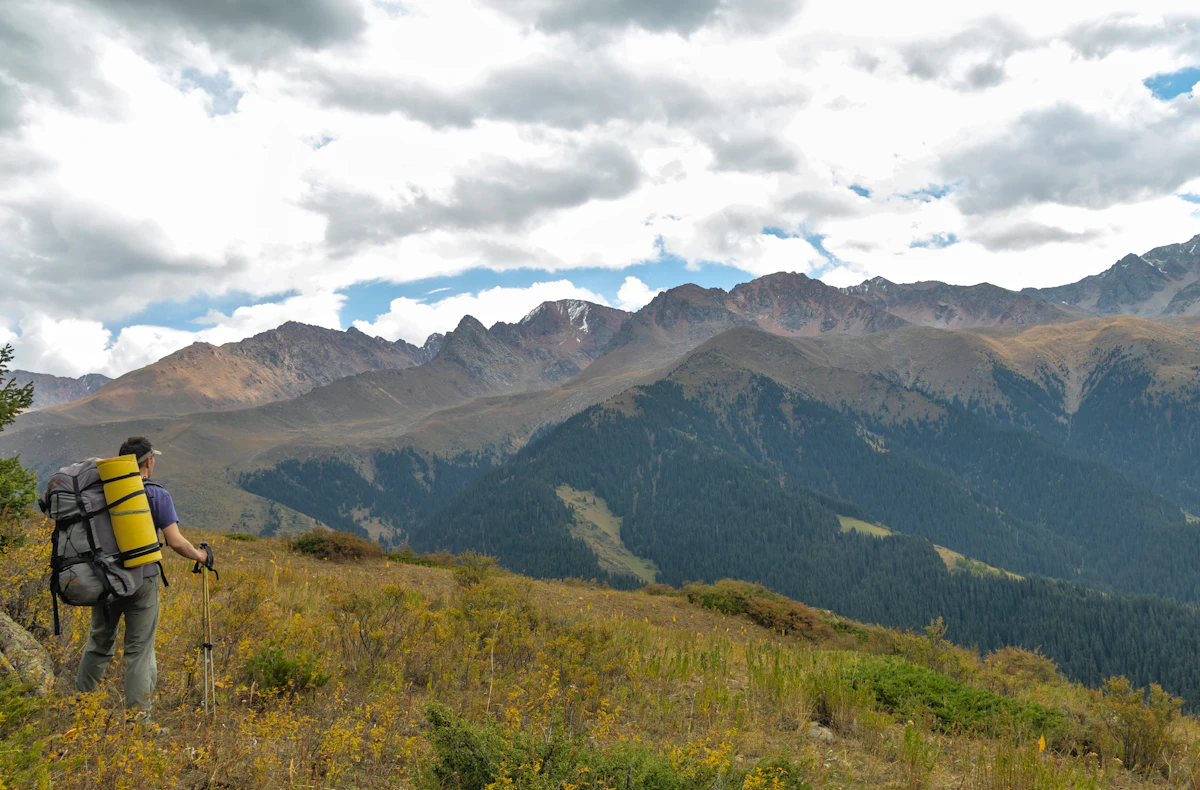
Most beginners walk into their first gear purchase and immediately get sidetracked — ultralight carbon-fiber tent poles, 850-fill power down bags, GPS watches with satellite messaging. All of it is real and useful eventually. None of it is what you need for your first overnight trip.
What you actually need is a shelter that keeps you dry, a sleep system that keeps you warm, a pack that fits, water you can trust, food you can cook, and the safety basics. This list is organized by those categories. Each section includes a budget pick for beginners who want to spend conservatively and a premium pick for those who want to buy gear they will use for years.
Items are linked directly to Amazon with the affiliate tag peakgear06-20. Where no specific ASIN exists, links go to a targeted Amazon search. Prices are approximate and subject to change.
The Big 3: Shelter, Sleep System, Pack
The Big 3 account for roughly 70% of your total gear weight and 80% of your total gear cost. Get these right first. Everything else is secondary. If you are working within a tight budget, spend it here, a cheap tent that leaks or a sleeping bag that leaves you cold at 2am will end the trip in a way that a basic headlamp or a simple spork never will.
Tent
For a first tent, you want a freestanding 3-season design with a full rainfly and a vestibule for gear storage. Freestanding means the tent holds its shape without needing to be staked out — critical when you're setting it up in the dark on rocky ground for the first time.
| Option | Price | Best For |
|---|---|---|
| REI Co-op Passage 2 | ~$150 | Budget / Occasional use |
| MSR Hubba Hubba NX 2 | ~$450 | Serious investment / Long-term |
Sleeping Bag
Match your bag rating to the coldest overnight temperature you expect, and then go 10°F colder to account for the fact that temperature ratings are tested on a non-beginner sleeping warm. A 20°F bag handles 3-season conditions at most elevations in the US.
| Option | Price | Notes |
|---|---|---|
| Kelty Cosmic Down 20 | ~$100 | Budget / Down / 3-season |
| Sea to Summit Spark | ~$180 | Premium / Ultralight / Packable |
Backpack
For 1–3 nights, a 55–65L pack is the right volume. Anything smaller and you are fighting to make gear fit; anything larger and you are tempted to fill it. The most important factor is fit, a pack that sits properly on your torso and hip bones carries heavy loads without punishing your back or shoulders.
Best Beginner Backpack
Osprey Atmos AG 65
The most forgiving fit system for beginners. Anti-Gravity suspension makes heavy loads feel manageable, and it adjusts easily to different torso lengths, so you can actually dial in the fit at the trailhead.
Check Price on Amazon →Budget alternative: REI Co-op Flash 55 (~$170) — lighter than most packs in its price range, with a good hipbelt and internal frame stays.
Navigation
Getting lost on a first trip is more common than people expect, and more dangerous. A downloaded offline map on your phone handles most beginner routes, but a dedicated GPS gives you a reliable backup that does not depend on battery-hungry smartphone screens.
| Item | Price | Notes |
|---|---|---|
| AllTrails App | Free / $36/yr premium | Offline maps, trail reviews, route tracking |
| Garmin eTrex 22x | ~$150 | Dedicated GPS backup — works without cell signal |
At minimum: download your route on AllTrails before leaving, enable offline maps, and keep your phone in airplane mode to conserve battery while still tracking your location with GPS.
Water Treatment
Never drink untreated backcountry water. Giardia is colorless and odorless, you will not see it or smell it in even the clearest mountain stream. Symptoms appear 1–3 weeks after exposure, making it easy to assume you got away with it. You did not. A water filter costs $30 and weighs a few ounces. There is no reason to skip it.
Standard Beginner Water Filter
Sawyer Squeeze
Weighs 3 oz, rated to 100,000 gallons, and works by squeezing filtered water directly into your bottle. The simplest possible system. Attach to a Smartwater bottle and you have a complete, no-fuss water setup.
Check Price on Amazon →| Item | Cost | Notes |
|---|---|---|
| Sawyer Squeeze Filter | ~$30 | The standard — lightweight, reliable |
| Smartwater 1L bottles (×2) | ~$3 | Pairs perfectly with Sawyer thread; wide mouth |
| Hydration bladder (optional) | $20–$40 | Convenient for drinking on the move; harder to clean |
Clothing
The one absolute rule: no cotton. Cotton holds moisture against your skin, dries slowly, and creates a real hypothermia risk when temperatures drop. Every layer should be synthetic or wool. The layering system — moisture-wicking base, insulating mid, waterproof shell — handles the widest range of conditions with the fewest garments.
| Item | Price | Notes |
|---|---|---|
| Moisture-wicking base layer | $30–$70 | Synthetic or merino wool — no cotton |
| Fleece mid-layer | $50–$120 | Warmth layer — worn at camp or on cold mornings |
| Marmot PreCip Eco Rain Jacket | ~$100 | Waterproof outer shell — essential on any trip |
| Salomon X Ultra 4 GTX | ~$160 | Waterproof hiking boots — low-cut / trail-running style |
| Darn Tough wool hiking socks (×3 pairs) | ~$20/pair | Merino wool — blister prevention, odor resistance |
Three pairs of wool socks for a 3-night trip: one on your feet, one drying on your pack, one clean in your bag. This rotation works.
Food and Cooking
Plan 1.5–2 lbs of food per day targeting 2,500–3,000 calories. For a first trip, freeze-dried dinners are the simplest option — boiling water is the only cooking skill required, and cleanup is minimal. A compact stove and a single isobutane canister add about 1 lb to your pack and make a significant difference in camp comfort.
Best Beginner Camp Stove
Jetboil Flash
Boils 1 liter of water in about 100 seconds. The integrated cup and stove make it a single compact unit — no fiddling with separate pots or pot supports. Ideal for freeze-dried meals and morning coffee.
Check Price on Amazon →| Item | Price | Notes |
|---|---|---|
| Jetboil Flash or MSR PocketRocket 2 | $50–$110 | Jetboil is faster and easier; PocketRocket is lighter |
| Mountain House freeze-dried meals | $10–$15/meal | Just-add-boiling-water dinners; wide variety |
| Titanium spork | ~$5 | Lightweight, indestructible, multi-purpose |
Safety and First Aid
Safety gear is the category most beginners under-pack. A headlamp, first aid kit, and emergency signaling device are non-negotiable. On remote routes, a satellite communicator is a serious safety upgrade, it lets you send an SOS or check in with someone at home without cell coverage.
| Item | Price | Notes |
|---|---|---|
| Adventure Medical Kits Ultralight .3 | ~$30 | Pre-assembled trail first aid kit |
| Black Diamond Spot 400 headlamp | ~$45 | 400 lumens, red night-vision mode, waterproof |
| Garmin inReach Mini 2 (optional) | ~$350 + plan | Satellite SOS + 2-way messaging — highly recommended for remote areas |
| Emergency whistle + mylar blanket | ~$5 | Weighs nothing; potentially life-saving |
Hygiene and Leave No Trace
Backcountry hygiene is simple: pack out everything, bury human waste 6–8 inches deep at least 200 feet from water and trails, and use only biodegradable soap. Microfiber towels pack down to almost nothing and dry quickly — leave the full-size bath towel at home.
| Item | Price | Notes |
|---|---|---|
| Backcountry trowel | ~$10 | Required for digging cat holes. LNT standard |
| Biodegradable soap | ~$5 | Hands, dishes, and body — only biodegradable allowed |
| Sea to Summit Tek Towel | ~$20 | Microfiber — packs to fist-size, dries fast |
Camp Comfort
Two items that first-timers consistently undervalue: trekking poles (knees will thank you on descents with a loaded pack) and a quality sleeping pad. The sleeping pad is the most underrated item in backpacking, it insulates you from the cold ground and affects sleep quality more than almost anything else in your kit. Learn how to pick the right insulation level in our sleeping pad R-value guide.
| Item | Price | Notes |
|---|---|---|
| Black Diamond Trail Ergo Cork trekking poles | ~$80 | Ergonomic grip, collapsible, foam-cork blend handle |
| Therm-a-Rest Z Lite Sol (budget) | ~$55 | Closed-cell foam — indestructible, no inflation needed |
| Therm-a-Rest NeoAir XLite (premium) | ~$200 | Inflatable — exceptional warmth-to-weight ratio |
Total Budget Breakdown
Building a complete starter kit from scratch? Here is what budget versus premium costs across every major category. You do not need to buy everything at once, the Big 3 are the priority. Most other items can be acquired over time or borrowed for a first trip.
| Category | Budget Pick | Cost | Premium Pick | Cost |
|---|---|---|---|---|
| Pack | REI Flash 55 | $170 | Osprey Atmos AG 65 | $270 |
| Tent | REI Passage 2 | $150 | MSR Hubba Hubba NX2 | $450 |
| Sleeping Bag | Kelty Cosmic Down 20 | $100 | Sea to Summit Spark | $180 |
| Sleeping Pad | Therm-a-Rest Z Lite Sol | $55 | Therm-a-Rest NeoAir XLite | $200 |
| Footwear | Merrell Moab 3 GTX | $120 | Salomon X Ultra 4 GTX | $160 |
| Rain Jacket | Columbia Watertight II | $70 | Marmot PreCip Eco | $100 |
| Stove | MSR PocketRocket 2 | $50 | Jetboil Flash | $110 |
| Water Filter | Sawyer Squeeze | $30 | Sawyer Squeeze + backup tabs | $40 |
| Headlamp | Black Diamond Spot 400 | $45 | Petzl Actik Core | $60 |
| Misc (FAK, trowel, towel) | Basic kit | $50 | Full kit | $80 |
| Total | Budget Setup | ~$840 | Premium Setup | ~$1,650 |
Prices are approximate. Budget total can drop to $600–$700 with sales, REI coupons, or buying used gear through REI's used gear program or Facebook Marketplace.
What to Leave at Home
Every beginner over-packs. Here are the five things that show up in first-trip packs and almost never get used, and why they are a problem beyond just the extra weight.
- 1
Cotton clothing
Cotton holds moisture, dries slowly, and chills you in wet or cold conditions. This includes cotton t-shirts, jeans, and hoodies. Any cotton layer is a potential hypothermia risk. Replace with synthetic or wool equivalents before you leave.
- 2
Full-size towels
A full bath towel weighs 1–2 lbs, takes up significant pack space, and takes hours to dry. A microfiber camp towel weighs under 2 oz and dries in minutes. There is no argument for the full towel.
- 3
Too much food
Beginners consistently over-pack food — partly from anxiety and partly because they don't know how little they actually eat on the trail. Plan 1.5–2 lbs per day and stick to it. Leftover food is weight you carry for no reason.
- 4
Extra shoes or sandals
Camp shoes are a comfort item, not a necessity. On a first 1–3 night trip, your hiking boots are your camp shoes. A pair of sandals adds a pound and is almost always left at the car on future trips once you realize they don't justify the weight.
- 5
Duplicate items
Three lighters, two headlamps, an entire separate first aid kit alongside the emergency kit. One reliable version of each item is the rule. Duplicates are weight without function. The exception: a backup fire starter (lighter + waterproof matches) is worth having, but it weighs almost nothing.
Frequently Asked Questions
How much does beginner backpacking gear cost?▼
A functional beginner setup costs $600–$800 if you buy budget-tier gear across the board. That covers a mid-range pack (~$170), a 3-season tent (~$150), a sleeping bag (~$100), a sleeping pad (~$40), and basic consumables like a water filter, stove, and first aid kit. If you buy premium versions of the Big 3 — shelter, sleep system, and pack — expect to spend $1,500–$2,000. The difference is mostly weight, packability, and long-term durability. For a first trip, budget gear is entirely adequate. Upgrade selectively after you have a few trips and know what matters to you.
What's the most important piece of backpacking gear?▼
Your sleep system — sleeping bag and sleeping pad together. Nothing ruins a backpacking trip faster than sleeping cold, and nothing wrecks the following day like a bad night's rest. The sleeping pad is especially underrated: it provides insulation from the ground (which pulls heat away faster than cold air) and affects comfort more than most people expect. A $30 foam pad is far better than no pad. Before cutting budget anywhere else, protect your sleep system investment.
Can I rent backpacking gear instead of buying?▼
Yes, and for a first trip it is often the smarter move. REI rents tents, sleeping bags, sleeping pads, and trekking poles at most locations. Backcountry and local outdoor outfitters often rent full kits. Renting lets you test gear before buying, avoids the cost of items you may not use again, and is especially useful for big-ticket items like a quality sleeping bag or 4-season tent that you won't need often. If you find yourself going out more than twice a year, the math shifts toward buying, but a rented setup is a perfectly valid way to do a first trip.
What gear do I absolutely need for a first backpacking trip?▼
The non-negotiables for any overnight trip: a shelter (tent or tarp), a sleeping bag rated below the expected overnight low, a sleeping pad, a water filter (Sawyer Squeeze is the standard), a backpack sized for your trip length (40–60L for 1–3 nights), and trail-appropriate footwear. Everything else — stove, trekking poles, GPS, electronics — is conditional on your route and comfort level. The water filter is the one item beginners most often underestimate; never drink untreated backcountry water regardless of how clear it looks.
How heavy should my backpack be for a beginner?▼
Your total loaded pack weight — including food, water, and all gear — should be no more than 25–30% of your body weight. For most people, that means 30–40 lbs. Heavier than that accelerates fatigue, strains hips and knees over multi-day distances, and makes elevation gain significantly harder. The best way to reduce pack weight on a first trip is to leave items that serve the same function as something else you are already carrying, avoid over-packing food (1.5–2 lbs per day is the target), and skip comfort items like camp chairs or full-size pillows. Weigh your loaded pack at home before leaving and remove anything that puts you over 35 lbs.
Related Guides
Plan Your First Backpacking Trip
Step-by-step planning guide covering route selection, permits, food, and preparation.
BlogFirst Backpacking Trip Mistakes
The most common errors beginners make, and how to avoid them before you leave.
GuideBackpacking Gear Checklist
Printable master checklist for every overnight trip — organized by pack category.
Best OfBest Hiking Backpacks
Top-tested hiking packs across every budget, volume, and trip length.


