Bear canister in a mountain backcountry camp
Updated April 2026

Best Bear Canisters of 2026

By Peak Gear Guide Editorial Team · Gear research & fact-checking

We compared the top bear canisters on capacity, weight, park approval, and ease of use. From the budget-friendly BearVault BV500 to the ultralight Bearikade, here are the five best options for backcountry food storage in 2026.

By Peak Gear Guide Editorial Team | Updated April 2026

Bear cans add 2.5–3 lb. Plan around them. Our Gear Weight Calculator changes the math on multi-day food carries. Toggle the canister as 'consumable' or 'base weight' depending on whether it's empty or full to see your true total carry on day 1.

Why bear canisters are non-negotiable in most US backcountry

A bear canister is not optional gear in the parts of North America where black bears or grizzlies have learned to associate humans with food. In Yosemite, Sequoia, Kings Canyon, Rocky Mountain National Park, Olympic, Denali, and large stretches of the Sierra Nevada and Cascades, a hard-sided IGBC-approved canister is a permit requirement, rangers will check at the trailhead, and you can be turned around without one. Outside those zones, a hung bear bag may be permitted, but the fail rate is high: any bear that has ever scored human food in its lifetime knows exactly how to defeat a properly hung PCT-style hang.

The canister exists to break the food-reward feedback loop. A bear that fails to access a canister loses interest in the campsite for the rest of the night and, more importantly, does not get reinforced for approaching humans. That single behavioral fact is the reason every grizzly-recovery program in the lower 48 has been pushed to mandate hard-sided storage. Soft sacks like the Ursack work in some jurisdictions but not most national parks, they prevent food loss but don't always prevent the bear from learning that humans equal food.

What separates a good canister from a cheap one

Three specs matter more than the rest: capacity in cubic inches, weight, and IGBC certification status. Capacity dictates how many days of food you can carry; the standard rule is roughly 100 cubic inches per person per day for typical backpacker meal density. A 700 cubic inch BV500 covers 5-7 days for one person. Weight ranges from 2 pounds 9 ounces (BearVault BV500) to under 2 pounds (Bearikade Weekender). The weight savings of the Bearikade come at roughly a 3-4× price premium, worth it for thru-hikers averaging 20+ miles a day, hard to justify for weekenders.

IGBC (Interagency Grizzly Bear Committee) certification is the gold standard. Park rangers in grizzly country specifically look for the IGBC stamp. SIBBG (Sierra Interagency Black Bear Group) is a separate, narrower certification accepted in many California parks but not always in grizzly country. If you hike across both ranges in a season, buy IGBC-certified and you'll be covered everywhere.

Packing strategy that actually fits

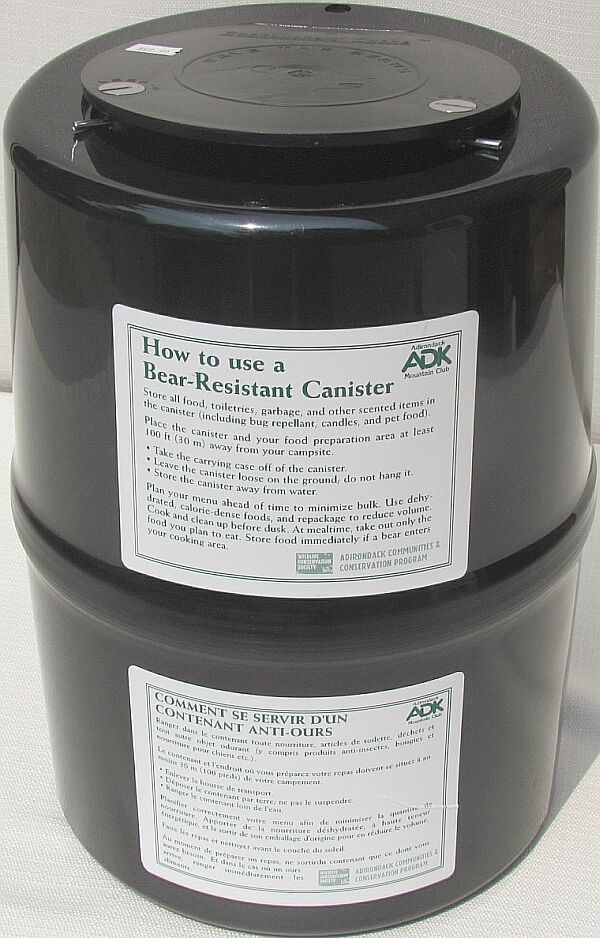
Bear canisters are cylinders, and most packs are designed for soft, packable contents. The trick is to load the canister last with high-density foods, then pack around it inside the pack body with your sleeping bag and clothing. The canister should sit horizontally midway up the pack so it doesn't pull the load away from your spine. On the trail, store the canister 100+ feet from your tent and downwind at night, bears are attracted by scent before sight. Place the canister on flat ground, not on a slope where a curious bear can roll it into water or off a cliff.

A common mistake first-time users make: storing the canister in a stuff sack inside the pack. This makes the cylinder slide around and creates an unstable load. Pack it bare against your sleeping pad or a folded jacket.

At a glance

Tap any name to jump to the detailed review.

PickTagPriceWeightBuy
BearVault BV500Best Overall$802 lb 9 ozCheck Price
Garcia Backpacker's CacheMost Park-Approved$752 lb 12 ozCheck Price
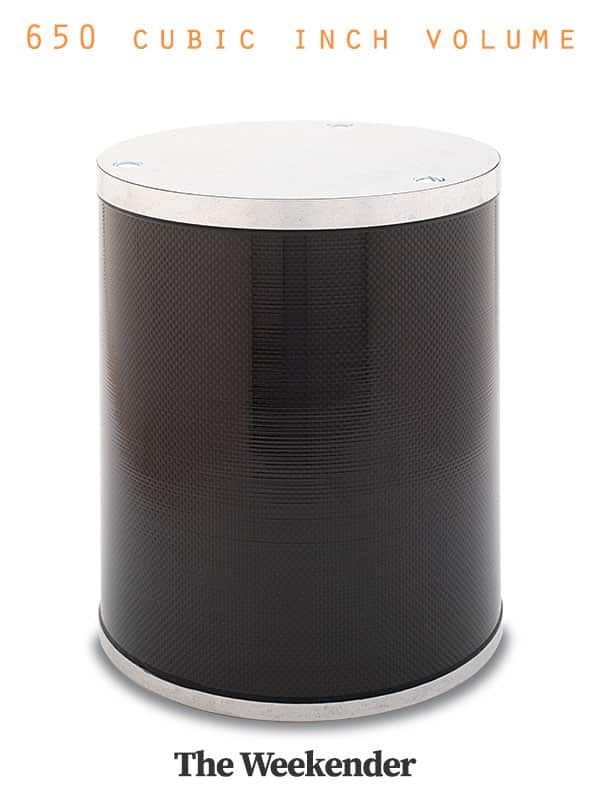
Bearikade WeekenderLightest Hard-Side$2951 lb 13 ozCheck Price
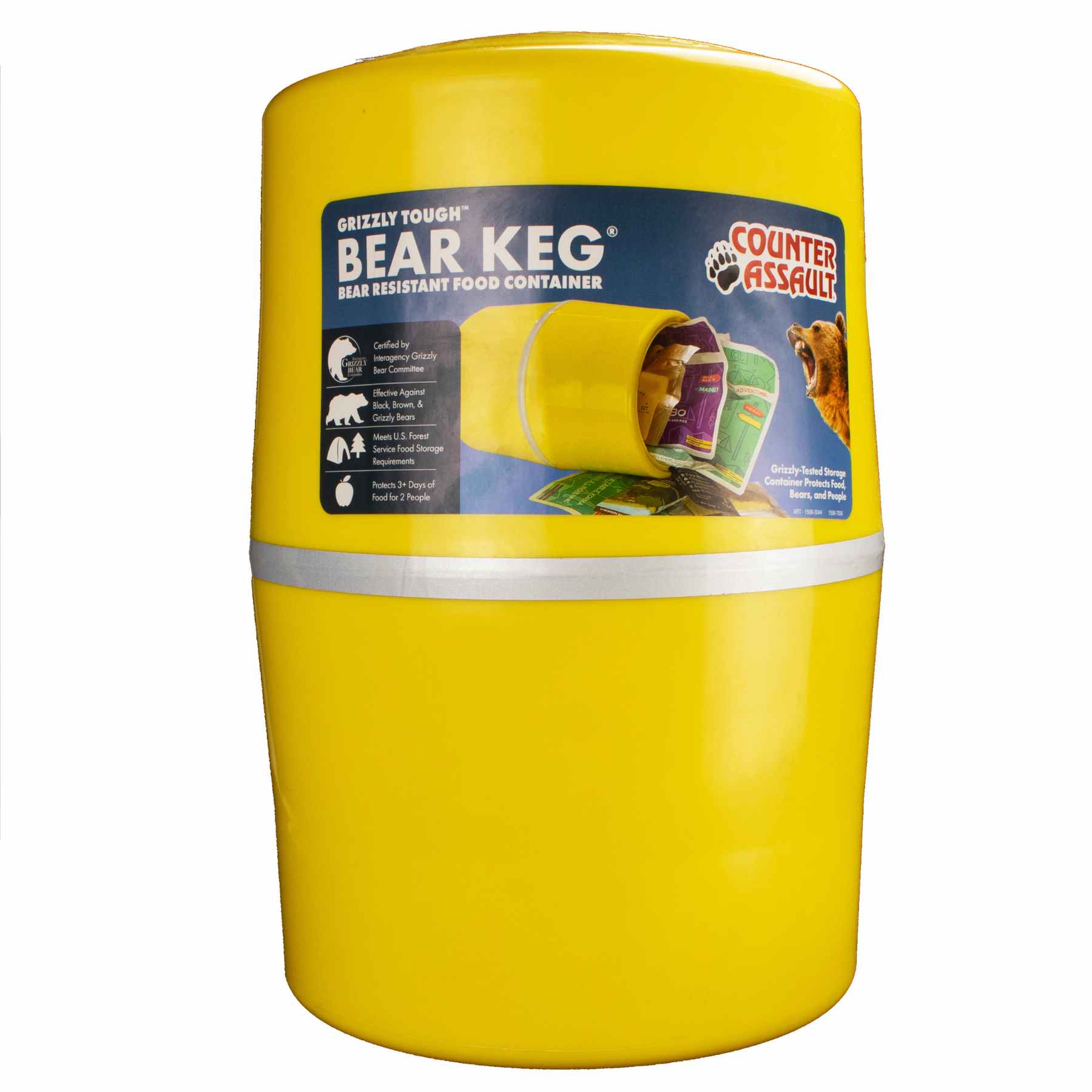
Counter Assault Bear KegBest Budget$702 lb 14 ozCheck Price
Wild Ideas WeekenderBest for Tall Food$2651 lb 14 ozCheck Price
Best Overall#1 Pick

BearVault BV500

Price: $80Weight: 2 lb 9 ozCapacity: 700 cu inMaterial: PolycarbonateCertification: Required in many national parksLid: Tool-free twist
BearVault BV500

The BearVault BV500 is the most popular bear canister on the market for good reason: it holds more food than nearly any other approved canister, opens without tools, and is constructed from transparent polycarbonate that lets you see exactly what's inside without unscrewing the lid. That last detail might sound trivial until you're digging through a pack at 6am trying to find breakfast. The 700 cubic inch capacity is the largest available in a commonly stocked hard-sided canister, fitting roughly 5–7 days of backcountry food for a single person depending on meal density.

The tool-free lid design is one of the BV500's most appreciated features for everyday use. Two recessed tabs on opposite sides of the lid must be pressed simultaneously to open, a motion that's easy for humans with thumbs but impossible for bears. There's no coin slot to strip, no tool to lose in the bottom of your pack. In cold weather when fingers are numb, this matters more than you'd expect. The polycarbonate cylinder is thick and impact-resistant; even after being thrown, rolled, and batted by test subjects (real bears in field testing), the seal holds.

The BV500 is accepted as compliant in Yosemite, Sequoia, Kings Canyon, Rocky Mountain National Park, Denali, and virtually every other national park and wilderness area with mandatory canister requirements. This near-universal acceptance means you can buy one BV500 and carry it confidently on any US backcountry trip without checking compatibility. The transparent sides also make weight estimation for re-supply easier, you can see your food level without opening the lid.

The main limitation is weight and bulk. At 2 lb 9 oz, the BV500 adds meaningful mass to any pack, and its cylindrical shape creates packing challenges in bags designed for rectangular organization. Some hikers find the 8.7-inch diameter doesn't fit smoothly in certain pack configurations. For ultralight trips, the Bearikade is the lightweight answer, but it costs over three times as much. For the majority of backpackers who want a proven, capacious, universally-approved canister at a reasonable price, the BV500 is the default choice.

Pros

  • +Largest capacity of standard-priced canisters at 700 cubic inches
  • +Tool-free lid opens with bare hands — no coin or tool required
  • +Transparent polycarbonate lets you see contents without opening
  • +Accepted in virtually every national park with mandatory canister requirements
  • +Impact-resistant construction holds up to bear mauling and rough handling

Cons

  • -Adds 2 lb 9 oz to pack weight — significant on ultralight trips
  • -Cylindrical shape creates packing challenges in rectangular packs
  • -No integrated system to prevent rolling on uneven camp terrain
  • -Larger diameter than some competitors may not fit all pack configurations

Best for: Backpackers who want the most universally-accepted, highest-capacity standard canister without paying a premium for lightweight materials
Check Price on Amazon
Most Park-Approved#2 Pick

Garcia Backpacker's Cache

Price: $75Weight: 2 lb 12 ozCapacity: 615 cu inMaterial: PolycarbonateCertification: SIBBG certifiedLid: Coin-slot or tool required
Garcia Backpacker's Cache

The Garcia Backpacker's Cache is the original hard-sided bear canister — it's been around longer than the BV500, and its SIBBG (Sierra Interagency Black Bear Group) certification was among the earliest ever issued. That institutional history matters practically: the Garcia is accepted in every park that accepts any canister, and some older regulations written with the Garcia in mind are explicitly clear about its compliance. For conservative hikers who want zero ambiguity about legality, the Garcia provides maximum confidence.

The polycarbonate construction is robust and proven over decades of field use. The cylindrical shape is opaque rather than transparent, you need to open it to see contents, which is a minor inconvenience compared to the BV500's clear sides. The lid uses a coin-slot locking mechanism: one slot requires a coin or flathead tool to rotate. This is a simple, reliable system that bears have no mechanism to manipulate, though some users find digging for a coin at camp mildly frustrating.

Capacity at 615 cubic inches is respectable but trails the BV500 by 85 cubic inches. For most 5-day trips, this difference is manageable with efficient food packing. For longer trips or hungry hikers, the reduced space requires more careful meal planning. The Garcia's slightly smaller diameter — 8.6 inches versus the BV500's 8.7 — fits marginally more easily into tighter pack configurations, which is sometimes the deciding factor for hikers with specific pack dimensions.

At $75, the Garcia is $5 cheaper than the BV500, which makes it the budget choice in the hard-canister category. The savings are minimal, but combined with its smaller profile for pack fitting, it's a legitimate choice for hikers whose packs favor the Garcia's dimensions. For most people, the BV500's extra capacity and tool-free lid tip the balance, but the Garcia's decades of proven reliability and maximum park approval history make it a safe, sensible choice for any backcountry trip.

Pros

  • +SIBBG-certified — accepted in every park that accepts any hard canister
  • +Decades of proven reliability in the most demanding backcountry conditions
  • +Slightly smaller diameter fits better in packs sized for the Garcia's dimensions
  • +Lowest price of hard-sided canisters at $75
  • +Simple coin-slot lid mechanism is extremely reliable and bear-proof

Cons

  • -Opaque sides require opening to check food level
  • -Coin or tool required to open lid — inconvenient in cold or gloved conditions
  • -Lower capacity than BV500 at 615 cubic inches
  • -Heaviest canister in this roundup at 2 lb 12 oz

Best for: Hikers who prioritize maximum regulatory certainty and proven long-term reliability over every other consideration

Check Price on Amazon
Lightest Hard-Side#3 Pick

Bearikade Weekender

Price: $295Weight: 1 lb 13 ozCapacity: 650 cu inMaterial: Carbon fiber and polycarbonateCertification: Yosemite and SIBBG approvedLid: Quarter-turn tool-free
Bearikade Weekender

The Bearikade Weekender is what happens when engineers apply aerospace material thinking to a camping problem. Its carbon fiber and polycarbonate hybrid construction achieves a wall thickness that maintains full SIBBG and Yosemite approval while cutting weight to 1 lb 13 oz — more than 12 ounces lighter than the BV500 and nearly a full pound lighter than the Garcia. For ultralight backpackers who agonize over every gram, this is a transformative weight savings in a gear category where you can't compromise on function.

At 650 cubic inches, the Weekender delivers more capacity per ounce than any other canister in this guide. The quarter-turn lid opens without tools and snaps shut with a satisfying click that confirms the seal is locked. The carbon fiber body is noticeably stiffer than polycarbonate; even when shaken aggressively or compressed in a pack, the cylinder maintains its shape without flexing. This rigidity also makes it easier to pack around, the Weekender's walls don't bow under pack pressure the way thinner polycarbonate can.

The premium material comes with a premium price: $295 puts the Bearikade in a different spending category entirely from the $75–$80 polycarbonate options. For casual backpackers or those who go out a few times a year, this price is hard to justify. For thru-hikers, gear obsessives, and anyone doing extended backcountry travel where every ounce carries for weeks, the Bearikade pays for itself in reduced fatigue over a long trip. Many PCT and JMT hikers consider it a worthwhile investment specifically because those trails run through mandatory canister zones.

The Bearikade is manufactured in small quantities by a specialty outdoor company, not mass-produced, which means availability can be limited during peak seasons. Lead times for direct orders can run several weeks. If you're planning a permit-date trip, order early. For ultralight backpackers who can plan ahead and absorb the cost, the Bearikade Weekender is the clear best canister regardless of price — it's simply the best balance of weight, capacity, and compliance available.

Pros

  • +Lightest hard-sided approved canister at 1 lb 13 oz — nearly a pound lighter than polycarbonate
  • +Carbon fiber and polycarbonate hybrid is stiffer and more rigid than polycarbonate alone
  • +650 cubic inches provides strong capacity despite ultralight construction
  • +Quarter-turn tool-free lid is faster than coin-slot designs
  • +Full Yosemite and SIBBG approval — accepted everywhere hard canisters are required

Cons

  • -Premium price at $295 — nearly 4x the cost of polycarbonate alternatives
  • -Limited availability — can sell out during peak season and require advance ordering
  • -Weight savings require significant per-trip mileage to justify the cost premium
  • -No visual transparency — opaque body requires opening to check food level

Best for: Ultralight backpackers, thru-hikers on the PCT or JMT, and gear enthusiasts for whom every ounce matters on multi-week trips

Check Price on Amazon
Best Budget#4 Pick

Counter Assault Bear Keg

Price: $70Weight: 2 lb 14 ozCapacity: 686 cu inMaterial: PolycarbonateCertification: IGBC approvedLid: Coin-slot screwdriver required
Counter Assault Bear Keg

The Counter Assault Bear Keg offers the largest capacity of any canister in this roundup at 686 cubic inches — beating the Garcia comfortably and trailing only the BV500 by 14 cubic inches — while undercutting both on price at $70. This combination of generous volume and low cost makes it the value leader for backpackers who need serious food storage capacity without paying a premium. For group basecamp situations, family trips, or anyone doing 5–7 day stretches who wants room to spare, the Bear Keg's interior volume is a genuine advantage.

The IGBC (Interagency Grizzly Bear Committee) approval covers the Bear Keg in most backcountry areas, though some parks specifically reference SIBBG certification in their regulations. Before using it in Yosemite or other Sierra Nevada parks, verify current acceptance — while IGBC-approved canisters are generally accepted in most western wilderness areas, confirmation with the specific ranger district avoids problems at the trailhead. In practice, the Bear Keg is widely accepted across national forests, wilderness areas, and most national parks.

The lid uses a coin-slot mechanism requiring a flathead screwdriver or coin to open — similar to the Garcia but slightly more stiff in cold conditions. The polycarbonate construction is solid and opaque. At 2 lb 14 oz, the Bear Keg is the heaviest canister in this guide, which is the primary tradeoff for its large interior volume and budget pricing. The extra ounces add up on longer trips, and ultralight-focused hikers will feel the difference. For those who prioritize food capacity and price over pack weight, this mass is acceptable.

For backpackers who are new to bear canister requirements, occasional hikers, or families equipping multiple people for a one-time trip, the Counter Assault Bear Keg makes a strong case. At $70, buying one for every person in a group is more affordable than any other option. The large capacity means you're less likely to run out of room during packing, which reduces the frustration of calibrating food volume to canister space. It's a no-frills, heavy-but-functional workhorse that accomplishes the primary mission reliably.

Pros

  • +Most spacious affordable canister at 686 cubic inches — more room than Garcia
  • +Lowest price of any canister in this guide at $70
  • +IGBC approved — accepted in most national parks and wilderness areas
  • +Simple, robust polycarbonate construction with proven long-term reliability
  • +Good choice for groups where multiple canisters need to be budget-friendly

Cons

  • -Heaviest canister in this guide at 2 lb 14 oz
  • -Coin-slot lid requires a tool — inconvenient in wet or cold conditions
  • -IGBC rather than SIBBG certification may need verification for some Sierra parks
  • -Opaque body offers no visibility of contents without opening

Best for: Budget-conscious hikers, families equipping multiple people, and backpackers who prioritize food capacity over pack weight

Check Price on Amazon
Best for Tall Food#5 Pick

Wild Ideas Weekender

Price: $265Weight: 1 lb 14 ozCapacity: 650 cu inMaterial: Carbon fiber and polycarbonateCertification: Yosemite and SIBBG approvedShape: Taller cylinder — accommodates tall items
Wild Ideas Weekender

The Wild Ideas Weekender competes directly with the Bearikade in the premium ultralight canister category, arriving at nearly identical weight — 1 lb 14 oz versus Bearikade's 1 lb 13 oz, and similar pricing at $265 versus $295. What sets the Wild Ideas apart is its cylinder geometry. It's taller and narrower than competing canisters, which allows it to accommodate tall food items that don't fit well in the shorter, wider cylinders that dominate the market. Full-sized water bottles, tall fuel canisters, standing bags of trail mix — items that require folding or jamming in other canisters slide in cleanly.

Like the Bearikade, the Wild Ideas Weekender uses a carbon fiber and polycarbonate composite that delivers Yosemite and SIBBG approval at a fraction of the weight of standard polycarbonate-only designs. The construction is stiff, lightweight, and maintains its shape under pack pressure. The quarter-turn lid opens smoothly and seals with positive tactile confirmation. For backpackers who carry the same canister on multiple trips per year, the investment in quality materials shows over time, the composite body doesn't develop the surface crazing that polycarbonate exhibits after years of UV exposure.

The taller profile has a practical packing advantage beyond just accommodating tall food: some backpacks — particularly frameless or top-loading packs — accept a taller, narrower cylinder more naturally than a shorter, wider one. If you've struggled to pack a standard-diameter canister into a specific bag, the Wild Ideas' narrower profile may solve the problem. This is worth testing with your specific pack before committing, as body geometry preferences vary significantly between pack designs.

At $265, the Wild Ideas sits $30 below the Bearikade, making it the slightly more economical premium option. Performance is essentially equivalent, the choice between them comes down to preferred cylinder geometry and which fits your pack and food better. Both are exceptional pieces of gear that dramatically reduce canister weight without compromising protection or legal compliance. For PCT, JMT, and Sierra Nevada hikers specifically, having a Yosemite-approved ultralight canister eliminates a major gear headache on the most permit-intensive trails in the country.

Pros

  • +Taller cylinder accommodates full-height food items that other canisters can't fit
  • +Ultralight at 1 lb 14 oz — comparable weight savings to Bearikade at slightly lower price
  • +Carbon fiber composite construction resists UV crazing better than polycarbonate over years
  • +Yosemite and SIBBG approved — no regulatory uncertainty on any US backcountry trip
  • +Narrower profile fits certain pack configurations better than standard-diameter canisters

Cons

  • -Premium price at $265 limits accessibility for occasional backpackers
  • -Taller, narrower shape may not pack as efficiently in some packs as wider alternatives
  • -Like Bearikade, availability can be limited during peak season
  • -Opaque construction — cannot see food level without opening

Best for: Ultralight backpackers with tall food items or specific pack configurations that favor a narrower canister, especially on Sierra Nevada routes

Check Price on Amazon

Frequently Asked Questions

Do I legally need a bear canister?

In many wilderness areas and national parks, yes — bear canisters are legally required, not just recommended. Yosemite National Park mandates hard-sided bear canisters in most of its backcountry. Rocky Mountain National Park requires them in several designated zones. Sequoia and Kings Canyon, Denali, and parts of the Sierra Nevada also have mandatory canister regulations. The rules exist because food-conditioned bears — bears that associate humans with food — must be euthanized. Bear canisters prevent this outcome by making food inaccessible regardless of hanging technique or human error. Before any backcountry trip, check the specific land management agency's regulations for your route. Rules change seasonally and by zone, and fines for non-compliance are real. The National Park Service and USFS websites maintain current canister requirement maps.

What's the difference between hard-sided and soft-sided bear canisters?

Hard-sided bear canisters — made from polycarbonate or carbon fiber — are the only type approved for legal use in areas with mandatory bear canister requirements. They are rigid, crush-resistant, and physically impossible for a bear to bite through or deform enough to access contents. Soft-sided bear bags and Ursack-style sacks are made from cut-resistant fabric and use a different protective mechanism, the bear can pick them up or bat them around, but can't tear into them. Soft-sided options are lighter and more packable, but they're not approved in most mandatory-canister zones like Yosemite or Sequoia because bears have learned to damage or compromise them. If you're camping in a regulated area, hard-sided is the only legal option. For areas without regulations, a quality soft bag is a viable and lighter alternative.

How much food fits in a bear canister?

A standard-size bear canister holds roughly 5 to 7 days of backcountry food for one person, depending on how efficiently you pack and how calorie-dense your food choices are. The BearVault BV500 at 700 cubic inches is the most capacious commonly available canister; the Garcia at 615 cubic inches is tighter. As a rough rule: plan on about 100 cubic inches of space per person-day of food if you're packing efficiently with lightweight, high-calorie meals. Freeze-dried meals and dense snacks pack more efficiently than bulky items like tortillas or crackers. Removing food from original packaging and transferring to bags saves significant space. For groups, each person typically carries their own canister, though canister capacity can be shared between trip partners if food planning is coordinated carefully.

Are Ursack bags acceptable alternatives to bear canisters?

Ursacks are approved in some areas but not accepted as substitutes for hard-sided canisters in most regulated zones. The Ursack AllWhite, made from spectra fabric, is IGBC-approved as a bear-resistant container, meaning it can legally replace a hard canister in areas that accept IGBC-approved alternatives. However, Yosemite, Sequoia, Kings Canyon, and several other high-use parks explicitly require hard-sided canisters and do not accept Ursacks as substitutes — regardless of IGBC approval. Always verify with the specific park or wilderness area before relying on an Ursack. Where they are accepted, Ursacks offer a compelling weight advantage, the AllWhite weighs about 7.6 oz versus 2+ pounds for polycarbonate canisters. They're best suited for areas with regulations that accept them or backcountry where no mandatory rules apply.

Where do I store a bear canister at camp?

The standard guidance is to place your bear canister at least 100 feet from your tent and 100 feet from your cooking area — ideally in a third direction so the three zones form a triangle. Unlike bear bags hung in trees, canisters don't need to be suspended; you simply set them on the ground. However, placement still matters. Don't leave your canister near a cliff edge, steep drop, or body of water — bears will often roll, bat, or push canisters, and you don't want yours disappearing over a ledge or into a river. A slight depression in the ground or placement against a large rock (not near a cliff) can help prevent rolling. Remove all scented items — food, toothpaste, sunscreen, lip balm, trash — from your tent and store them in the canister. Leave the lid loosely accessible since bears sometimes investigate even empty canisters.

Is the BearVault BV500 worth it vs the Garcia Backpacker's Cache?

The BV500 wins on almost every practical metric for most backpackers. It holds 700 cubic inches versus the Garcia's 615 — that's 85 extra cubic inches, enough to fit roughly a full extra day of food. The BV500's lid is tool-free, meaning you can open it with your bare hands by pressing two tabs simultaneously, while the Garcia requires a coin or tool to turn its slotted lock. Both are approved in the same parks and hold the same SIBBG certification. The BV500 is also slightly lighter at 2 lb 9 oz versus the Garcia's 2 lb 12 oz. The Garcia has one edge: its smaller circumference can fit into a pack more easily if interior volume is tight. For most users, the BV500's larger capacity, tool-free access, and transparent sides — which let you see contents without opening — make it the better default choice at a comparable price of $80 versus $75.

References & further reading

External, authoritative sources we consulted while researching this guide.

Browse All Gear Categories

Every Peak Gear Guide roundup, organized by category. Research-vetted picks with transparent comparisons across 100+ gear types.

Big 4 — Shelter, Sleep, Pack, Stove

Footwear

Apparel & Layering

Packs & Carry

Camp Comfort

Cooking & Food

Tech & Navigation

Trekking Poles & Accessories

Sleep — Specialty

Tents — Specialty

By Fit & Foot Shape

Budget Picks

Water & Adventure