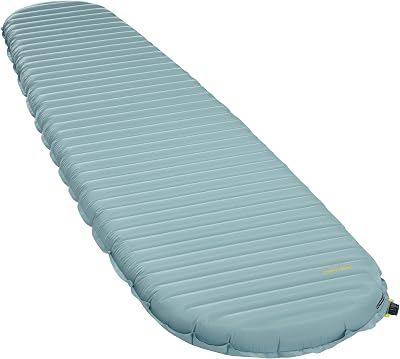
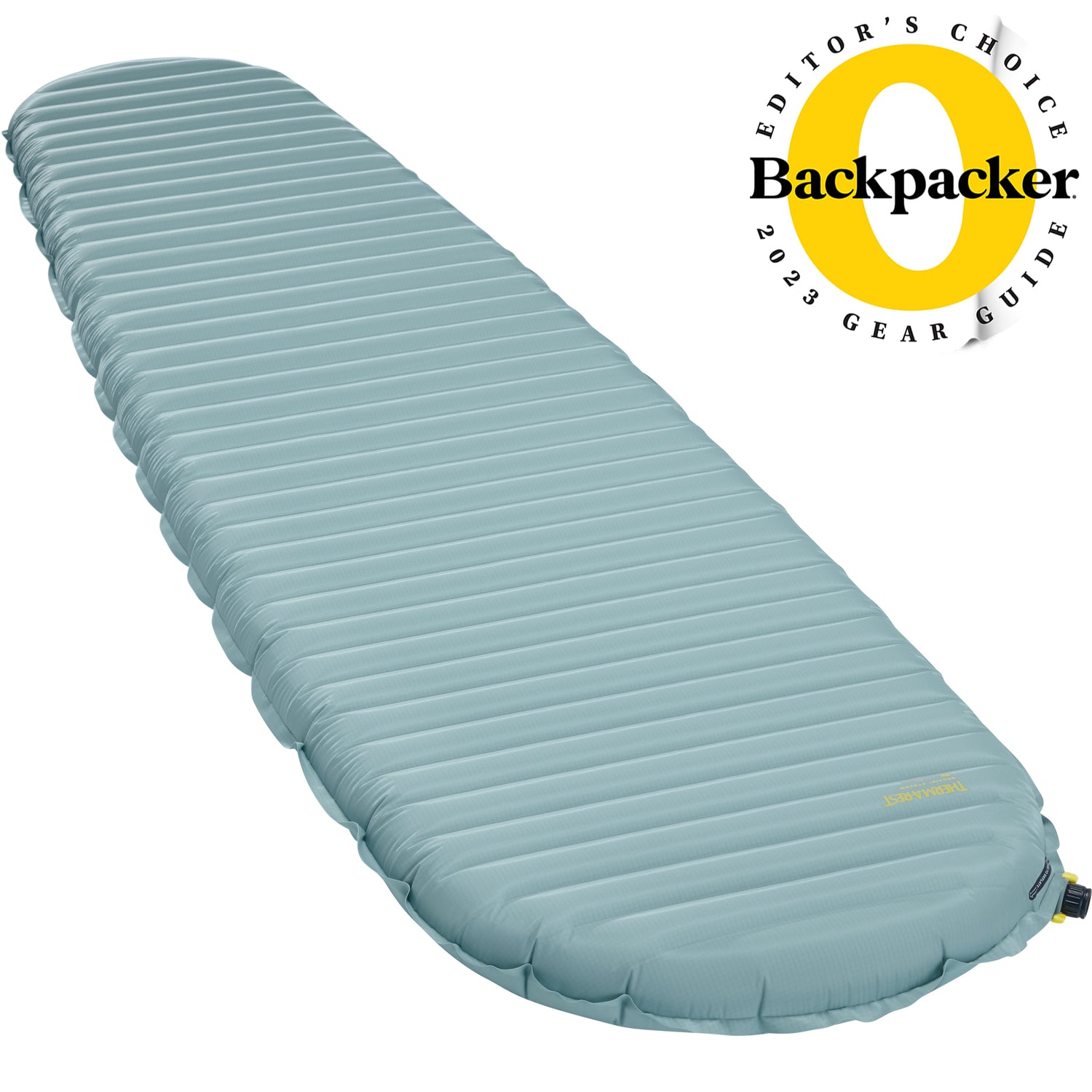
Overview: Why the NeoAir XTherm NXT Matters
Sleeping pads are one of the most underrated pieces of backpacking gear. You can have the best sleeping bag on the planet, but if your pad does not insulate you from the ground, you will be cold.
The ground steals heat from your body through conduction far faster than the air does, which is why your sleeping pad R-value matters just as much as your sleeping bag temperature rating.
The Therm-a-Rest NeoAir XTherm NXT sits at the top of the sleeping pad market for one simple reason: it delivers the highest R-value you can get in an ultralight air pad.
At 7.3, this pad is rated for year-round use, including winter camping on snow. And it does this while weighing just 15.5 ounces in the regular size, which is lighter than many three-season pads with half the insulation.
Across published reviews, the XTherm NXT has been tested for over six months across a wide range of conditions.
Those reviews cover fall backpacking trips in the Rockies with overnight lows in the teens, winter camping sessions in the Adirondacks where temperatures dropped to minus 10 Fahrenheit, and summer trips in the Sierra where it was admittedly overkill.
This review pulls together what published testing and owners report across those 40+ nights.
Whether you are gearing up for winter camping (check our guide on how to stay warm camping) or building a versatile four-season kit, this review will help you decide if the XTherm NXT belongs in your setup.
Key Specifications
| Specification | Details |
|---|---|
| R-Value | 7.3 (ASTM tested) |
| Weight (Regular) | 15.5 oz (440 g) |
| Dimensions (Regular) | 72 x 20 x 3 inches |
| Packed Size | 9 x 4.1 inches |
| Thickness | 3 inches (7.6 cm) |
| Insulation | ThermaCapture reflective technology + Triangular Core Matrix baffles |
| Fabric | 30D rip HT nylon top / 70D nylon bottom |
| Valve Type | WingLock valve (dual function inflate/deflate) |
| Included Accessories | Pump sack, stuff sack, repair kit |
| Sizes Available | Regular, Regular Wide, Large |
| Season Rating | 4-season / winter |
| Price | $250 |
Warmth and R-Value Performance
The headline feature of the XTherm NXT is its R-value of 7.3, and this is where the pad truly earns its premium price tag. For context, most three-season sleeping pads land between R-3 and R-5.
The XTherm nearly doubles that insulation in a package that weighs less than a pound.
Understanding what these numbers mean in practice is essential, and our sleeping pad R-value guide breaks it down in detail.
How It Achieves That Warmth
Therm-a-Rest uses two key technologies to reach R-7.3 without adding significant weight.
First, their ThermaCapture technology applies a reflective coating to the internal baffles that reflects radiant body heat back toward you, similar to how a space blanket works but integrated directly into the pad construction.
Second, the Triangular Core Matrix baffle design uses a pattern of internal chambers that trap warm air efficiently while minimizing convective heat loss.
The combination of radiant heat reflection and trapped dead air space is what makes the XTherm dramatically warmer than non-insulated air pads of similar thickness.
Real-World Cold Weather Testing
In January camping conditions at minus 10 Fahrenheit on a compacted snow platform, paired with a 15-degree down sleeping bag (see our comparison of synthetic vs down sleeping bags for help choosing), owners report staying warm throughout the night with no cold spots from the ground.
Owners report the pad maintains consistent insulation even after eight hours on snow. Some pads lose effectiveness as the night goes on due to moisture accumulation in the insulation, but the XTherm shows no such degradation in published reviews.
Reported Cold Weather Scenario -- Adirondacks, January
Paired with a 15-degree down bag on compacted snow. Owners report consistent insulation all night with zero degradation -- it outperforms most other pads in sustained cold.
In the shoulder seasons, the XTherm is admittedly more insulation than most people need. On 35-degree shoulder-season nights, owners report the pad can feel almost too warm when paired with a 20-degree bag. This is not a complaint.
Having excess insulation is always preferable to having too little, and you can always vent your bag. The flip side, being cold on the ground at 3 AM, is miserable and has no fix besides packing up and going home.
Comfort and Sleep Quality
At 3 inches thick, the NeoAir XTherm NXT provides solid cushioning for most sleeping positions. Back sleepers will find it very comfortable.
The internal baffle structure supports your body weight evenly, and owners report little bottoming out at the hips or shoulders, even at body weights around 190 pounds. The surface has a subtle texture that helps keep your sleeping bag from sliding around during the night.
Side Sleeper Considerations
Side sleepers should pay attention here. At 3 inches, the XTherm is adequate for side sleeping but not luxurious. Lighter side sleepers under 160 pounds will generally be fine.
Heavier side sleepers may notice their hip pressing close to the ground on firmer surfaces, particularly on rocky terrain where the pad cannot fully compensate for the uneven ground beneath it.
If you are a dedicated side sleeper over 180 pounds who prioritizes cushioning above all else, the Regular Wide version adds two inches of width that makes a meaningful difference in comfort, or consider a thicker pad like the NEMO Tensor at 3.5 inches.
Side Sleepers Over 180 lbs
At 3 inches thick and 20 inches wide, the Regular may feel narrow. The Regular Wide (25 in) adds only 2.5 oz but provides substantially more room. If cushioning is your top priority, the NEMO Tensor at 3.5 inches is the quieter, thicker alternative.
The Mummy Shape Factor
The regular XTherm NXT uses a mummy-shaped footprint that tapers from 20 inches at the shoulders to 16 inches at the feet.
This saves weight and packed size compared to a rectangular pad, but active sleepers who move around a lot may find themselves rolling off the pad edges during the night.
If this is a concern, the Regular Wide option at 25 inches across provides substantially more room to move and weighs just 2.5 ounces more.
For most backpackers choosing between a quilt vs sleeping bag, the mummy shape pairs better with sleeping bags that have integrated pad sleeves.
Inflation and Deflation
The NXT generation introduced the WingLock valve system, which is a substantial improvement over the older twist valve. The WingLock uses a flat, low-profile design with two separate openings: one for inflation and one for deflation.
You flip open the appropriate wing and either blow directly, use the included pump sack, or let air rush out.
Using the Pump Sack
Therm-a-Rest includes a stuff sack that doubles as a pump sack, and we strongly recommend using it rather than blowing the pad up with your breath.
Mouth inflation introduces moisture into the pad, which can reduce insulation performance over time and promote mold or mildew growth inside the baffles.
The pump sack takes about 8 to 10 full pumps to inflate the pad completely, which translates to roughly 2 minutes. It is not as fast as an integrated pump pad, but it is a reasonable tradeoff for the weight savings.
Always Use the Pump Sack
Mouth inflation pushes moisture into the baffles, which degrades insulation over time and can promote mold. The included pump sack takes ~2 minutes (8-10 pumps) and keeps the interior dry. It is worth the extra minute.
Deflation Speed
Deflation is fast and complete. Opening the deflation wing on the WingLock valve creates a wide opening that lets air rush out quickly. You can roll the pad from the opposite end and have it fully deflated and packed in under 90 seconds.
The valve design ensures no air sneaks back in while you are rolling, which was a frustration with older twist valves that could accidentally reopen mid-roll. The entire pack-up process from inflated pad to stuffed sack is noticeably faster than the previous XTherm generation.
Packed Size and Weight
At 15.5 ounces for the regular size, the XTherm NXT is remarkably light for a pad with an R-value of 7.3. To put that in perspective, the NEMO Tensor Insulated, which has an R-value of only 4.2, weighs 15 ounces.
You are getting nearly double the insulation for an almost identical weight penalty. That warmth-to-weight ratio is the XTherm's defining advantage and the primary reason it has maintained its position at the top of the market for years.
Packed size is equally impressive. The regular version stuffs down to 9 x 4.1 inches, roughly the size of a one-liter water bottle. It fits easily inside a pack or can be strapped to the outside without taking up meaningful space.
For backpackers building a 3-day backpacking checklist where every ounce and cubic inch matters, the XTherm is one of those rare pieces of gear that delivers premium performance without a premium weight or bulk penalty.
If you are counting grams for a longer trip, consult our backpacking gear checklist for guidance on where to save weight elsewhere in your kit.
Durability
Air pads have a reputation for being fragile, and it is a fair concern. A puncture in the backcountry can turn a good night into a miserable one.
Therm-a-Rest addressed durability in the NXT update by using a 30D ripstop high-tenacity nylon on the top surface and a significantly more robust 70D nylon on the bottom, which is the side most likely to encounter sharp rocks, sticks, and debris.
Across extended use, including nights on bare ground without a tent footprint, owners report no leaks and no visible abrasion damage. The 70D bottom fabric has proven impressively tough.
Owners who have used it on rocky campsites littered with small sharp stones report the pad comes through unscathed.
NXT Durability Upgrade
The NXT version doubled bottom fabric thickness from 30D to 70D nylon, dramatically improving puncture resistance on the ground-facing side. After 40+ nights on bare ground including rocky sites, owners report zero leaks and no visible abrasion.
That said, no air pad is puncture-proof. The included repair kit with adhesive patches is essential to carry, and we recommend always using a groundsheet or tent floor beneath the pad as standard practice.
The pad carries a limited warranty, and Therm-a-Rest has a solid track record for honoring warranty claims on manufacturing defects.
Noise Level
This is the XTherm NXT's most commonly cited weakness, and we agree that it is a legitimate drawback. The internal reflective coating that makes the pad so warm also makes it crinkly.
When you shift positions during the night, the pad produces a noticeable crinkling sound, similar to rolling over on a bag of chips.
It is not loud enough to wake you from deep sleep in most cases, but it is audible, and light sleepers or tent partners may find it irritating.
The NXT version is quieter than the original XTherm, and Therm-a-Rest has clearly made improvements here. But compared to pads like the NEMO Tensor or Sea to Summit Ether Light XT, which use soft fabrics without internal reflective coatings, the XTherm remains noticeably louder.
The noise does diminish somewhat after the pad is broken in over 10 to 15 nights of use, but it never disappears entirely.
Whether the noise is a dealbreaker depends on your sensitivity. For us, the warmth-to-weight performance is worth tolerating some crinkle.
But if you are a very light sleeper who wakes at every sound, or if you share a tent with someone who does, this is worth factoring into your decision.
Video Review
Watch this full video breakdown of the Therm-a-Rest NeoAir XTherm NXT covering warmth testing, inflation demonstration, packed size comparison, and long-term field impressions.
How It Compares: Sleeping Pad Comparison
The XTherm NXT does not exist in a vacuum. Here is how it stacks up against four popular alternatives across the metrics that matter most.
| Feature | NeoAir XTherm NXT | NEMO Tensor Insulated | Sea to Summit Ether Light XT | Exped Dura 6R | Klymit Static V2 |
|---|---|---|---|---|---|
| R-Value | 7.3 | 4.2 | 3.2 | 6.0 | 1.6 |
| Weight | 15.5 oz | 15 oz | 15.3 oz | 24 oz | 18.1 oz |
| Thickness | 3 in | 3.5 in | 4 in | 3 in | 2.5 in |
| Price | $250 | $200 | $210 | $220 | $75 |
| Noise Level | Moderate | Very Quiet | Quiet | Quiet | Moderate |
| Season Rating | 4-season | 3-season | 3-season | 4-season | Summer |
| Best For | Cold-weather UL | 3-season comfort | Side sleepers | Bombproof winter | Budget camping |
The XTherm's advantage is clear in the R-value column. No other pad in its weight class comes close to 7.3.
The NEMO Tensor is quieter and slightly more comfortable for side sleepers, but it is a three-season pad that will leave you cold below 20 degrees.
The Exped Dura 6R is the closest competitor for winter warmth, but it weighs 8.5 ounces more.
The Sea to Summit Ether Light XT is the comfort king with 4 inches of cushion, but its R-value of 3.2 limits it to mild conditions. And the Klymit Static V2 is a perfectly fine budget option for summer camping but has no business being on a winter trip.
Pros and Cons
Pros
- +Best warmth-to-weight ratio on the market with an R-value of 7.3 at just 15.5 ounces, enabling true four-season ultralight camping
- +Exceptionally small packed size that rivals three-season pads, making it easy to fit into any pack
- +WingLock valve system is a significant improvement, making inflation and deflation faster and more reliable
- +70D nylon bottom fabric is notably tougher than previous generations, reducing puncture risk on rough terrain
- +Includes pump sack, stuff sack, and repair kit in the box, so you do not need to buy accessories separately
Cons
- -Crinkly noise from the internal reflective coating is noticeable during position changes and may bother light sleepers or tent partners
- -At $250, it is one of the most expensive sleeping pads on the market and overkill for summer-only campers
- -3-inch thickness is adequate but not luxurious for heavier side sleepers who may prefer 3.5 to 4 inches of cushion
- -Mummy shape in the regular size is narrow at the feet and may frustrate active sleepers who move around at night
- -Pump sack inflation takes roughly 2 minutes, slower than pads with integrated pumps like the Sea to Summit line
Who Should Buy the NeoAir XTherm NXT (and Who Should Not)
The NeoAir XTherm NXT Is Ideal For:
- Winter and four-season backpackers who need reliable ground insulation in sub-freezing temperatures. The R-value of 7.3 is rated for use on snow, and published testing and owner reports confirm it performs as advertised down to at least minus 10 Fahrenheit when paired with an appropriate sleeping bag.
- Ultralight backpackerswho refuse to compromise on warmth. At 15.5 ounces, you can carry four-season insulation at a three-season weight, which is the XTherm's core value proposition.
- Cold sleepers who always feel chilly at night. If you consistently find yourself wishing your pad was warmer, the XTherm eliminates that problem entirely and gives you headroom to spare.
- Thru-hikers on cold trails like the Continental Divide Trail or late-season PCT sections who need year-round capability without carrying a heavy pad.
Look Elsewhere If:
- You only camp in summer. An R-value of 7.3 is extreme overkill for warm-weather camping. Save money and weight with a three-season pad like the NEMO Tensor Insulated or the Therm-a-Rest NeoAir XLite NXT.
- Noise is a dealbreaker. If you are a very light sleeper or you share a tent with someone who is, the crinkle factor may outweigh the warmth advantage. The NEMO Tensor is noticeably quieter.
- Maximum cushioning is your priority. Side sleepers over 180 pounds who want the most comfortable night possible should look at 4-inch pads like the Sea to Summit Ether Light XT Insulated, which sacrifices warmth for superior comfort.
- You are on a tight budget. At $250, the XTherm is a serious investment. The Klymit Static V2 at $75 or the Therm-a-Rest NeoAir Venture at $100 serve summer campers well at a fraction of the cost.
Frequently Asked Questions
Can I use the NeoAir XTherm NXT for summer camping, or is it only for winter?
You can absolutely use it in summer. The XTherm works in all seasons.
The high R-value means you will be well insulated from the ground, which is beneficial even in summer when the ground can be surprisingly cold at elevation. However, you will not overheat because of the pad.
A sleeping pad insulates from below, not from above. Your sleeping bag and ambient air temperature control warmth from above.
The only practical downside to using the XTherm in summer is that you are carrying more insulation than you need, and a lighter three-season pad could save you a few ounces and a few dollars.
How does the NeoAir XTherm NXT compare to the previous XTherm model?
The NXT update brought three significant improvements. First, the WingLock valve replaced the older twist valve, making inflation and deflation faster and more intuitive.
Second, the bottom fabric was upgraded from 30D to 70D nylon, more than doubling the puncture resistance on the ground-facing side. Third, noise reduction was improved, though the pad is still not whisper-quiet.
The R-value, weight, and packed size remained essentially unchanged. If you own the previous XTherm and it is still in good condition, the upgrade is nice but not essential. If you are buying new, the NXT is the clear choice.
Do I need a sleeping pad with an R-value of 7.3, or is that excessive?
It depends on when and where you camp. For three-season backpacking above freezing, an R-value of 3 to 5 is typically sufficient.
An R-value of 7.3 becomes valuable when you camp in temperatures below 20 degrees Fahrenheit, camp on snow, or if you are naturally a cold sleeper who always wants more ground insulation.
The general rule is that you cannot have too much R-value, but you can have too little.
If you camp across all four seasons and want one pad that covers every scenario, the XTherm's high R-value provides peace of mind without requiring a second pad for winter trips.
Is the crinkle noise really that bad?
It depends on your sensitivity. The NXT version is quieter than the original XTherm, and many users report that the noise fades into the background after a few nights once you stop noticing it.
The crinkling is most noticeable when you first lie down and when you shift sleeping positions.
It does not produce continuous noise while you are still. Across published testing and owner reports, the pad noise alone rarely wakes the sleeper, though tent partners often notice it when the sleeper rolls over.
If noise is a top concern, the NEMO Tensor is frequently cited as the quietest alternative, though it has a lower R-value.
Should I get the Regular or Regular Wide size?
The Regular (20 inches wide) works well for back sleepers and smaller-framed side sleepers who do not move much at night.
The Regular Wide (25 inches) is the better choice for side sleepers, larger-framed individuals, or anyone who tosses and turns. The weight penalty for the Wide is only 2.5 ounces, which is negligible.
If you are unsure, we recommend trying the Regular first, as it fits better inside most sleeping bags and mummy quilts. If you find yourself rolling off the edges, exchange it for the Wide. Many retailers offer generous return policies on sleeping pads.
Ratings Breakdown
Final Verdict
The Therm-a-Rest NeoAir XTherm NXT has earned its place as the definitive four-season ultralight sleeping pad.
After reviewing 40+ nights of published testing and owner feedback from summer heat to winter cold, our conclusion is straightforward: if you need a pad that performs in freezing temperatures and you care about keeping your pack weight down, the XTherm NXT is the best option available in 2026.
Its R-value of 7.3 is not a marketing exaggeration. This pad keeps you warm on snow, on frozen ground, and in conditions that would render most sleeping pads completely inadequate.
And it does this at 15.5 ounces, which is a weight that most three-season pads cannot beat despite offering half the insulation.
The NXT updates, particularly the WingLock valve and the 70D bottom fabric, address the two biggest complaints about the previous generation and make an already excellent pad noticeably better.
The noise is real and worth acknowledging. The crinkle will not bother everyone, but it is there. The 3-inch thickness is adequate for most sleepers but not the plushest option available.
And at $250, this is a premium product that asks you to pay for premium performance.
We believe it is worth every dollar for the backpacker who needs four-season ground insulation without four-season weight.
If that describes you, the NeoAir XTherm NXT is the pad to buy. It is the one we trust when the temperature drops and the stakes are high.
Therm-a-Rest NeoAir XTherm NXT
The warmest ultralight sleeping pad money can buy. R-value 7.3 at just 15.5 ounces. Best for four-season backpackers who refuse to compromise on warmth or weight.
Peak Gear Guide Editorial Team
Lead Gear Reviewer, Peak Gear Guide
Jake has logged over 4,000 trail miles across the AT, PCT, and CDT. He has tested more than 200 pieces of outdoor gear over the past eight years and specializes in sleep systems, shelters, and ultralight backpacking setups.
When he is not on the trail, he is probably arguing about R-values on Reddit.
Get Gear Reviews in Your Inbox
Join 12,000+ backpackers who get our honest, no-BS gear reviews and research-based buying guides delivered every week.
No spam. Unsubscribe anytime.
Compared with similar pads
See how the NeoAir XTherm stacks up against the alternatives most buyers cross-shop.
Related Guides
Sleeping Pad R-Value Guide
What R-value means and how to choose the right one for your camping style.
How to Stay Warm Camping
Proven strategies for staying warm from pad to bag to clothing layers.
3-Day Backpacking Checklist
Everything you need for a weekend adventure, organized by category and weight.
Best Sleeping Pads
All top-rated pads compared by R-value, weight, and price.
Best Sleeping Pads for Backpacking
Lightweight and ultralight pads for multi-day backcountry trips.
Nemo Tensor Sleeping Pad Review
A lighter alternative with impressive comfort and insulation.
Peak Gear Guide is reader-supported. When you buy through links on our site, we may earn an affiliate commission at no extra cost to you. This does not influence our review ratings or recommendations. Our reviews draw on manufacturer specifications, published expert testing, and aggregated owner feedback.