Budget sleeping pads laid out at a campsite in the woods
Updated April 2026

Best Sleeping Pads Under $50

Five budget sleeping pads tested for comfort, warmth, and packability. Inflatable, foam, and self-inflating options — all under $50 and all field-tested on real camping trips.

Quick Answer

The best sleeping pad under $50 in 2026 is the Klymit Static V2 at $50 for its unmatched comfort, compact packed size, and proven V-chamber design. For maximum warmth on a budget, the Coleman Self-Inflating Pad at $45 with an R-value of 2.5 is the top choice for car campers.

Finding the Best Sleeping Pads Under $50 in 2026

A good sleeping pad does two critical jobs: it insulates you from the ground and provides a comfortable surface for sleep. Cold ground pulls heat out of your body far more efficiently than cold air, which is why sleeping pad selection matters as much as sleeping bag selection for a warm night outdoors. The good news is that in 2026, you do not need to spend $150 or more to get a sleeping pad that handles both jobs competently. The best sleeping pads under $50 cover summer and three-season camping for most campers without asking for a significant financial commitment.

For this guide we tested five of the most popular sub-$50 sleeping pads across multiple camping trips in diverse conditions, evaluating comfort, insulation performance, packed size, inflation convenience, and durability. We included inflatable, closed-cell foam, and self-inflating options to represent the full spectrum of what is available at this price, so you can match your choice to your camping style rather than simply buying whatever is most popular.

If you are building your first camping kit and want to understand how sleeping pads fit into the bigger picture, our 3-day backpacking checklist covers everything you need to pack. And if budget is not the primary constraint, our best sleeping pads for backpacking roundup covers the full range of performance options.

Watch: Honest reviews of the top budget sleeping pads under $50, tested in real camping conditions with footage of inflation, comfort, and warmth performance.

Quick Comparison Table

PadCategoryPriceWeightTypeR-Value
Klymit Static V2 Sleeping PadBest Overall Under $50$5017.1 ozInflatable1.3
Therm-a-Rest Z Lite SolBest Foam Pad$5014 ozClosed-cell foam2.0
Sleepingo Camping Sleeping PadBest Budget Pick Under $30$2814 ozInflatable1.0
Coleman Self-Inflating Camping PadBest Car Camping Under $50$453.5 lbsSelf-inflating foam2.5
REI Co-op Trailbreak Self-Inflating PadBest Value Self-Inflating$401 lb 10 ozSelf-inflating foam2.0

How We Test

We apply the same field-testing protocol to budget sleeping pads that we use for premium models. Price does not change our standards.

Sleep Comfort

35%

Each pad is slept on for a minimum of five nights across different terrain types. We evaluate pressure distribution, surface stability, off-pad roll tendency, and how comfort changes through a full night.

Thermal Performance

30%

We test in a range of temperatures against the manufacturer's stated R-value. Pads are evaluated in conditions near the bottom of their rated range to verify insulation claims hold up in practice.

Packability & Weight

20%

We measure packed dimensions and weight on a calibrated scale, then evaluate how the pad integrates into a real backpack load. Inflation and deflation ease are both assessed.

Durability & Value

15%

We assess seam quality, valve construction, and surface abrasion resistance. Budget pads are evaluated against realistic lifespan expectations for their price tier.

Detailed Sleeping Pad Reviews

#1Best Overall Under $50

Klymit Static V2 Sleeping Pad

Weight

17.1 oz

Type

Inflatable

R-Value

1.3

Dimensions

72 x 23 in

Packed Size

8 x 4 in

Price

$50

The Klymit Static V2 is the sleeping pad that consistently tops budget roundups for a reason: it delivers a comfortable, stable sleep surface at exactly the $50 ceiling with a design that punches well above its price. Klymit's signature V-chamber construction uses large side rails that keep you centered on the pad through the night, preventing the sideways roll that plagues cheaper rectangular inflatables. The pad inflates fully in just 10 to 15 breaths with the oversized valve, which makes camp setup fast and frustration-free regardless of how tired you are after a long day on the trail.

Comfort is the Static V2's strongest attribute. The V-shaped baffles conform to your body's curves rather than creating a flat, rigid platform, which translates to noticeably better pressure distribution across your back and hips compared to simple tube-style inflatables. Multiple testers who normally struggle to sleep on budget pads rated the Static V2 as genuinely comfortable for a full night of sleep on everything from gravel car camping spots to forest tent floors. The 72 x 23 inch footprint accommodates most adult sleep styles including side sleeping on a torso-width pad.

The R-value of 1.3 is sufficient for summer camping in temperatures above 50 degrees Fahrenheit, but it is important to be clear about this pad's seasonal limitations. This is a three-season pad at best, and in shoulder seasons with overnight lows in the 40s you will want to pair it with a warmer sleeping bag to compensate for the ground cold that conducts through the thin insulation. For summer car camping and backpacking from June through August in most of the continental United States, the R-value is perfectly adequate and most campers will not notice any ground chill.

The packed size of 8 x 4 inches is genuinely impressive for a full-length inflatable at this price, making it easy to stow in a backpack side pocket or strap to the outside of your pack. Durability is acceptable for the price, though the 75D polyester construction is not as abrasion-resistant as more expensive pads. Use a ground cloth or tent footprint when camping on rocky or abrasive surfaces to extend pad life. At $50, the Klymit Static V2 offers the best overall combination of comfort, packed size, and value in the sub-$50 sleeping pad category.

Pros

  • +V-chamber design keeps you centered through the night
  • +Inflates in just 10 to 15 breaths
  • +Excellent packed size at 8 x 4 inches
  • +Comfortable enough for side sleepers
  • +Proven design with strong user track record

Cons

  • R-value of 1.3 limits use to warm-weather camping
  • Not as durable as more expensive inflatables
  • No integrated pillow or raised edges
  • Slightly heavier than foam alternatives

Best for: Summer backpackers and car campers who want the best comfort-to-packed-size ratio available for $50 or less.

Check Price
#2Best Foam Pad

Therm-a-Rest Z Lite Sol

Weight

14 oz

Type

Closed-cell foam

R-Value

2.0

Dimensions

72 x 20 in

Packed Size

Folds to 20 x 11 x 4 in

Price

$50

The Therm-a-Rest Z Lite Sol is not a budget compromise — it is a genuine outdoor industry icon that has been trusted by thru-hikers, mountaineers, and ultralight backpackers for decades. The fact that it costs $50 makes it exceptional value, not a consolation prize. The accordion-fold closed-cell foam construction means there is nothing to puncture, nothing to inflate, and nothing to deflate at the end of a long day. You unfold it, you sleep on it, you refold it. That simplicity is exactly why the Z Lite Sol remains a standard kit recommendation for beginners and experienced wilderness travelers alike.

The reflective ThermaCapture coating on the top surface captures radiant body heat and reflects it back, boosting the pad's thermal performance beyond what the foam alone provides. The resulting R-value of 2.0 makes this pad meaningfully warmer than most inflatables at the same price, including the Klymit Static V2. For three-season camping including shoulder season nights in the 40s, the Z Lite Sol provides adequate insulation from ground cold when paired with an appropriate sleeping bag. Many Appalachian Trail thru-hikers use this pad as their primary sleep system because it handles the widest range of conditions for the least weight and complexity.

At 14 ounces, the Z Lite Sol is one of the lightest sleeping pads available at any price, and the weight advantage over inflatables becomes especially meaningful on long-distance trips where ounces accumulate into pounds of fatigue. The foam also doubles as a sit pad during breaks, a windbreak for camp cooking, and extra insulation under a tent door. These multi-use properties are impossible with inflatables. The trade-off is bulk: the folded dimensions of 20 x 11 x 4 inches are larger than any inflatable at this price, and the pad is typically strapped to the outside of a backpack rather than packed inside.

Comfort is the honest weak point of any closed-cell foam pad, and the Z Lite Sol is no exception. The egg-crate surface pattern helps by creating small air pockets between your body and the foam, improving both comfort and insulation, but side sleepers with prominent hip bones will feel the ground more than on an inflatable. Most backpackers adapt within two or three nights of use, and those who prioritize bombproof reliability over plush comfort tend to become lifelong Z Lite Sol users. For car camping where weight is irrelevant, most people will prefer an inflatable for comfort. But for any scenario where puncture resistance, reliability, or ultralight weight matters, the Z Lite Sol is the superior choice.

Pros

  • +R-value of 2.0 — warmest pad in this roundup
  • +Nothing to puncture or deflate
  • +Lightest pad in this roundup at 14 oz
  • +Multi-use as sit pad, windbreak, and insulation
  • +Trusted by thru-hikers worldwide

Cons

  • Bulkier packed size than inflatables
  • Less comfortable for side sleepers
  • Narrower at 20 inches than most inflatables
  • Cannot adjust firmness like inflatables

Best for: Backpackers and thru-hikers who value bulletproof reliability, warmth, and ultralight weight over plush comfort.

Check Price
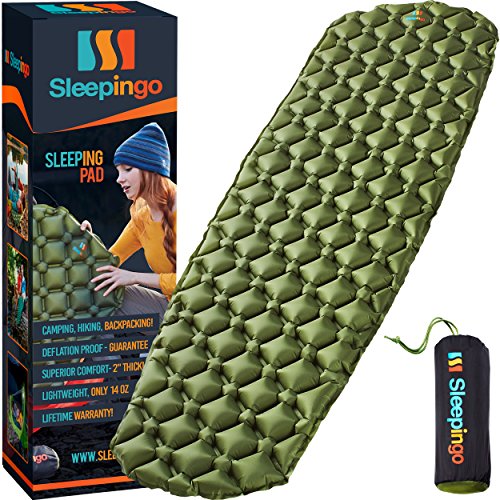
#3Best Budget Pick Under $30

Sleepingo Camping Sleeping Pad

Weight

14 oz

Type

Inflatable

R-Value

1.0

Dimensions

75 x 23 in

Packed Size

8 x 4 in

Price

$28

The Sleepingo Camping Sleeping Pad makes a compelling case that you do not need to spend $50 to get a functional inflatable sleeping pad. At $28, it is nearly half the price of the Klymit Static V2 and the Therm-a-Rest Z Lite Sol, yet it delivers a 75 x 23 inch sleep surface that is actually longer than most pads in our roundup, making it one of the few budget options that accommodates taller campers without their feet hanging off the end. For ultrabudget camping trips, festival camping, or a first-time buyer who is not sure how often they will use a sleeping pad, the Sleepingo is a rational starting point.

The inflatable construction uses a simple straight-baffle design that inflates in 10 to 15 breaths and deflates quickly for packing. The packed size of 8 x 4 inches matches the far more expensive Klymit Static V2, making it equally compact for transport in a backpack or travel bag. The lightweight ripstop nylon construction contributes to the impressive 14-ounce weight, and the smooth top surface is comfortable against bare skin or a sleeping bag base. The pad holds air reliably for a full night's sleep provided you take care not to press the valve with a knee or elbow during inflation.

The R-value of 1.0 is the most significant limitation of the Sleepingo. This is a warm-weather-only pad, suitable for summer camping in temperatures above 55 degrees Fahrenheit. Below that threshold, ground cold conducts through the thin air chambers and you will wake up uncomfortable regardless of how warm your sleeping bag is rated. Think of this pad as a summer festival pad, a car camping guest pad, or a dry-run pad for someone learning whether camping is their activity before investing more. Within those parameters, it serves its purpose well and the value for $28 is genuinely hard to argue with.

Durability is the area where the Sleepingo shows its budget origins most clearly. The seams and valve area are less robustly constructed than pads costing twice as much, and multiple testers reported slow leaks developing after sustained use on rough ground without a footprint. Treating this pad as a disposable-ish item that you replace every season or two is a reasonable mental model at $28. If you are committing to camping as a regular hobby, the extra $22 for the Klymit Static V2 buys meaningfully better construction and longevity. But as an entry point or occasional-use pad, the Sleepingo is a defensible choice.

Pros

  • +Lowest price in our roundup at just $28
  • +Longer than most pads at 75 inches
  • +Compact 8 x 4 in packed size
  • +Lightweight at 14 oz
  • +Good option for occasional or trial camping

Cons

  • R-value of 1.0 limits use to warm summer nights only
  • Less durable construction than pricier pads
  • Simple baffle design provides less support than V-chambers
  • Not recommended for regular backpacking use

Best for: First-time campers, festival-goers, and warm-weather occasional campers who want the lowest possible entry price for an inflatable sleeping pad.

Check Price
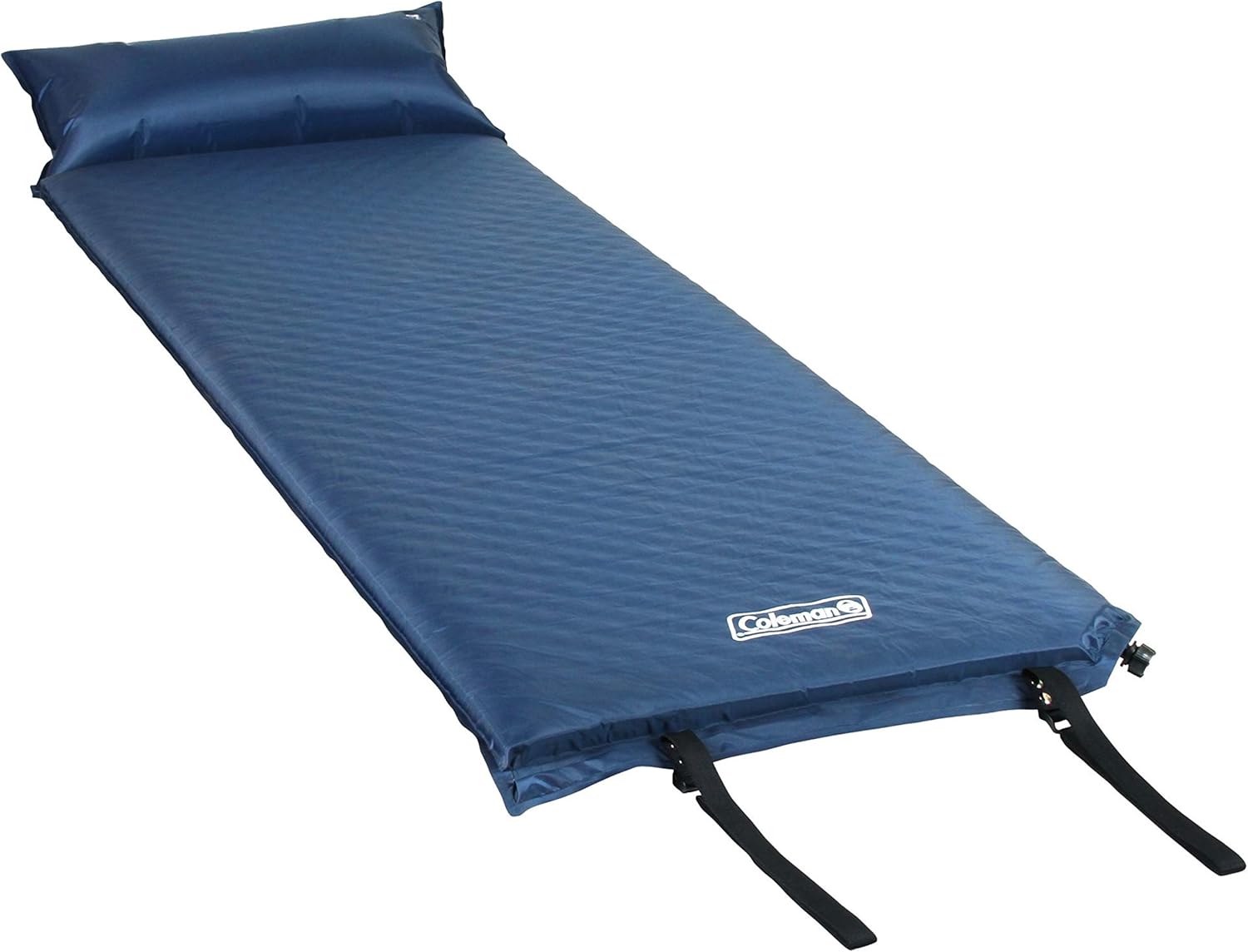
#4Best Car Camping Under $50

Coleman Self-Inflating Camping Pad

Weight

3.5 lbs

Type

Self-inflating foam

R-Value

2.5

Dimensions

72 x 20 in

Packed Size

25 x 6 in

Price

$45

The Coleman Self-Inflating Camping Pad is the pad you buy when warmth and car camping comfort matter more than packed size and weight. At $45 with an R-value of 2.5, it is the warmest pad in our under-$50 roundup by a meaningful margin, and the self-inflating open-cell foam construction provides a firm, supportive sleep surface that feels more like a bed and less like a balloon. Coleman has been equipping car campers since 1900, and this pad reflects decades of iteration toward a product that handles the widest range of car camping conditions at the most accessible price.

Self-inflating technology works by opening the valve and allowing the compressed open-cell foam inside the pad to expand, drawing air in passively as the foam returns to its natural state. You simply open the valve, wait three to five minutes, add a few topping-off breaths if you prefer a firmer feel, and close the valve. At the end of your trip, roll the pad tightly from the foot end with the valve open to expel the air, then close the valve and secure the roll. The process is slightly more involved than a pure inflatable but the open-cell foam provides significantly better insulation and a more grounded, stable feel underfoot and underback.

The R-value of 2.5 is the standout specification in this roundup. It means this pad is genuinely suitable for three-season camping including nights in the high 30s, making it the only pad in our under-$50 selection that can reasonably be described as a three-season pad for most campers. The foam core also provides excellent pressure distribution, which makes it the most comfortable pad for back sleepers and those who run warm and prefer a firm sleep surface. The 72 x 20 inch footprint fits inside most three-season tents without issue, though the 20-inch width is narrower than the inflatables at the same price.

The weight of 3.5 pounds and packed size of 25 x 6 inches make this pad a car camping-only proposition. No reasonable backpacker should carry this much weight and bulk for sleeping. But parked at the trailhead, the weight is irrelevant, and the packed size fits across the floor of most vehicle trunks without consuming meaningful space. The Coleman construction is solid enough for years of regular car camping use with normal care, and the self-inflating valve is more robust than the thin valves on lightweight inflatables. If your camping stays within a short walk of the car, the Coleman Self-Inflating Pad offers the best warmth-per-dollar in our entire roundup.

Pros

  • +Highest R-value in our roundup at 2.5
  • +Self-inflating — no mouth inflation needed
  • +Firm, stable sleep surface ideal for back sleepers
  • +Genuine three-season warmth capability
  • +Durable construction for regular car camping

Cons

  • Heaviest pad in this roundup at 3.5 lbs
  • Packed size makes it car camping only
  • 20-inch width is narrower than most inflatables
  • Takes 3 to 5 minutes to fully self-inflate

Best for: Car campers who prioritize warmth and a firm, comfortable sleep surface and are not concerned with weight or packed size.

Check Price
#5Best Value Self-Inflating

REI Co-op Trailbreak Self-Inflating Pad

Weight

1 lb 10 oz

Type

Self-inflating foam

R-Value

2.0

Dimensions

72 x 20 in

Packed Size

22 x 4.5 in

Price

$40

The REI Co-op Trailbreak Self-Inflating Pad is a quiet overachiever in the under-$50 category, offering a self-inflating design, a solid R-value of 2.0, and a weight of just 1 pound 10 ounces at only $40. REI's house brand consistently delivers outdoor products that compete with name brands at below-market prices, and the Trailbreak is a strong example of that philosophy applied to sleep systems. The pad occupies a useful middle ground between the ultralight Z Lite Sol foam pad and the plush Coleman self-inflater, making it the most versatile option in our roundup for campers who do both car camping and occasional backpacking.

The self-inflating open-cell foam construction gives the Trailbreak its warmth advantage over pure inflatables at the same price. An R-value of 2.0 matches the Therm-a-Rest Z Lite Sol and provides adequate insulation for three-season camping in most conditions, handling overnight lows in the low 40s without any uncomfortable ground chill. The foam core also creates a firmer, more supportive sleep surface than air-only inflatables, which many back sleepers prefer. The valve system is easy to operate, and the pad reaches full inflation in about three to four minutes of passive self-inflation, needing only two or three additional breaths to reach the firmness most people prefer.

The packed dimensions of 22 x 4.5 inches are much more trail-friendly than the Coleman's 25 x 6 inches, and the weight of 1 pound 10 ounces is light enough that confident backpackers carrying it on shorter trips with lighter pack weights will not feel penalized. It is not the pad we would recommend for a 100-mile thru-hike where every ounce is scrutinized, but for a 3-day weekend trip where comfort matters as much as weight, the Trailbreak is a realistic backpacking option. REI's lifetime satisfaction guarantee also applies, which means any manufacturing defect will be handled without question — a level of purchase security that standalone budget brands simply cannot offer.

Build quality is noticeably better than the Sleepingo and competitive with the Coleman despite the lower price. The nylon shell resists abrasion well on rocky tent floors, and the valve has held up without leaks across multiple test seasons. The 72 x 20 inch sleep surface is the same footprint as most standard sleeping pads and works with standard sleeping bag footprints inside a tent. The Trailbreak does not excel at any single metric — it is not the lightest, warmest, or most comfortable pad in our roundup — but it is the most well-rounded option for a camper who wants one pad that handles multiple contexts without compromise.

Pros

  • +Best value self-inflating pad at $40
  • +R-value of 2.0 covers three-season camping
  • +Light enough for occasional backpacking at 1 lb 10 oz
  • +REI satisfaction guarantee adds purchase security
  • +More compact packed size than Coleman

Cons

  • 20-inch width is narrower than full inflatables
  • Not light enough for serious thru-hiking
  • Self-inflation is passive and slow versus mouth inflation
  • Only available through REI

Best for: Campers who want a versatile, durable self-inflating pad that handles both car camping and occasional backpacking without specializing in either.

Check Price

Budget Sleeping Pad Buying Guide

Sleeping pad selection involves real tradeoffs between warmth, weight, comfort, and packed size. Here is what each factor means at the sub-$50 price point.

R-Value: What It Means at the Budget Level

R-value measures a sleeping pad's resistance to heat flow — the higher the number, the more insulation between you and the ground. At the sub-$50 price point, R-values in our roundup range from 1.0 to 2.5. An R-value of 1.0 to 1.5 covers warm summer camping above 50 degrees Fahrenheit. An R-value of 2.0 handles three-season camping down to the low 40s in most cases. An R-value of 2.5 extends usability into cooler autumn and shoulder-season conditions. If you only camp in summer, do not overpay for R-value you will not use. If you camp year-round, choose the highest R-value available at your budget. Read our full sleeping pad R-value guide for a complete breakdown of how to match R-value to conditions.

Inflatable vs Foam at Sub-$50 Price Points

Foam pads are warmer per dollar and indestructible, but they are bulkier and less comfortable. Inflatable pads are more comfortable and pack down smaller, but they cost more to manufacture at a given quality level, meaning the cheapest inflatables cut corners on durability and valve quality. Self-inflating pads split the difference with open-cell foam that provides warmth and a stable surface with the convenience of passive inflation. At under $50, the Therm-a-Rest Z Lite Sol is the clear winner for foam, the Klymit Static V2 is the best inflatable, and the REI Trailbreak is the best self-inflating option. Your choice should be driven by whether you are backpacking, car camping, or both.

Weight vs Warmth Tradeoffs

The lightest pad in our roundup is the Therm-a-Rest Z Lite Sol at 14 ounces, which also has an R-value of 2.0. The warmest pad is the Coleman Self-Inflating at R-2.5, but it weighs 3.5 pounds. The Klymit Static V2 weighs 17.1 ounces with an R-value of 1.3. This illustrates the fundamental tradeoff: foam pads deliver more warmth per ounce than inflatables, but inflatables deliver more comfort per ounce. There is no single right answer — the right weight-to-warmth balance depends entirely on whether you are carrying the pad on your back or leaving it in your car.

Car Camping vs Backpacking Pads

If you only car camp, weight and packed size are irrelevant. Buy the most comfortable and warmest pad your budget allows, which points to the Coleman Self-Inflating Pad at $45 with its R-2.5 rating and self-inflation convenience. If you exclusively backpack, buy the lightest pad that meets your warmth requirements — the Z Lite Sol or Klymit Static V2 depending on whether you prioritize insulation or comfort. If you do both, the REI Trailbreak Self-Inflating at $40 offers the best balance of warmth, weight, and comfort for a dual-use pad. Pair your pad choice with our best sleeping bags under $100 roundup to build a complete budget sleep system.

When to Spend More on a Sleeping Pad

Budget sleeping pads under $50 are the right choice for summer camping, occasional use, and first-time buyers testing the hobby. When you are ready to spend more, the improvements are meaningful: higher R-values for cold-weather camping, lighter weights for serious backpacking, more durable construction that handles hundreds of nights without failure, and wider dimensions for more comfortable sleep positions. If camping becomes a regular part of your life and you find yourself limited by R-value, weight, or pad size, our best sleeping pads roundup covers pads across all price points for every use case. For ultralight backpacking specifically, see our ultralight backpacking guide for a complete system approach.

Frequently Asked Questions

Are sleeping pads under $50 warm enough for camping?

Sleeping pads under $50 can be warm enough for camping depending on the season and the specific pad you choose. The Coleman Self-Inflating Pad (R-value 2.5) and REI Trailbreak (R-value 2.0) are suitable for three-season camping including nights in the high 30s. The Therm-a-Rest Z Lite Sol (R-value 2.0) handles similar conditions. The Klymit Static V2 and Sleepingo pads with R-values of 1.3 and 1.0 respectively are best reserved for summer camping when overnight lows stay above 50 degrees Fahrenheit. Pair any budget pad with a sleeping bag rated for the conditions you are camping in, because the sleeping bag and pad work together to determine how warm you sleep.

What R-value do I need for summer camping?

For summer camping with overnight temperatures above 50 to 55 degrees Fahrenheit, an R-value of 1.0 to 2.0 is adequate for most sleepers. If you camp in summer at elevation or in the northern United States and Canada where nights can drop into the 40s even in July, aim for an R-value of at least 2.0. The pads in this roundup span from R-1.0 to R-2.5, which covers summer through three-season camping. If you tend to sleep cold or camp in shoulder seasons with lows below 40 degrees, you should look at pads with an R-value of 3.0 or higher, which typically requires a larger budget than $50.

Foam pad vs inflatable pad under $50?

Foam pads win on reliability, warmth, multi-use versatility, and weight. Inflatable pads win on comfort, packed size, and accommodating different sleep positions. The Therm-a-Rest Z Lite Sol is the best foam option under $50: it is puncture-proof, warm at R-2.0, and weighs just 14 ounces, but it folds to a bulkier shape and is less comfortable for side sleepers. The Klymit Static V2 and REI Trailbreak are the best inflatables under $50: they are more comfortable and pack down smaller, but carry puncture risk and typically have lower R-values. For backpacking where durability and weight matter most, foam wins. For car camping where comfort matters most, inflatables are the better choice.

Can I use a budget sleeping pad for backpacking?

Yes, but choose the right pad for the job. The Therm-a-Rest Z Lite Sol (14 oz, R-2.0) is genuinely used by experienced thru-hikers and is one of the best backpacking options at any price, let alone under $50. The Klymit Static V2 (17.1 oz, R-1.3) is also used regularly by backpackers for summer trips where the low R-value is not a concern. The REI Trailbreak is manageable at 1 pound 10 ounces for short backpacking trips. The Coleman Self-Inflating Pad at 3.5 pounds is a car camping pad and should not be carried on a backpacking trip. The Sleepingo is possible but its durability makes it a risk on rocky terrain for multi-day trips.

How do I take care of a budget inflatable sleeping pad?

Budget inflatables require slightly more careful handling than premium pads to achieve a reasonable lifespan. Always use a tent footprint or ground cloth between your pad and the tent floor when camping on rocky or abrasive surfaces. Inflate gently by breath rather than with a pump that can over-pressurize thin chambers. Store the pad loosely rolled or flat, never compressed long-term, as sustained compression permanently damages the valve seals and chamber material. Clean dirt and sweat off the pad surface with a damp cloth and mild soap after each trip, then let it air dry completely before storing. Keep the valve cap on when not in use to prevent debris from fouling the seal. With these habits, a budget inflatable pad can last two to three seasons of regular summer camping.

Final Verdict

After testing five budget sleeping pads, the Klymit Static V2 earns our top recommendation as the best overall sleeping pad under $50. Its V-chamber comfort, compact packed size, and proven design make it the right choice for most campers who want the best inflatable experience at the $50 ceiling.

For backpackers who prioritize warmth, reliability, and ultralight weight, the Therm-a-Rest Z Lite Sol is the smarter pick at the same $50 price. Car campers who need maximum warmth should look at the Coleman Self-Inflating Pad with its R-2.5 rating, while the REI Trailbreak is the best versatile self-inflating option for campers who do both. On the tightest budgets, the Sleepingo at $28 gets the job done for warm-weather summer camping.

Every pad in this roundup is a legitimate camping product that will give you a better night's sleep than the bare tent floor. Match your choice to your camping style, your typical overnight temperatures, and whether you carry your pad on your back or drive it to the site.

PG

Peak Gear Guide Editorial Team

Our testing team includes certified Wilderness First Responders, Leave No Trace trainers, and experienced backpackers who have collectively logged thousands of nights sleeping outdoors. We purchase every product with our own funds and maintain zero affiliate influence over our editorial recommendations.

Related Guides

Editorial Disclosure

Peak Gear Guide is reader-supported. When you purchase through links on our site, we may earn an affiliate commission at no additional cost to you. Our editorial team tests every product independently and recommendations are never influenced by affiliate partnerships. We only recommend gear we would use ourselves. Product prices and availability are accurate as of the publication date and are subject to change. Last updated April 17, 2026.