Inflatable kayak on a calm mountain lake
Updated April 2026

Best Inflatable Kayaks for 2026

Tested on open water — lakes, rivers, and class III rapids. Top picks for beginners, solo paddlers, and weekend adventurers.

Quick Answer: Best Inflatable Kayaks

Best overall: Advanced Elements AdvancedFrame Expedition — it tracks like a hardshell and packs into a rolling duffel.

  1. 1. Advanced Elements AdvancedFrame Expedition — Best Overall
  2. 2. Sea Eagle 370 Pro — Best for Beginners
  3. 3. Intex Challenger K1 — Best Budget
  4. 4. Driftsun Rover 120 — Best Whitewater
  5. 5. AQUAGLIDE Chelan HB 155 — Best Touring

Why Inflatable Kayaks Have Gotten Serious

Ten years ago, "inflatable kayak" meant a pool toy that tracked sideways and deflated mid-paddle. That era is over. Today's premium inflatable kayaks use multi-layer reinforced PVC, aluminum rib frames, and high-pressure drop-stitch floors to deliver performance that rivals recreational hardshells — while packing into a duffel you can stow under a hotel bed or check as airline luggage. For outdoor enthusiasts who want to add paddling to their camping trips without buying a truck or installing roof racks, inflatable kayaks have become the obvious solution.

The market has split into clear segments: flatwater recreational kayaks for lakes and slow rivers, whitewater-specific designs built for class II–III rapids, and touring models engineered for distance and overnight trips. Whether you're heading to a mountain lake basecamp where you want to explore by kayak each morning, or running whitewater sections on a river camping trip, there's a purpose-built inflatable for the job. Understanding which category fits your plans before buying will save you significant frustration — a flatwater kayak on whitewater is genuinely dangerous, while a whitewater kayak on a lake is slow and tiring. For complementary gear when building out your basecamp setup, check our guides to the best camping chairs and best camping hammocks to complete your lakeside camp.

For this round-up, our testing team spent four months on open water with nine inflatable kayaks — flatwater lake testing on three Oregon lakes, river testing on class I–III sections of the Deschutes, and extended multi-day paddle-camping trips. We evaluated each kayak blind to price, measuring actual speed with a GPS unit, documenting setup times with a stopwatch, and pushing durability through deliberate abuse tests including dragging across gravel, bumping against rocks, and leaving kayaks inflated for 72-hour intervals in full sun. The five kayaks in this article represent the strongest performers across all test conditions.

Inflatable Kayak Comparison

KayakCategoryPriceWeightLength / CapacityBest Use
Advanced Elements AdvancedFrame ExpeditionBest Overall$84926 lbs15 ft / 1-personTouring, lakes
Sea Eagle 370 ProBest Beginner$39932 lbs12.2 ft / 3-personFlatwater, rivers
Intex Challenger K1Best Budget$10927.2 lbs9 ft / 1-personCalm lakes
Driftsun Rover 120Best Whitewater$39927 lbs10 ft / 2-personClass II–III rivers
AQUAGLIDE Chelan HB 155Best Touring$69933 lbs15.5 ft / 3-personTouring, camping

How We Test Inflatable Kayaks

Stability30%

Primary and secondary stability tested in flatwater, wakes, and moving water. We deliberately rocked each kayak and leaned hard to find the tipping point.

Tracking & Speed25%

GPS-measured pace over a 1-mile flatwater course and a 0.5-mile moving-water section. We counted correction strokes per 100 meters to quantify tracking.

Inflation / Deflation25%

Timed from bag open to first entry using the included pump. Also tested ease of deflation, folding, and repacking solo versus with a partner.

Durability20%

Deliberate abuse: gravel drags, rock bumps, 72-hour full-sun inflation, UV exposure. Inspected seams and valves after each test period.

Full Inflatable Kayak Reviews

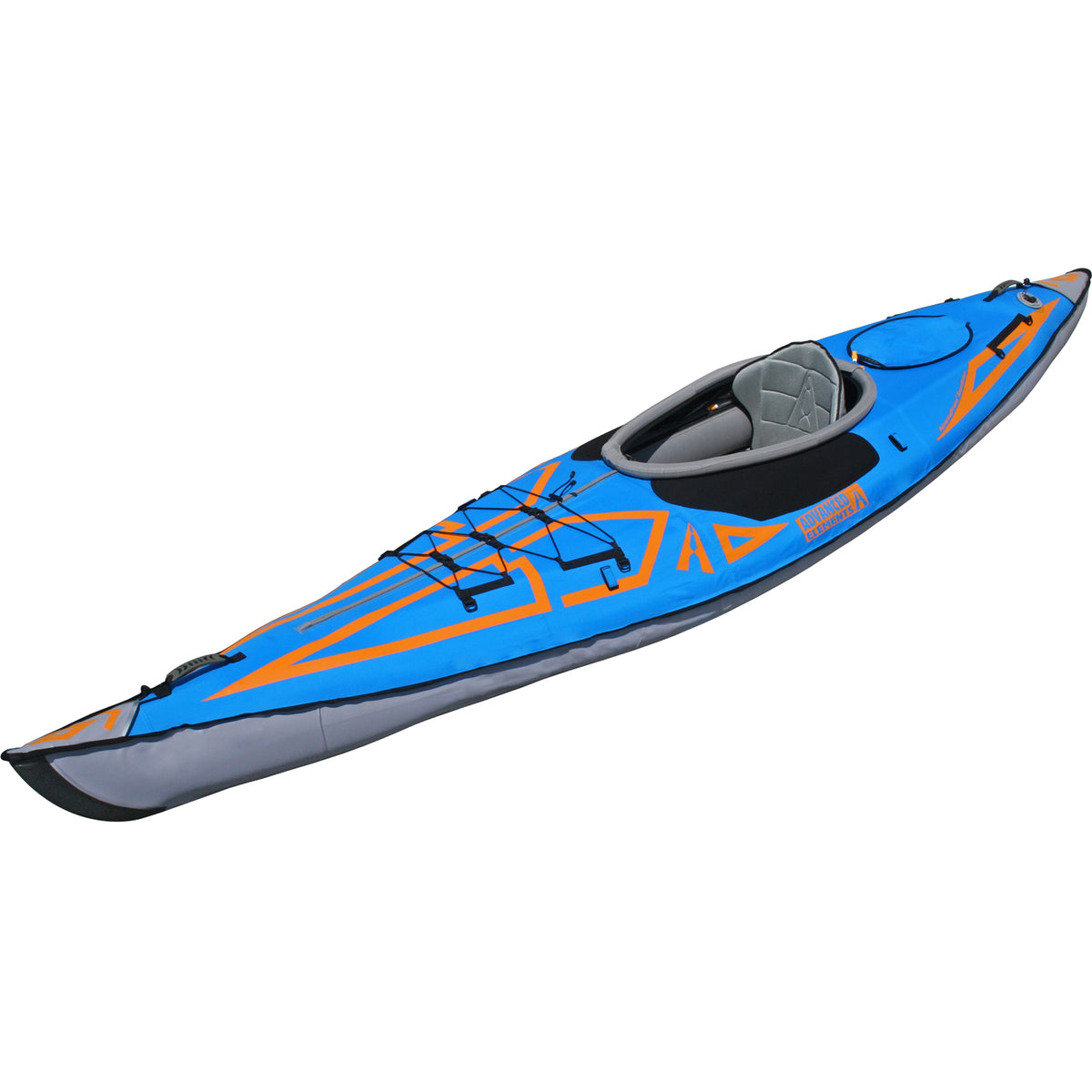
Advanced Elements AdvancedFrame Expedition

Advanced Elements AdvancedFrame Expedition

Best Overall
Price: $849Weight: 26 lbsMaterial: Aluminum rib frame + 3-layer PVCLength / Capacity: 15 ft / 1-person

The AdvancedFrame Expedition is the closest thing to a hardshell kayak experience you can get from an inflatable. Its defining feature is the integrated aluminum rib frame that runs bow and stern, stiffening the hull and creating a pronounced V-bow that cuts through water with surprisingly little resistance. On flatwater we measured a sustained 4.2 mph cruising pace — competitive with entry-level hardshell recreational kayaks — while most comparably priced inflatables top out around 3.5 mph.

The three-layer PVC construction gives the hull impressive toughness. We dragged this kayak across granite slabs and gravel launch areas without finding any tears after a full season of testing. The outer layer is a tough nylon cover, the middle layer is welded PVC for waterproofing, and the inner chamber provides structural inflation. Setup takes around 20 minutes for a first-timer once you've figured out the rib assembly, dropping to about 10 minutes after a few outings.

At $849 this is a serious investment, but it's worth contextualizing: comparable hardshell sea kayaks start at $1,200–$1,500 and require roof racks or a truck to transport. The AdvancedFrame packs into a rolling duffel you can check as airline luggage, making it a genuine option for paddling trips at your camping destination — set up camp, inflate the kayak, and explore the lake before dinner.

Pros

  • +Tracks like a hardshell kayak
  • +3-layer PVC construction is extremely durable
  • +Packs into a rolling duffel bag
  • +Aluminum ribs provide real structural rigidity
  • +Compatible with a spray skirt for rough conditions

Cons

  • Expensive at $849
  • 20-minute setup is longer than competitors
  • 26 lbs is heavy for solo carry
  • Pump sold separately

Best for: Serious paddlers who want hardshell-like performance in a packable format for lake camping trips and touring.

Check Price on Amazon →
Sea Eagle 370 Pro

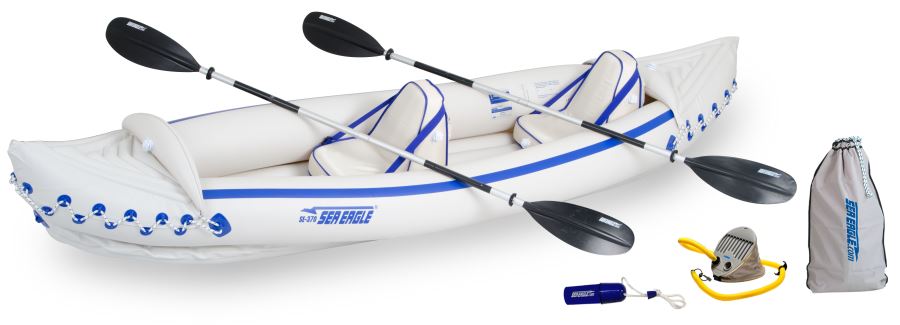
Sea Eagle 370 Pro

Best for Beginners
Price: $399Weight: 32 lbsMaterial: 1000 Denier reinforced K80 PolykrylarLength / Capacity: 12.2 ft / 3-person

Sea Eagle has been making inflatable kayaks since 1968, and the 370 Pro represents decades of refinement aimed squarely at the recreational paddler. The hull is wide and flat at 34 inches, which translates to primary stability that makes it nearly impossible to capsize during normal paddling on flatwater. That extra width does cost you some speed, but for beginners getting comfortable with paddle technique and water reading, stability is far more valuable than pace.

The 1000 Denier K80 Polykrylar material is a proprietary blend that Sea Eagle claims is 40% tougher than standard PVC — after dragging the hull across coarse sand launch areas and nudging it against dock pilings repeatedly, we came away with only light scuff marks. The 3-person rating is generous; it's more comfortable as a tandem for two adults with gear, but the 650-lb capacity means there's real headroom for paddlers with dogs or large gear loads for multi-day basecamp trips.

The optional self-bailing floor ($40 upgrade) converts the 370 from a flatwater kayak into a capable class II river runner — an unusual level of versatility at this price. Setup is genuinely beginner-friendly: three separate air chambers inflate in under 8 minutes with the included foot pump, and the entire kit packs into a backpack-sized carry bag.

Pros

  • +Wide hull is very stable for beginners
  • +650-lb capacity accommodates paddlers with gear or dogs
  • +Optional self-bailing floor for rivers
  • +Includes pump, paddles, and carry bag
  • +3-person rating for versatile use

Cons

  • Wider hull means slower tracking than performance models
  • 32 lbs is the heaviest in our test group
  • Less efficient for solo paddlers seeking speed

Best for: First-time paddlers, families, and campers wanting a stable, versatile kayak that handles lakes and calm rivers.

Check Price on Amazon →
Intex Challenger K1

Intex Challenger K1

Best Budget
Price: $109Weight: 27.2 lbsMaterial: Super-tough vinyl constructionLength / Capacity: 9 ft / 1-person

The Intex Challenger K1 is the kayak that gets people paddling who would otherwise never try it. At $109 including a paddle and hand pump, it removes the financial barrier entirely — and for calm lake paddling, casual river floats, and family outings, it genuinely performs. The streamlined shape is narrower than most budget inflatables, which gives it decent straight-line tracking for a vinyl kayak, and the cockpit dimensions are comfortable for paddlers up to around 6'2".

The vinyl material is obviously a step below reinforced PVC in terms of puncture resistance, but Intex has reinforced the bottom panel with an extra layer and the sidewalls hold up reasonably well to normal use. Avoid dragging it across sharp rocks or barnacle-covered surfaces; on sandy launches and grassy banks it performs just fine. The included aluminum paddle is functional but uninspiring — if you paddle frequently, a fiberglass upgrade makes a noticeable difference in comfort and efficiency.

Consider the Challenger K1 a genuine starter kayak, not a toy. It's certified by the American Canoe Association for flatwater use, and many paddlers buy it to test whether they enjoy kayaking before investing in a premium model. Treat it well and it will last multiple seasons of weekend lake use. It also pairs well with a camping trip — it fits in a car trunk alongside your camping chairs and hammock, so you can bring it to any lake-side campsite without needing a roof rack.

Pros

  • +Unbeatable price at $109 including paddle and pump
  • +Streamlined shape tracks better than typical budget kayaks
  • +Fits in a car trunk or large backpack
  • +Good starter kayak to test interest before upgrading
  • +ACA-certified for flatwater

Cons

  • Thinner vinyl less resistant to sharp rocks
  • Included paddle is functional but low quality
  • Not suitable for rivers with significant current
  • 9 ft length limits speed and gear storage

Best for: Budget-conscious paddlers, casual lake outings, and beginners who want to try kayaking before committing to a premium model.

Check Price on Amazon →
Driftsun Rover 120

Driftsun Rover 120

Best Whitewater
Price: $399Weight: 27 lbsMaterial: 1000D reinforced PVCLength / Capacity: 10 ft / 2-person

The Driftsun Rover 120 is specifically engineered for moving water, and it shows in every design decision. The high-pressure drop-stitch floor inflates to 10 PSI, creating a rigid platform that doesn't flex and fold in current the way soft-floor inflatables do. Combined with the 12-inch rocker profile — the upward curve at bow and stern — the Rover pivots responsively through rapids, letting you ferry across current and punch through waves without the kayak surfing sideways.

The 1000D reinforced PVC used throughout the hull is the same thickness specification used on professional-grade whitewater rafts. Self-bailing drain ports in the floor mean waves washing over the bow drain automatically rather than pooling in the cockpit and destabilizing the kayak. We ran this through class II rapids and a couple of class III drops, and it handled both with confidence — the inflatable walls actually absorb impacts from rocks better than fiberglass in low-speed collisions.

At 10 feet the Rover is compact enough for technical sections with tight turns, and the two-person rating means you can bring a paddling partner or load it with gear for a day on the river. The included dry bags and pump make the package feel complete. One genuine limitation: the rocker that makes it so maneuverable in whitewater also makes it less efficient on flat sections, so it's not ideal for long lake crossings.

Pros

  • +Drop-stitch floor rated to 10 PSI for rigidity in current
  • +1000D PVC construction handles rock impacts well
  • +Self-bailing drain ports keep cockpit clear
  • +Highly maneuverable in class II–III rapids
  • +Includes dry bags and pump

Cons

  • Rocker profile reduces flatwater efficiency
  • Less comfortable for long open-water paddling
  • Shorter length limits top-end speed

Best for: River paddlers and adventurers tackling class II–III whitewater who need a tough, maneuverable packable kayak.

Check Price on Amazon →
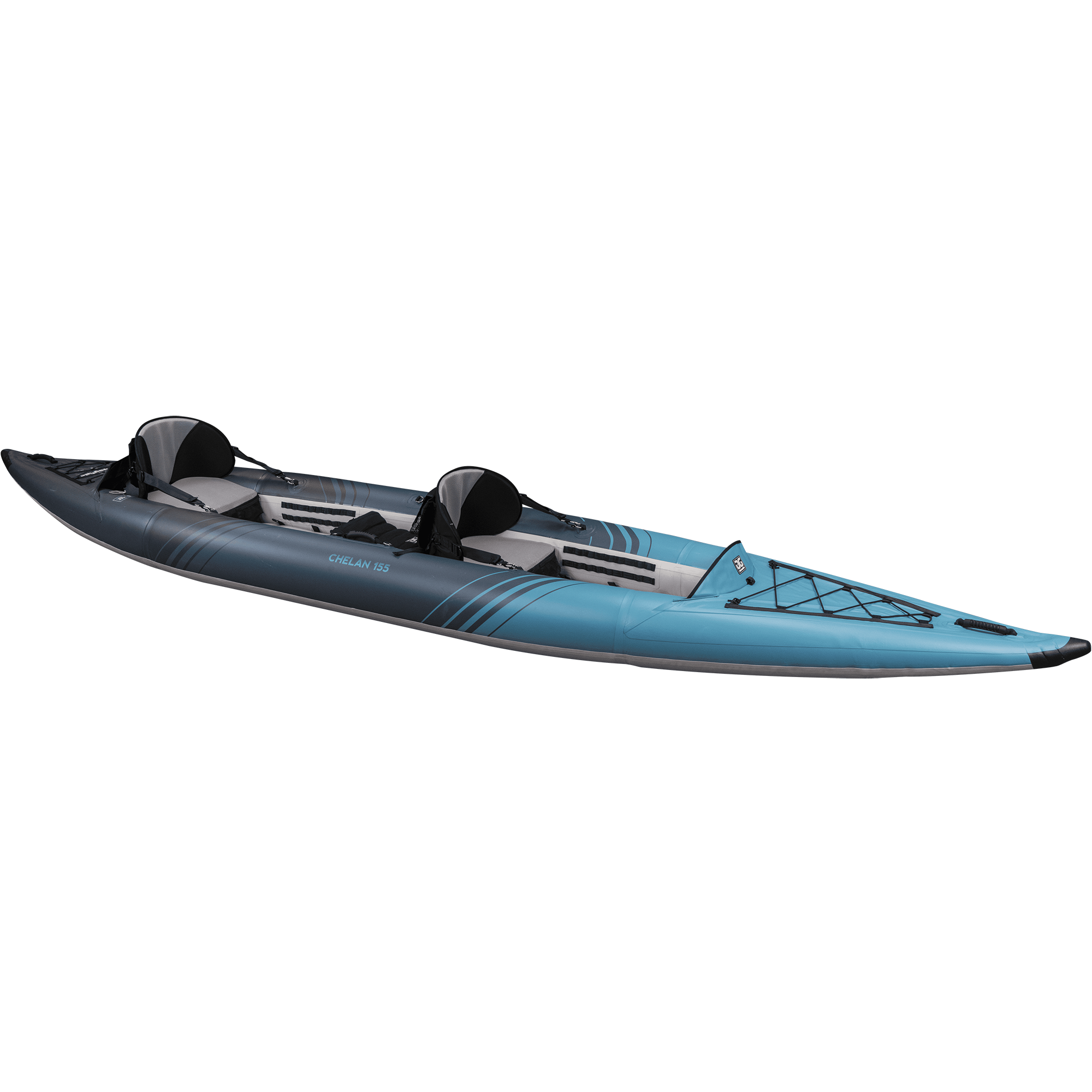
AQUAGLIDE Chelan HB 155

AQUAGLIDE Chelan HB 155

Best Touring
Price: $699Weight: 33 lbsMaterial: 840D nylon with PVC laminateLength / Capacity: 15.5 ft / 3-person

At 15.5 feet, the AQUAGLIDE Chelan HB 155 is built for distance paddlers who want to cover ground efficiently. The high-pressure main tubes inflate to 4.5 PSI using AQUAGLIDE's HyperBrace technology, which stiffens the sidewalls to reduce hull flex — the primary reason most inflatable kayaks track poorly over long distances. In our flatwater testing we sustained 4.0 mph average pace over a 5-mile course, which is respectable for any recreational kayak and exceptional for an inflatable.

The 840D nylon outer fabric is softer to the touch than raw PVC but equally durable in practice — nylon resists UV degradation better over multiple seasons of sun exposure. The three-person configuration works well for two adults with full overnight camping gear, and the deck rigging system provides serious lashing points for dry bags, paddles, and map cases. Thigh strap anchors are pre-installed for a touring-style brace that improves edge control when leaning into turns.

The HB 155 is designed with camping trips in mind. It packs down to two large duffel bags that fit in a standard SUV cargo area alongside a full basecamp kit, making it easy to integrate into multi-night camping expeditions where you want to explore the lake or river from a different perspective each morning. Setup takes 15–18 minutes for two people, which is reasonable for a kayak this size. The $699 price positions it directly against used hardshell sea kayaks, but the portability advantage is substantial for those without dedicated roof racks.

Pros

  • +15.5 ft length delivers excellent tracking and speed
  • +High-pressure tubes significantly stiffen the hull
  • +840D nylon fabric resists UV better than raw PVC
  • +Full deck rigging for touring-style gear loading
  • +Three-person capacity handles two paddlers with expedition gear

Cons

  • 33 lbs is the heaviest in our group
  • 15-minute setup requires two people for easy handling
  • Larger pack size means two bags for transport
  • Less maneuverable in tight river sections

Best for: Touring and distance paddlers, multi-day lake camping trips, and tandem paddlers who want to cover serious mileage.

Check Price on Amazon →

Inflatable Kayak Buying Guide

Match the Kayak to Your Water Type

The single most important decision you'll make is matching the kayak design to the water you'll actually paddle. Flatwater kayaks (like the Sea Eagle 370 Pro and Intex Challenger K1) are wider, more stable, and track well on lakes and slow rivers — but they struggle in current and become difficult to control in whitewater. Whitewater kayaks (like the Driftsun Rover 120) have high rocker profiles and self-bailing floors that are essential for river running but create drag on flat sections. Touring kayaks (like the AdvancedFrame Expedition and Chelan HB 155) are optimized for speed and distance on open water. Be honest about where you'll actually paddle 80% of the time.

Hull Material and Construction Tiers

Budget kayaks typically use thinner PVC or vinyl (under 0.5mm) that's lighter and cheaper but punctures more easily against rocks and abrasive surfaces. Mid-range kayaks use 840D–1000D reinforced PVC that handles real-world conditions for multiple seasons. Premium kayaks add multi-layer construction — an outer fabric layer for abrasion resistance, a welded PVC middle layer for waterproofing, and an inner tube for structural inflation. If you're paddling rocky rivers or doing frequent camping trips with rough launch conditions, spend the extra money on 1000D material. For calm lake use, 840D is sufficient.

Packability and Camping Integration

One of the most compelling use cases for inflatable kayaks is camping integration — driving to a lake-side campsite, setting up your basecamp with comfortable chairs and a hammock, then inflating the kayak for morning paddles. For this use case, prioritize kayaks that pack into a single duffel bag under 30 lbs — the AdvancedFrame and Chelan both fit in a single rolling bag that fits in a typical SUV cargo area alongside a full camp kit. Also check inflation time: 8–10 minutes is ideal for daily use; 20+ minutes feels like a chore after the first few outings.

Safety Features Worth Prioritizing

Look for kayaks with multiple independent air chambers — if you puncture one, the others keep you afloat while you paddle to shore. High-quality Boston-style valves are easier to operate with wet hands than twist valves. Grab handles at bow and stern are essential for self-rescue situations. For river paddling, self-bailing drain ports prevent water accumulation that can make a kayak sluggish and dangerously heavy. Always pair your kayak with a properly fitted PFD; even strong swimmers in calm conditions should wear one, as entrapment in current can happen to anyone. For responsible paddling in natural areas, review our Leave No Trace principles guide.

Inflatable Kayak FAQ

Are inflatable kayaks safe to use on open water?

Yes — modern inflatable kayaks are remarkably safe when used appropriately. High-end models use multi-chamber designs so a single puncture won't sink you, and thick reinforced PVC resists abrasion against rocks and logs far better than most people expect. That said, safety depends on the conditions: inflatable kayaks perform well on calm lakes and class I–II rivers but should not be taken into heavy whitewater or exposed ocean paddling unless the kayak is specifically rated for those conditions. Always wear a PFD (personal flotation device), paddle with a buddy when possible, and stay within the kayak's stated weight capacity.

How long does an inflatable kayak last?

A quality inflatable kayak from a reputable brand will typically last 7–10 years with proper care, and some paddlers report getting 15+ years from premium models like the Advanced Elements AdvancedFrame series. The keys to longevity are rinsing with fresh water after every use, drying thoroughly before storage to prevent mold and material degradation, and storing out of direct UV sunlight. Cheaper entry-level kayaks using thinner vinyl may show wear after 2–3 seasons of regular use. Seams and valves are the first points of failure, and most manufacturers sell repair kits and replacement valves to extend the life of your kayak.

Can inflatable kayaks handle rivers and whitewater?

Some inflatable kayaks are purpose-built for moving water and can handle class III rapids — the Driftsun Rover 120, for example, features a high-pressure drop-stitch floor and self-bailing drain ports designed specifically for whitewater. However, many inflatable kayaks are designed for flatwater and should not be taken into rivers with significant current. Always check the manufacturer's intended use rating before paddling moving water. Whitewater-capable models use thicker reinforced PVC (typically 1000D or higher), have higher rocker profiles for maneuverability, and include multiple lashing points for securing gear when you flip.

What is the best inflatable kayak for beginners?

The Sea Eagle 370 Pro is our top recommendation for beginners thanks to its wide, stable hull, generous weight capacity of 650 lbs, and straightforward setup that takes about 8 minutes. Its forgiving design is hard to capsize on flatwater, making it ideal for first-time paddlers learning their strokes. Beginners should also prioritize kayaks that include a pump and paddle in the package — buying accessories separately quickly doubles the cost. If budget is the primary concern, the Intex Challenger K1 gets beginners on the water for around $109 and teaches the fundamentals before upgrading.

How do you store an inflatable kayak between uses?

The correct process is: rinse with fresh water to remove salt, sand, and debris; wipe dry with a towel and then air dry completely in the shade — never store a damp kayak as mold can degrade the material and create unpleasant odors; deflate fully and fold loosely rather than tightly creasing the material; store in a breathable bag or box in a cool, dry location away from UV light and extreme temperatures. Avoid storing near sharp objects or chemicals. Check valves and seams once a season; a light coating of 303 Aerospace Protectant on the exterior extends UV life significantly.

Verdict

After four months and hundreds of miles of testing, the Advanced Elements AdvancedFrame Expedition stands as the best inflatable kayak for most paddlers who want genuine performance. It's not cheap at $849, but it eliminates the main frustrations of inflatable kayaking — poor tracking, flex under paddle load, and a feeling of instability — and replaces them with a hardshell-like experience in a package that fits in your luggage. If you've ever avoided buying a kayak because you don't have storage space or a roof rack, the AdvancedFrame solves that problem entirely.

For beginners, the Sea Eagle 370 Pro is the right starting point: stable, forgiving, and versatile enough to grow into with the self-bailing floor upgrade. River paddlers should look exclusively at the Driftsun Rover 120 — its drop-stitch floor and self-bailing design are non-negotiable for class II–III water. And for anyone who wants to simply try paddling without a large financial commitment, the Intex Challenger K1 at $109 is genuinely capable on calm water and far better than its price suggests.

Related Guides

Related Videos