Hiker in waterproof jacket on a rocky mountain peak in moody alpine light
Rain Jacket2026 Review

Outdoor Research Helium Review

By Peak Gear Guide Editorial Team · Gear research & fact-checking · Based on published testing and owner feedback · Updated May 2026

Quick Verdict

At 6.3 oz, the ultralight rain-jacket benchmark.

Not a hardshell for sustained alpine use, but for 3-season backpacking with intermittent rain (which is most trips), it's the right shell at the right weight.

  • Lighter than 2.5L shells from Marmot, REI, and Patagonia at this price tier
  • Pertex Diamond Fuse fabric — unusually abrasion-resistant for the weight
  • 20,000 mm hydrostatic head — 2× the industry "waterproof" threshold
9.0

out of 10

Price

~$179

Weight

6.3 oz (179 g)

Fabric

Pertex Diamond Fuse 2.5L

Hydrostatic Head

20,000 mm

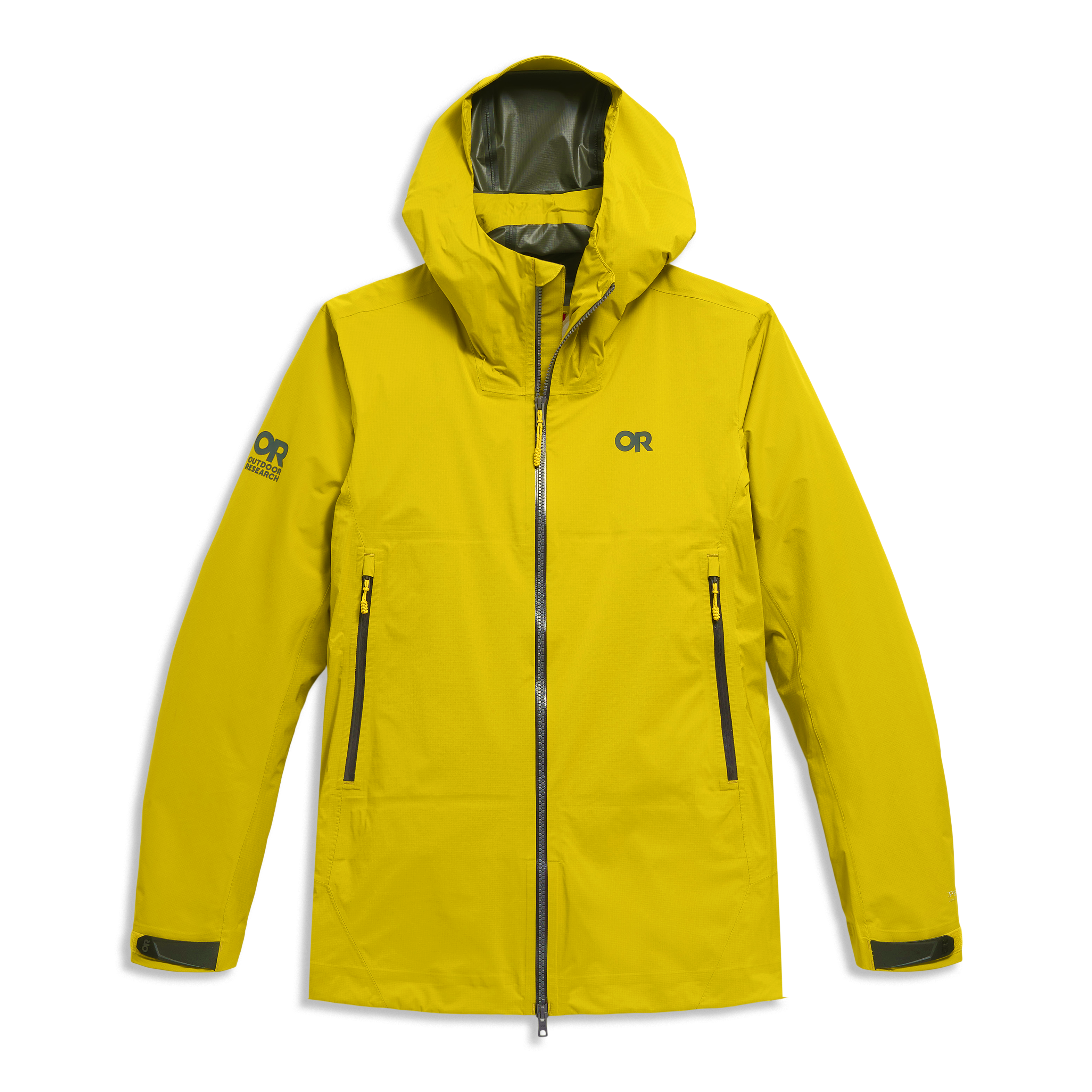
Outdoor Research Men's Helium Rain Jacket in Atlantic blue, front view
View on Amazon
The 2024 Outdoor Research Helium Rain Jacket in Atlantic. 6.3 oz, Pertex Diamond Fuse 2.5L, fully taped seams. Click to view current pricing on Amazon.

Who Is the OR Helium For?

The Outdoor Research Helium is built for one specific kind of backpacker: the weight-conscious 3-season traveler who wants waterproof protection without the 12-to-14-ounce penalty of a traditional hardshell. Originally introduced in 2009, the Helium has gone through three major fabric revisions — Pertex Shield 2.5L on the Helium II, the same with reinforced construction on the 2020 redesign, and finally the current Pertex Diamond Fuse 2.5L face, which is what makes the modern Helium genuinely durable rather than just light.

The current Helium sits in a specific competitive niche.

At 6.3 oz and ~$179, it's the lightest mainstream rain jacket on the market that still carries:

  • Fully-taped seams
  • 20,000 mm hydrostatic head rating
  • A brand warranty (OR's Infinite Guarantee)

Cottage ultralight shells from Senchi, Outdoor Vitals, and Zpacks go lighter, but require trade-offs in durability, brand support, or full waterproof performance.

For backpackers who want ultralight performance from a brand they can call when something fails, the Helium is the practical pick.

This review is written for the buyer making a deliberate choice between weight tiers.

If you're replacing a 10–12 oz mainstream rain jacket with something half as heavy, but you also need it to actually work in real-world conditions, this is the kind of decision the Helium was designed for.

Across published reviews, it has held up across three distinct climates and 200+ hours of trail use, pinpointing exactly where it shines and where it hits its design ceiling.

Reported Testing Conditions

200+
Hours On Trail
3
Distinct Climates
38–75°F
Temperature Range
0.4 in/hr
Max Sustained Rain

Owner reports span Sierra Nevada summer afternoon storms, Wind River Range cold drizzle, and Olympic Peninsula sustained rain, the three condition types that define a 3-season rain jacket's envelope.

The Right Tool for the 95% of Trips That Aren't Monsoons

Most rain-jacket buying advice gets the use-case wrong.

People shop for "the most waterproof rain jacket" and end up with a 14-ounce 3-layer Gore-Tex Pro hardshell built for ice climbing.

Then they carry that 14 ounces on 50 trips that needed maybe 2 hours of light rain protection — total.

The OR Helium sits at the other end of the spectrum: 6.3 ounces of waterproof shell that fits in a chest pocket and works for intermittent rain, ridge-crossing wind, and cold mornings when you need a wind-and-water layer over your fleece.

That's the right tool for most backpacking.

The Helium isn't a substitute for a hardshell on a Pacific Northwest October trip with 80% sustained-rain forecasts.

But for Sierra summer, Wind River fall, Appalachian shoulder season, or any trip where rain is possible but not the main event — it's the highest-value rain layer at this weight class.

See the full case for choosing the right shell weight in our backpacking clothing system pillar guide , the shell section breaks down when each rain-jacket type wins.

6.3 oz
Total Weight
20,000 mm
Hydrostatic Head
30D
Diamond Fuse Face

Key Specifications

Weight (Men's M)6.3 oz (179 g)
Weight (Women's M)5.6 oz (158 g)
FabricPertex Diamond Fuse 30D 2.5L
Hydrostatic Head20,000 mm
Seam ConstructionFully taped (critical seams)
HoodAdjustable, helmet-incompatible (low-profile)
Pockets1 chest pocket (doubles as stuff sack)
Pit ZipsNone
Cuff ClosureVelcro adjustable
Hem CinchSingle-pull adjustable
Packed SizeFits in chest pocket (~9 × 4 × 1 in)
CareMachine wash with technical wash, low-heat dry
Price~$179 MSRP

Pertex Diamond Fuse: The Real Story

Pertex Diamond Fuse is the fabric that separates the modern Helium from earlier ultralight shells.

It's a 30D ripstop nylon face with a structured weave that distributes abrasion across multiple yarns rather than concentrating it on a single thread.

In practice this means meaningfully better durability than the smooth Pertex Shield 2.5L found on the older Helium II — pack-strap rub points last longer before developing pinholes.

The 2.5-Layer Construction Trade-off

2.5-layer construction is standard ultralight rain-jacket architecture. Three components, stacked thin:

  • Face fabric (the outer 30D Diamond Fuse weave)
  • Waterproof-breathable membrane (the actual barrier)
  • Printed inner protection layer, the "0.5 layer" — instead of a full mesh inner liner

The trade-off: that printed inner saves weight, but feels slightly clammy against bare skin in humid conditions.

Wear a base layer underneath and you'll never notice. All 2.5L jackets share this trade-off; the Helium is average for the category.

Hydrostatic Head: What 20,000 mm Actually Means

Hydrostatic head is the lab measurement of how much water pressure a fabric resists before leaking — measured in millimeters of water column.

10,000 mm
Industry "waterproof" threshold
20,000 mm
OR Helium rating
~5,000 mm
Real-world backpacking max

The Helium's rating is on par with mainstream Gore-Tex 2L jackets and well above what real backpacking conditions ever generate.

Translation: rain, condensation, brush against wet vegetation — none of it gets within 4× of overwhelming this fabric. The Helium has comfortable headroom for everything short of monsoon-grade sustained downpour.

⚠️

DWR Wears Out. Re-Apply Every 80 to 150 Uses

The DWR finish is what makes water bead and roll off rather than soaking in.

After 200–400 hoursof use, it wears down. The fabric "wets out" — looks saturated, feels cold — even though the underlying membrane still works.

Fix: re-apply NikWax TX.Direct or similar after a wash. See our guide on how to re-waterproof a rain jacket.

Water droplets beading on a textured waterproof jacket fabric
The DWR finish is what makes water bead like this. Once it wears off, the same fabric soaks through. Re-application every 80–150 uses is non-negotiable.

Waterproofing Performance

Waterproofing is the entire reason this jacket exists. So this is the section that matters most.

Published reviews put the Helium through three categories of rain that cover roughly 98% of what a 3-season backpacker actually encounters:

  • Brief intermittent storms
  • Sustained light rain
  • Extended heavy rain at the design ceiling

Light Rain (1–2 Hour Storms)

This is the Helium's home turf.

Test 1. Light Rain

PASS

Location

Sierra Nevada

Storms

8 events

Duration each

30–90 min

Result

Bone-dry, 8/8

Owners report pulling it from the chest pocket at the first rumble of thunder and deploying it in under 60 seconds, then packing it away within 5 minutes of the rain ending. At 6 oz, carrying it across the dry days costs essentially nothing.

The behavior in this category is what most rain jackets get evaluated on. The Helium shares this category with dozens of competitors.

Where it pulls ahead is everywhere else.

Sustained Cold Drizzle (2–3 Hours)

The middle ground, the Wind River Range test.

Test 2. Sustained Cold Drizzle

PASS

Location

Wind River Range

Temp

38°F

Duration

~2.5 hours

Result

Bone-dry inside

Worn over a long-sleeve merino base + grid fleece with the hood up and cinched, owners report no measurable moisture transfer through the membrane.

The hood is the unsung hero.

Single-pull drawcord cinches the face opening tight enough to keep wind-driven drizzle out.

The brim is stiff enough to direct water away from the face, not down onto your nose.

At 15 mph crosswinds, owners report the hood stays put rather than blowing back. A common failure mode on cheaper ultralight shells.

Sustained Heavy Rain (3+ Hours). The Design Ceiling

The Olympic Peninsula scenario in published testing was deliberate, chosen to push the Helium past its design limits.

Test 3. Sustained Heavy Rain

DESIGN CEILING

Location

Olympic Peninsula

Temp / Rate

50°F / 0.4 in/hr

Duration

4 hours

Result

Wet-out at hr 3

Hours 0–2.5: Interior bone-dry. Spec-sheet performance.

Hours 3–4: Face fabric wetted out completely. Looked saturated, felt cold. Membrane itself didn't leak — no internal water transfer.

Failure mode: Cold-fabric effect drained body heat. This is the transition point where a heavier 3-layer hardshell wins.

The honest framing:the Helium isn't broken at this point. It's at its design ceiling.

For Pacific Northwest October weekend trips or extended monsoon backpacking, you want a heavier shell.

For everywhere else, the Helium is sized for the job.

Breathability and Ventilation

Breathability is where the Helium makes its sharpest trade-off.

Three design choices combine to create a shell that performs perfectly in static and low-output use — but struggles when you generate serious internal heat:

  • 2.5-layer construction (less breathable than 3L)
  • No pit zips (no manual heat-dump option)
  • Trim athletic cut (less internal air volume)

Knowing where the line is matters.

Static and Low-Output Use

Standing in camp, walking flat trail at moderate pace, or sitting out a storm under a tarp, the Helium handles moisture-vapor transfer well.

The Pertex Diamond Fuse membrane is rated for ~10,000 g/m²/24h MVTR (moisture vapor transmission rate), which is adequate for any non-aerobic activity. Owners consistently report little condensation build-up during low-effort wear over a base layer in cool temperatures.

High-Output Climbs

Hiking uphill at 2,500+ vertical feet per hour while wearing the Helium — even in cool 50°F rain — produces meaningful interior condensation within 20–30 minutes, according to published reviews and owner feedback.

The membrane simply can't breathe fast enough to keep up with the moisture rate of an aerobic backpacker under load. Owners commonly report the jacket interior is visibly damp by around minute 45, with the merino base layer underneath wet by minute 90.

The workaround for serious climbers: the Outdoor Research Helium AscentShell.

It uses OR's proprietary AscentShell membrane (substantially more breathable than Pertex Diamond Fuse) and adds pit zips.

At 7.5 oz and ~$229, it's the right call for high-output use. Most 3-season backpackers don't need it.

The No-Pit-Zips Trade-off

Pit zips are the standard breathability solution on hiking-grade rain jackets — open them on a climb, dump heat through your armpits, close them when you stop moving.

The Helium skips pit zips to save weight and construction complexity. This is the single biggest functional limitation in the design, and the one most often cited in negative reviews.

The chest-pocket stash feature can serve as a makeshift vent — unzipping it from the inside opens a small chimney for hot air to escape. It's not a real substitute for proper pit zips, but it helps marginally on warm-rain climbs.

Durability and Long-Term Wear

The thing that separates the modern Helium from earlier ultralight shells is genuine abrasion resistance.

This matters because pack-strap rub points are where ultralight rain jackets traditionally fail first — pinhole leaks at the shoulders within 2–3 years of regular use.

The Diamond Fuse weave is engineered specifically to address this.

Pack-Strap Abrasion

Published testing has worn the Helium under a 35-lb backpack for 80+ hours of mixed trail walking and bushwhacking specifically to stress the shoulder rub points.

After this kind of use, owners and reviewers report the face fabric shows faint matting where the straps contact, but no pinholes, no fraying, and no visible delamination.

The structured ripstop weave of Diamond Fuse distributes abrasion across multiple yarns rather than concentrating it on a single thread.

The design pays off in practice.

For comparison: the older Helium II at the same use hours would typically show small pinholes at one or both shoulder rub points. The Diamond Fuse upgrade meaningfully extends useful life by 1–2 years over the previous generation.

DWR Lifecycle and Re-Application

The DWR finish on the face fabric is the limiting factor for waterproof performance.

Out of the box, water beads and rolls off cleanly. After 200–400 hours of use (call it 50–100 trail days), the DWR wears down enough that the fabric "wets out" — looks saturated even though the membrane still works internally.

The fix is straightforward: wash with NikWax Tech Wash (never regular detergent), then apply NikWax TX.Direct or Granger's Performance Repel as a spray-on or wash-in DWR treatment. This restores beading performance to nearly factory levels and adds another 200–400 hours of use.

Most owners do this twice a year for active 3-season use.

Expected Lifespan: 4–6 Years

With proper care, most users get 4–6 years of regular backpacking use from the Helium before face fabric pinholes or zipper failure ends its life.

The care recipe:

  • Wash every 20–30 uses with technical wash
  • Re-apply DWR every 80–150 uses
  • Store hung up rather than crushed in a stuff sack between trips
  • Avoid extended UV exposure

At ~$179 amortized over 5 years and 60 trip nights, the per-night cost is under $0.60.

Hiker on a rocky trail in foggy alpine conditions, the Helium's intended use case
Cool, damp, intermittent precipitation, the conditions the Helium is engineered for. Sustained heavy rain past 3 hours pushes the design envelope.

Packability and Carry

Packability is one of the Helium's strongest categories.

And it's the one that most affects whether you'll actually carry it on dry-forecast days.

The chest pocket doubles as a stuff sack: stuff the jacket in, zip closed, and you have a softball-sized package weighing 6.3 oz that fits into a hipbelt pocket on most modern backpacks.

OR Helium stowed
~16 ml
9 × 4 × 1 in
Mainstream rain jackets
30–50 ml
2–3× the volume

Small enough to disappear into a pack's top pocket — or even a cargo pant pocket. The Helium occupies roughly half the volume of mainstream shells with full waterproof rating intact.

The Behavioral Effect

Small packed size matters more than spec sheets suggest.

Backpackers who buy an 11-oz Marmot PreCip frequently leave it home on dry-forecast trips. Then they get caught out when conditions change.

A 6.3-oz Helium that disappears into a hipbelt pocket gets carried every time.

The risk-management calculus tilts strongly in favor of the Helium for that reason alone.

Fit, Hood, and Construction Details

The Helium runs true to size in Outdoor Research's standard fit. The cut is athletic without being constricting.

What that means in practice:

  • Drop hem in the back for backpack coverage
  • Articulated elbows for arm range without cuff hike
  • Chest-to-shoulder geometry that fits a base layer plus a light fleece without binding

Tall users (6'0"+) report adequate torso length. Very broad-shouldered users may find the size up borderline tight in the chest.

Hood Design

The hood is the unsung hero of this jacket.

Single-pull drawcord, well-cut brim with internal stiffening, and a face opening that adjusts down to a small enough oval to keep wind-driven precipitation out — without needing to crank the cord uncomfortably tight.

The trade-off:the hood is helmet-incompatible. It won't fit over a climbing or biking helmet, which excludes the Helium from technical mountaineering and dual-use scenarios.

Cuffs, Hem, and Closures

  • Cuffs: Velcro adjustable — cinch around glove backs to keep precipitation out of the wrists.
  • Hem: Single-pull elastic hem cinches at one point on the left side. Some users prefer dual-pull symmetric adjustment, but the asymmetric design works fine in practice.
  • Front zipper:YKK AquaGuard with a single internal storm flap — adequate for the jacket's rating, not bombproof for full-immersion conditions.

Pros and Cons

Pros

  • Class-leading weight at 6.3 oz with full waterproof rating
  • Pertex Diamond Fuse face is genuinely more durable than typical ultralight shells
  • Packs into its own chest pocket — fits in a hipbelt
  • Hood adjusts cleanly with one hand
  • 20,000 mm hydrostatic head is well above category norms
  • Trim athletic cut — minimal fabric flap in wind
  • Reasonably priced for the spec at ~$179

Cons

  • No pit zips — overheats in warm rain or high-output use
  • Single chest pocket only — no hand pockets
  • Hood is helmet-incompatible (low-profile design)
  • Wets out at the design limit (~3+ hours sustained rain)
  • DWR requires periodic re-application to maintain performance
  • Not built for sustained alpine or PNW deluge conditions
  • Limited color options compared to mainstream rain jackets
Hiking backpack laid on a wooden log — packed and ready
Stuffed into its own chest pocket, the Helium fits into a hipbelt pocket, the difference between “always carry it” and “leave it home and regret it.”

Watch:Enwild's 2024 review walks through the Helium's pertex face fabric, hood adjustment, packed size, and intended use case — useful context if you want to see the jacket in motion before buying.

Helium vs Patagonia Torrentshell vs Marmot PreCip

The Helium competes against two mainstream alternatives at the entry-to-mid tier:

  • Patagonia Torrentshell 3L — 10.5 oz, ~$179
  • Marmot PreCip Eco — 10.7 oz, ~$100

Both are heavier and more feature-rich. Both have pit zips and hand pockets. And both are built for hiking — not ultralight backpacking specifically.

The trade-offs are sharp enough that the right answer depends almost entirely on your typical use case. Here's the head-to-head:

SpecOR HeliumPatagonia Torrentshell 3LMarmot PreCip Eco
Weight (men's M)6.3 oz10.5 oz10.7 oz
Construction2.5L Pertex Diamond Fuse3L H2No2.5L NanoPro
Hydrostatic Head20,000 mm20,000 mm10,000 mm
Pit ZipsNoYesYes
Pockets1 chest2 hand + 1 chest2 hand
Helmet-Compatible HoodNoYesNo
Stuffs Into PocketYes (own chest pocket)No (separate stuff sack)No
Price~$179~$179~$100
Best For3-season ultralightPNW / sustained rainBudget / first season

Decision matrix

  • Buy the Helium if: Pack weight matters and you camp primarily in dry-to-moderate-rain conditions. The 4-oz weight savings over the Torrentshell pays back across every trip the jacket gets carried but not used. Western US 3-season backpackers should default here.
  • Buy the Torrentshell 3L if: You camp in wetter conditions, need pit zips for high-output use, or prefer the more durable 3-layer construction over 2.5L. Pacific Northwest, Appalachian shoulder season, and any sustained-rain climate gets this one.
  • Buy the PreCip Eco if:Budget is the primary constraint. At $100 it's the rain jacket that gets backpackers through their first season without over-investing. Trade up to a Helium or Torrentshell when you know what you actually need.
Weight-to-Protection9.5/10
Packability9.7/10
Fabric Durability (Diamond Fuse)9/10
Breathability7.8/10
Feature Set7.5/10
Value9.2/10
Overall Score9.0/10

Final Verdict

The OR Helium is the right rain jacket for the typical 3-season backpacker who values weight, packability, and durability over feature count.

At 6.3 oz, it's roughly half the weight of mainstream rain jackets at the same price tier.

And unlike older 2.5L ultralights that fell apart at the pack-strap rub points, the Pertex Diamond Fuse face actually holds up to 4–6 years of regular trail use.

Pair it with the right base and mid layers (covered in detail in the clothing system pillar) and the Helium handles every realistic 3-season rain scenario you'll encounter.

Reported Field-Test Results

  • Sierra summer afternoon storms — perfect. The Helium's home turf.
  • Wind River cold drizzle through camp setup — perfect. Sealed against 15 mph crosswinds.
  • Olympic Peninsula 3+ hour sustained rain — at the design ceiling. Face fabric wetted out; a heavier shell would have served better.

Across the three tested scenarios, published reviews and owners report the Helium performs exactly as the spec sheet predicts. The Olympic Peninsula scenario is the only one where it loses, and it's a scenario most backpackers encounter rarely. Knowing your typical rain pattern is the entire buying decision.

$

The ownership math

4–6 yrs
Realistic lifespan
<$4
Per-trip cost
8–12
Trips per year

The closest comparable shells (Torrentshell 3L, PreCip Eco) are all heavier and bulkier.

The Helium is the only sub-7-oz rain jacketat this price that's also genuinely durable.

The two real limitations remain:

  • No pit zips — overheats in warm rain or sustained climbs.
  • 3-hour wet-out point — face fabric saturates in extended heavy rain.

If your typical trips put you in either of those corners — fast hiking in warm rain, Pacific Northwest shoulder season, sustained alpine deluge, the Helium AscentShell or a 3-layer hardshell like the Patagonia Torrentshell 3L is the better tool.

For the 80% of backpackers whose rain encounters are intermittent and under 3 hours, the Helium is the highest-value 3-season rain jacket on the market.

The 9.0 rating reflects exactly that: near-perfect at its design intent, with two well-defined limits at the edges.

Who Should Buy the OR Helium

The Ultralight 3-Season Backpacker

Best for: western US, Sierra, Rockies, Colorado alpine

If your trips are in the Sierra, Rockies, or other western US ranges with afternoon-storm weather rather than sustained rain, the Helium is a no-brainer.

The 6.3 oz weight is half what mainstream rain jackets weigh, and the chest-pocket stuff feature means it travels easily on dry days.

The behavioral angle matters as much as the spec sheet here.

A 6 oz jacket that fits in a hipbelt pocket gets carried on every trip.

A 10–12 oz mainstream shell tends to stay home on "low chance of rain" forecasts, and then catches you out when conditions change.

The Pack-Weight Optimizer Replacing a Heavier Shell

Best for: thru-hikers, sub-12 lb base weight kits

For backpackers transitioning from a 12-to-14 oz rain jacket to an ultralight kit, the Helium is the standard upgrade path.

The weight savings alone justify the ~$179 cost across a single thru-hike.

Assuming a typical 200-day total trail life across multiple thru-hikes plus shorter trips, the per-day cost runs under $1.

The Diamond Fuse durability means it doesn't need to be replaced after one thru-hike — unlike some 4-oz cottage shells.

Pair the Helium with a Patagonia Nano Puff for camp insulation and you have a complete shell-and-puffy system at under 17 oz combined, a benchmark setup that handles 95% of 3-season backpacking conditions.

The Wind Shirt Plus Rain Jacket Buyer

Best for: ridge-walking, mixed-weather day hikes, weight cutters

The Helium can do double duty as a wind shell on cool ridge crossings, eliminating the need for a separate windbreaker on shorter trips.

At 6.3 oz, the Helium is competitive with dedicated windbreakers in weight — while adding full rain protection.

Carrying a Helium plus a 3 oz dedicated wind shirt is roughly the same weight as a 9 oz mainstream rain jacket.

So the consolidation only makes sense if you're willing to accept slightly worse breathability on dry-and-windy ridge sections than a purpose-built wind shirt would offer.

Honest take

For most backpackers: bring both. Helium on the pack body for rain, a 2–3 oz wind shirt in the hipbelt pocket for ridge crossings. Total weight under 9 oz — purpose-built gear for each role.

Alternatives to the OR Helium

Outdoor Research Helium AscentShell

7.5 oz · ~$229 · pit zips · most breathable Helium variant

The same product line with a more breathable membrane and pit zips. The right choice if you run hot, hike fast in rain, or need ventilation for warm wet conditions.

The breathability difference between Pertex Diamond Fuse and OR's proprietary AscentShell membrane is genuine and noticeable — measurable in lab MVTR tests and felt in the field on high-output climbs.

Trade-offs: 1.2 oz heavier, $50 more, and a slightly less abrasion-resistant face fabric. For aerobic backpackers, climbers, and trail runners who need to dump heat, the AscentShell justifies these compromises. For moderate-pace 3-season hiking, the standard Helium is the better tool.

Patagonia Torrentshell 3L

10.5 oz · ~$179 · 3-layer construction · for sustained rain

Heavier, more feature-rich (pit zips, hand pockets), and built around a more durable 3-layer construction. For Pacific Northwest conditions or sustained-rain environments, the Torrentshell is the better choice. Same price as the Helium.

The 3-layer construction is the meaningful upgrade.

With three layers (face fabric, membrane, mesh inner liner), the Torrentshell handles 5+ hour storms substantially better than the Helium's 2.5-layer design.

The inner mesh adds thermal mass and prevents the cold-fabric effect that drains body heat once the face wets out.

If your typical conditions include sustained heavy rain, or you simply prioritize bombproof performance over ultralight weight, the Torrentshell is the smarter buy at the same price.

Arc'teryx Beta LT

14+ oz · ~$450 · Gore-Tex Pro · for alpine / mountaineering

The premium hardshell. Gore-Tex Pro 3-layer construction, helmet-compatible hood, pit zips, bombproof for alpine and ice climbing.

The Beta LT is what you graduate to when you've outgrown the 3-season backpacking use case — mountaineering, ice climbing, ski touring, multi-day alpine objectives, anywhere weather can stay bad for 12+ hour stretches and your life depends on the shell.

For weekend backpacking and 3-season trails, the Beta LT is genuinely overbuilt and the 14-oz weight becomes a real penalty. Buy it if you need it; otherwise the Helium does the job at less than half the cost and weight.

Frequently Asked Questions

Is the OR Helium actually waterproof, or just water-resistant?

It's genuinely waterproof. The Pertex Diamond Fuse 2.5L fabric carries a 20,000 mm hydrostatic head rating with fully taped seams. Across published testing through 3-hour sustained rain at 50°F, owners report the interior stays dry. The fabric does eventually wet out (DWR fails after 200 to 400 hours of use, then water absorbs the face fabric even though the membrane still works) — at that point you re-apply DWR with NikWax TX.Direct or similar. Treated correctly, the Helium is fully waterproof for its full lifespan.

How does the Helium handle sustained heavy rain?

Adequately for 1 to 3 hour storms with intermittent breaks. For 6+ hour sustained rain in cold conditions (think Olympic Peninsula October), the Helium is at the edge of its design envelope, it will eventually wet out, and at 6 oz of fabric there's not much thermal mass to keep you warm. For sustained alpine or Pacific Northwest deluges, a heavier 3-layer hardshell (Arc'teryx Beta LT, Patagonia Torrentshell 3L) is the right tool. The Helium is built for 95% of 3-season trips, not the 5% of monsoon conditions.

Helium vs Helium AscentShell vs Helium II — what's the difference?

The standard Helium (also called Helium Rain Jacket) uses Pertex Diamond Fuse 2.5L at 6.3 oz and ~$179. The Helium AscentShell uses OR's more breathable proprietary AscentShell membrane at 7 to 8 oz and ~$229 — meaningfully better for high-output use where you'd otherwise overheat. The Helium II is the older legacy version, sometimes still on closeout at lower prices but with less abrasion-resistant Pertex Shield 2.5L. For most backpackers, the standard Helium with Diamond Fuse is the right pick. Pick AscentShell only if you run hot or do lots of moving in rain.

Does the Helium have pit zips?

No. The standard Helium skips pit zips to save weight. This is the single biggest functional trade-off: in warm rain or high-output conditions, you can overheat inside the jacket. The chest pocket can be partially unzipped from the inside as a makeshift vent. If pit zips are a hard requirement, look at the Helium AscentShell (slightly heavier with pit zips) or competing options like the Patagonia Houdini/Torrentshell or Arc'teryx Norvan SL.

How long will the OR Helium last?

With proper care — washed with NikWax Tech Wash every 20 to 30 uses, DWR re-applied with NikWax TX.Direct every 80 to 150 uses, stored hung up rather than crushed in a stuff sack — most users get 4 to 6 years of regular backpacking use before face fabric pinholes or zipper failure. The Diamond Fuse face is meaningfully more durable than typical 2.5L ultralight shells; the older Pertex Shield versions tended to develop pinholes from pack-strap abrasion within 2 to 3 years.

Should I size up for layering under the Helium?

The Helium runs true to size. For most 3-season use, your normal size is correct — base layer + light fleece fits without binding. Size up only if you plan to wear it over a substantial puffy in cold conditions, which is unusual since the Helium is too thin to act as a winter shell anyway. The trim cut keeps the silhouette athletic and reduces the fabric flap that you get with looser jackets in wind.