Head-to-head · 2-person tents
Big Agnes Copper Spur HV UL2 vs MSR Hubba Hubba NX 2
Two of the most-searched 2-person backpacking tents in the catalog, both with full reviews on this site. Here's how they actually stack up — with picks by use case rather than a single "winner."
The weights, fabrics, and floor dimensions below are checked against the makers’ own spec sheets — Big Agnes for the Copper Spur HV UL2 and MSR for the Hubba Hubba. For neutral advice on picking a backpacking tent, REI’s expert-advice library is a good starting point.
Gear research & fact-checking

Quick verdict
Pick the Copper Spurif weight matters more than weather and you're hiking 3-season, fair-to-moderate conditions. It's 14 oz lighter and feels roomier inside.
Pick the Hubba Hubba if you want a tent that just worksin any 3-season weather, sets up easily in the dark or wind, and survives 4+ seasons of heavy use. It's the safer all-rounder.
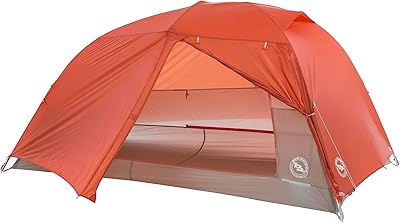

Side-by-side specs
| Spec | Copper Spur HV UL2 | Hubba Hubba NX 2 |
|---|---|---|
| Trail weight | 2 lb 10 oz (1,190 g) | 3 lb 8 oz (1,588 g) |
| Floor area | 29 sq ft (2.7 m²) | 29 sq ft (2.7 m²) |
| Peak height | 40 in (102 cm) | 40 in (102 cm) |
| Vestibules | 2 × 9 sq ft | 2 × 8 sq ft |
| Doors | 2 (D-shape) | 2 (D-shape) |
| Fly fabric | 15D ripstop nylon | 20D ripstop nylon |
| Floor fabric | 15D ripstop nylon | 30D ripstop nylon |
| Pole material | DAC Featherlite NSL | DAC Featherlite NSL |
| MSRP | $499 | $549 |
| Season rating | 3-season | 3-season (handles light winter) |
| Best for | Weight-conscious hikers | Versatile all-conditions |
Emerald cells = best in row on that single metric. A "win" on weight or fabric thickness doesn't make a tent better overall — it depends on what you're optimizing for.
Want to add a third tent to the comparison? Use our side-by-side tool:
Open in compare toolWhat both tents share
These two tents are designed for the same buyer, a 3-season backpacker who values weight, durability, and livability roughly equally. The shared traits matter as much as the differences:
- DAC Featherlite NSL pole sets. Both use the same poles, so durability is comparable. The pole is the most-replaced tent part long-term and these are industry-standard.
- Two-door, two-vestibule layout. Symmetric design with a door per side and a vestibule per side. No climbing over your tent partner to get out at 3 a.m.
- 29 sq ft floor area. Both are sized for 2 standard adult sleeping pads with maybe an inch of overlap. Two 25-inch wide pads fit; two 30-inch wide pads do not.
- 40-inch peak height. You can sit up in either, change clothes inside without contortion.
- 3-season focus. Neither is designed for sustained winter. Both handle a surprise snow dusting; neither survives a week of heavy snow load.
Where the Copper Spur wins
Weight — by a meaningful margin
14 oz (400 g) lighter trail weight. Over a 4-day trip with a 12 lb base weight, that's ~6% off your total — roughly equivalent to swapping your sleeping pad for a much lighter one. The Copper Spur achieves this with thinner fabrics (15D vs 20D fly, 15D vs 30D floor) and a single hubbed pole architecture.
Interior livability, the HV ridge pole works
Big Agnes's "HV" (high-volume) ridge pole pushes the walls outward at the top, creating a more rectangular interior shape than the Hubba Hubba's sloped sides. Same floor area, same peak height, but the Copper Spur feels less claustrophobic, especially when sitting up to read or play cards.
Larger vestibules
9 sq ft per side vs 8 sq ft. A small but real difference when two people's packs are stashed for the night. You can fit a 65L pack and your boots without tetris-ing.
$50 cheaper at MSRP
$499 vs $549. On sale during shoulder season the gap usually holds — both go 20–30% off, but the Copper Spur tends to dip first and lower. If price is the deciding factor, the Copper Spur wins by a margin that grows during sale season.
Where the Hubba Hubba wins
Weather performance
Sustained rain and moderate wind are where the heavier 20D fly and proven dual-pole geometry pay off. The Hubba Hubba's rainfly extends closer to the ground all the way around, reducing splash-back into the inner. In multi-day rain, the Copper Spur's fly tension can sag enough to require re-staking; the Hubba Hubba holds its shape better.
Long-term durability
The 30D floor on the Hubba Hubba is the single biggest durability advantage — twice the abrasion resistance of the Copper Spur's 15D floor. Pinhole leaks from years of ground contact appear later. Multi-year thru-hikers commonly replace Copper Spur floors at the 2–3 year mark; Hubba Hubbas tend to last 4–5 seasons before needing patching.
Easier setup, especially in adverse conditions
Two simple poles, color-coded clips, fly attaches via buckles rather than hooks. The Copper Spur's hubbed pole assembly is faster in fair weather but more fiddly in wind, you have to manage the whole web at once. The Hubba Hubba's separated poles can each go in independently, which matters when you're pitching at 9 p.m. with a headlamp in 20 mph wind.
Better for couples (mostly)
The Hubba Hubba's sloped walls feel a touch tighter to sit up in, but the inner volume is better for two-person sleeping — less wall contact at the foot end if you're both 6' or taller. If you and a partner are both tall, the Hubba Hubba rides better.
Real-world differences (after a season of use)
Spec sheets only get you so far. Here are the things you only notice after carrying a tent for a few hundred miles:
Pitch time
Copper Spur: ~3 min in fair weather, 5+ min in wind. Hubba Hubba: ~4 min in fair weather, 4 min in wind. The Hubba Hubba's pitch time is more consistent across conditions.
Condensation
Copper Spur: more condensation in still humid conditions due to steeper walls. Hubba Hubba: better airflow when both vestibules are partially open, less morning wipe-down.
Pack volume
Copper Spur packs to ~6" × 19.5". Hubba Hubba packs to ~6" × 20". Both fit horizontally in the bottom of a 55–65L pack.
Resale value
Both hold value well used — typically 50–60% of MSRP at 2 years in good condition. The Hubba Hubba moves slightly faster on Geartrade and r/ULgeartrade because of its broader recognition.
Who should buy which
Buy the Copper Spur if you...
- · Backpack mostly in summer / shoulder season
- · Hike trips of 7+ days where weight compounds
- · Care more about sit-up comfort and vestibule space than absolute weather resistance
- · Are willing to pitch carefully every time and re-stake in changing weather
- · Want to save $50
Buy the Hubba Hubba if you...
- · Backpack across all 3 seasons including shoulder rain/sleet
- · Want a tent that's easy to pitch in adverse conditions
- · Plan to use the same tent for 4+ seasons of regular trips
- · Hike with a partner who's 6'0" or taller
- · Don't mind 14 oz extra in exchange for a more robust setup
Frequently asked questions
Which is lighter. Copper Spur or Hubba Hubba?
The Big Agnes Copper Spur HV UL2 is about 14 oz (400g) lighter than the MSR Hubba Hubba NX 2 — 2 lb 10 oz (1,190 g) vs 3 lb 8 oz (1,588 g) for the trail weight. Over a multi-day trip that's a meaningful difference on the climbs.
Which tent handles weather better?
The MSR Hubba Hubba is the more weather-capable tent. Its slightly heavier 20D fabrics, full-coverage rainfly, and proven 2-pole geometry handle sustained rain and moderate wind better than the lighter Copper Spur. The Copper Spur is rated for 3-season use and handles fair weather well, but in serious wind or extended rain the Hubba Hubba inspires more confidence.
Which is roomier for two adults?
The Copper Spur HV UL2 has slightly more usable interior volume thanks to its high-volume (HV) ridge pole that pushes the walls outward. Floor area is similar (29 sq ft Copper Spur vs 29 sq ft Hubba Hubba), but the Copper Spur's vertical walls and 40-inch peak height feel more livable. The Hubba Hubba's 40-inch peak is identical, but its sloped walls make the same dimensions feel tighter near the head.
How do they compare on price?
MSRP is $499 for the Copper Spur HV UL2 and $549 for the Hubba Hubba NX 2, a $50 difference. Both go on sale 20–30% off during shoulder seasons (late summer for the Copper Spur, late fall for the Hubba Hubba). On sale, you can typically pick up either for $350–400.
Which is more durable long-term?
The Hubba Hubba's slightly heavier 20D fabrics handle abrasion better than the Copper Spur's lighter fly. Multi-year thru-hikers tend to wear through Copper Spur floors faster — usually pinhole leaks at year 2–3 of heavy use. The Hubba Hubba typically lasts 4–5 seasons of regular use before needing patching. Both pole sets (DAC Featherlite NSL on both) are equivalent in durability.
Which should beginners buy?
For beginners, the Hubba Hubba is the safer pick. Its dual-pole geometry is simpler to set up in the dark or wind, the rainfly is more forgiving of imperfect pitches, and the slightly heavier weight is barely noticeable on weekend trips. The Copper Spur rewards a more experienced user, the lighter fabrics need a careful pitch, and the design has more failure modes if you skip a guy line.
Related
Full review
Big Agnes Copper Spur HV UL2
Long-term review with field-test photos and pitch tips.
Full review
MSR Hubba Hubba NX 2
Long-term review with weather-test notes.
Compare
Durston X-Mid 2 vs Copper Spur
The other Copper Spur head-to-head. UL trekking-pole vs UL freestanding.
Pillar guide
Backpacking Shelter Systems
When to choose a tent vs tarp vs hammock vs bivvy — the pillar guide above tents specifically.