Quick Answer
Plan 2,500–3,000 calories per day for moderate trips and 3,500 or more for high-mileage or cold days; most backpackers burn 3,000–5,000. The number that actually drives your food bag is calorie density: aim for 100 calories per ounce or better. Nuts, nut butters and hard cheeses reach 150–180 cal/oz, which is why they anchor most menus. Going stoveless saves weight and camp time but narrows your options and makes cold-weather trips harder.
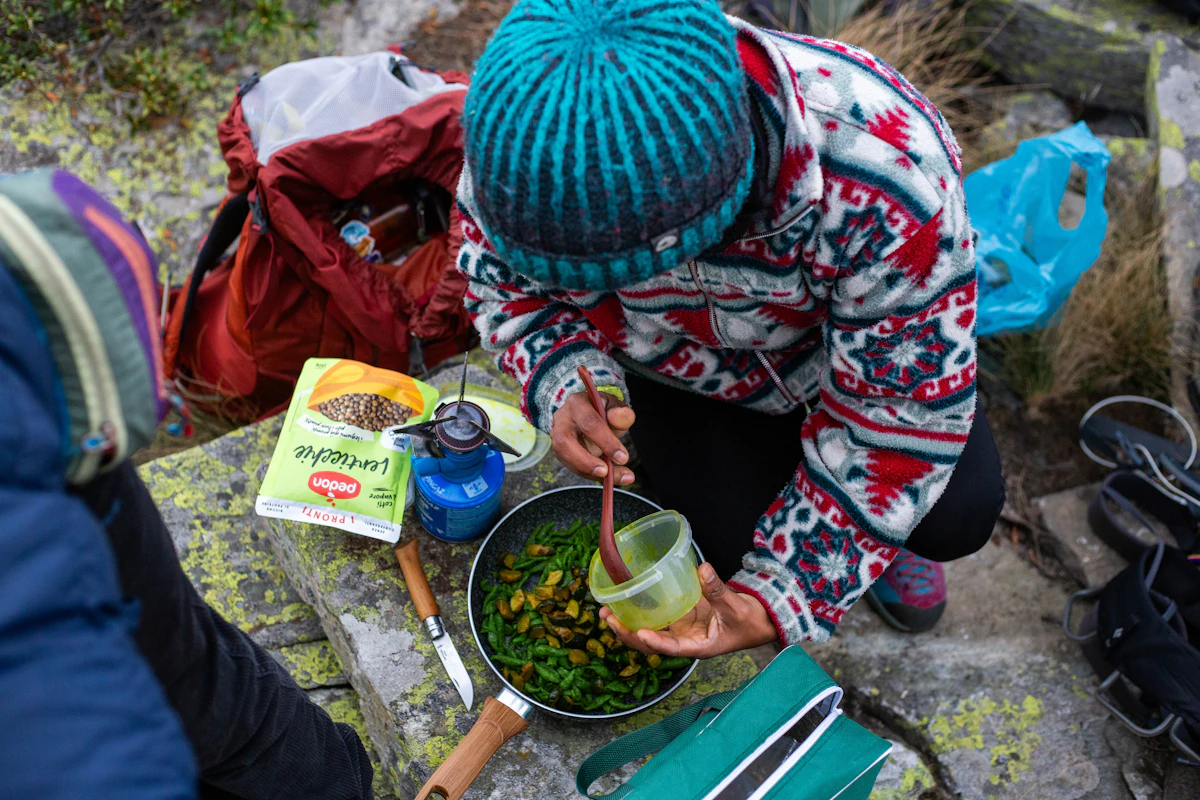
Backpacking Food Guide: What to Eat on the Trail (2026)
By Peak Gear Guide Editorial Team · Gear research & fact-checking
Food is the one backpacking category where getting it wrong has immediate, unavoidable consequences. Too little and you bonk on day three. Too heavy and your pack feels like a punishment. This guide covers the numbers, the options, and the planning process that experienced backpackers use to eat well without breaking their backs.
Our planning numbers line up with the trail-nutrition guidance in the REI Expert Advice library, and the food-storage rules below follow the National Park Service hiking-safety guidance on keeping food away from wildlife. Proper storage is also a core part of Leave No Trace ethics in bear country.
In This Guide
Calorie Math for Backpackers
The standard planning unit is pounds of food per day. Most experienced backpackers target 1.5–1.75 lbs per person per day. At average calorie density of around 100 calories per ounce, this gives you 2,400–2,800 calories. For high-output days with significant elevation gain, you may need 3,500+ calories — plan accordingly with higher-density foods or more volume.
The goal is calorie density, not just quantity. High-calorie-per-ounce foods include nuts (160-200 cal/oz), nut butters (160-180 cal/oz), salami and hard cheese (120-150 cal/oz), and olive oil added to meals (250 cal/oz). Mixing these into your food plan gets your average density up, which means more fuel for less weight.
Skip the rule-of-thumb. Our Backpacking Calorie Calculator our backpacking calorie calculator returns kcal per day for your specific body weight, intensity, and conditions — plus the food weight at 4.5 kcal/g average density.
Breakfast Options
Breakfast has two competing demands: it needs to be fast (you want to be moving, not cooking) and calorie-sufficient (you are about to hike, possibly for 6-10 hours). The fastest options require no cooking at all — a bar plus some nuts and dried fruit is enough for moderate days.
When you want a hot breakfast, instant oatmeal with powdered milk and added nuts is the classic: fast to prepare, high enough calorie density, and genuinely filling. Granola with powdered milk rehydrated the night before is another no-cook option. For a more substantial hot meal, instant mashed potatoes or grits with olive oil and cheese add calories quickly. Add a hot drink (coffee, tea, or hot chocolate) for morale and warmth on cold mornings.
Lunch and Snacks
Most backpackers graze rather than sit down for a formal lunch. This means eating 200-400 calorie snacks every 60-90 minutes while moving rather than stopping for 30 minutes to prepare and eat a meal. Snack selection is where calorie density really matters — every ounce you carry should be working hard.
Best trail snacks by calorie density: mixed nuts (any combination), nut butter packets, hard salami or summer sausage, hard cheese (parmesan and gouda last best without refrigeration), energy bars (look for 200+ calories per bar), dark chocolate, and coconut chips. A typical lunch spread is a tortilla with peanut butter and honey, plus a handful of nuts and a bar. Total: roughly 700-900 calories, no cooking required.
Dinner Strategies
Dinner is when most backpackers use their stove, and it is the meal with the most room for variety and satisfaction. The base formula: a starch (instant rice, pasta, ramen, couscous) plus a protein (tuna, salmon, chicken, or salami) plus fat (olive oil, cheese, or nut butter) plus flavoring. This combination hits 600-900 calories per serving and takes 10-15 minutes to prepare.
Adding olive oil to every dinner is one of the highest-impact calorie density tricks. Two tablespoons adds 250 calories to any meal and weighs almost nothing in a small dropper bottle. Instant mashed potatoes with olive oil, dried cheese powder, and a tuna packet is a complete, high-calorie dinner that costs very little per serving and requires only boiling water.
Freeze-Dried vs Real Food
Freeze-dried meals are convenient, relatively lightweight, and taste surprisingly good. The drawbacks are cost ($10-18 per meal) and sodium content (often 700-1,200mg per serving). For trips up to 5 days, using freeze-dried for dinners while making your own breakfasts and lunches is a good balance.
Real food (DIY dehydrated meals, grocery store components) costs a fraction of commercial freeze-dried and gives you control over ingredients and sodium levels. The investment is time and a food dehydrator. Many experienced backpackers do a mix: commercial freeze-dried for 2-3 dinners per week on longer trips, and DIY component meals for the rest.
Stoveless Backpacking Food
Stoveless systems work well for fast-and-light trips in warm conditions. The food list is similar to regular backpacking but shifts toward items that require no heat: tortillas with nut butter, tuna or salmon packets, bars, nut mixes, hard cheese, salami, instant oatmeal soaked overnight in cold water, and cold-soak ramen (soaked in a jar, not cooked). The weight savings — stove, fuel canister, pot, windscreen — typically run 8-14 ounces, which is meaningful on a week-long trip.
Food Storage and Bear Safety
Bear canisters are required in many wilderness areas and are the simplest, most reliable food storage method. Hard-sided canisters approved by the Interagency Grizzly Bear Committee include the BearVault and Garcia Backpacker's Cache. They add 2-3 lbs to your kit but are non-negotiable where required.
Where canisters are not required, a proper bear hang (PCT method or counterbalance method) keeps food 12+ feet off the ground and 6+ feet from the trunk. Practice the hang before your trip — doing it in the dark for the first time with a headlamp is unnecessarily difficult. Ursack bear-resistant bags are an accepted alternative in many areas and weigh significantly less than hard canisters.
Recommended Cooking Gear
- Ultralight canister backpacking stove — Integrated canister stoves boil water in 2-3 minutes and weigh 3-5 oz. Best for efficiency and simplicity on most trips.
- Titanium backpacking pot (700ml) — Right-sized for solo cooking, compatible with most canister stoves, and significantly lighter than aluminum.
- Bear canister — Required in many wilderness areas. The BearVault and Garcia are the most widely accepted hard-sided options.
Frequently Asked Questions
How many calories do I need per day backpacking?▼
Most backpackers burn 3,000–5,000 calories per day depending on mileage, elevation gain, temperature, and body size. Plan for at least 2,500–3,000 calories per day on moderate trips, and 3,500+ on high-mileage or mountaineering days. Altitude also suppresses appetite while increasing caloric burn, which makes it easy to under-fuel at elevation.
What is a good calorie-to-weight ratio for backpacking food?▼
Aim for 100 calories per ounce or higher. Most nuts, nut butters, and hard cheeses hit 150-180 calories per ounce. Freeze-dried meals average 100-130 calories per ounce. Instant oatmeal, rice, and pasta are lower at 80-100 cal/oz but are filling and cheap. Avoid fresh fruit, canned foods, and anything with high water content.
How do I store food safely in bear country?▼
Use a bear canister (required in many wilderness areas) or hang food from a tree using the PCT hang or bear bag method. Food, scented items, and trash must be stored at least 200 feet from your sleeping area. Never sleep with food or cook near your tent. In areas without bear canisters or trees, a bear-resistant bag like the Ursack is an accepted alternative.
What is the best freeze-dried meal brand for backpacking?▼
Mountain House and Backpacker's Pantry are the most widely available and consistently good. Heather's Choice and Good To-Go are premium options with better ingredient quality and lower sodium. For budget options, Harmony House makes dehydrated vegetables that supplement your own base ingredients effectively.
Can I backpack without a stove?▼
Yes. Stoveless backpacking works well in warm weather. You rely on no-cook foods: wraps, peanut butter, tuna packets, tortillas, trail mix, bars, and instant oatmeal soaked cold. The weight savings (stove, fuel, pot) are roughly 8-14 ounces. In cold weather or on long trips, hot meals and hot drinks make a significant difference to morale and warmth.
How do I calculate how much food to bring backpacking?▼
The standard planning formula is 1.5 to 2 pounds of food per person per day, targeting 100 to 130 calories per ounce. On low-output days under 10 miles, 1.5 lbs per day is sufficient for most people. On high-output days with big elevation gain or cold weather, 2 to 2.5 lbs per day is more realistic — cold temperatures dramatically increase caloric burn. To hit 100+ calories per ounce, focus on high-fat foods: nuts, nut butters, olive oil, hard cheeses, and freeze-dried meals. Use a simple spreadsheet listing each food item, its weight, and its calories, then confirm you hit your daily caloric targets before packing.


