Synthetic Insulated Jackets · 2026 Comparison
Patagonia Nano Puff vs Arc'teryx Atom Hoody
Side-by-side published specs and one research-based review plus the other side's specs. No fabricated verdicts.
Quick Answer
On published specs, the Patagonia Nano Puff is 14 g lighter than the Arc'teryx Atom Hoody. For weight-conscious backpackers in the synthetic insulated jackets category, that's the spec-sheet pick; the other side needs a fit, durability, or feature reason to justify the extra grams. Only the Patagonia Nano Puff has a full research-based review on this site, which strengthens the case for that side. Current prices move with sales and season, so check both before deciding.
Check current price
Prices change with sales and season. Opening both in the same sitting is the only fair comparison.
The Specs Side by Side
 Clothing
Patagonia
Patagonia Nano Puff
- Weight
- 0.36 kg (357 g)
- Ultralight
- No
- Our rating
- 9/10
Our verdict
The Patagonia Nano Puff remains one of the most versatile synthetic insulated jackets available. Its PrimaLoft Gold Eco insulation, featherweight packability, and do-everything design make it an essential layering piece for hikers, climbers, and everyday adventurers.
 Clothing
Arc'teryx
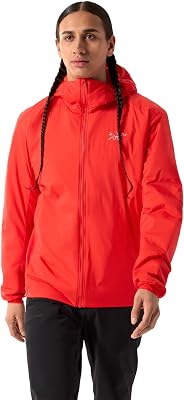
Arc'teryx Atom Hoody
- Weight
- 0.37 kg (371 g)
- Ultralight
- No
- Our rating
- specs only — no full review yet
Manufacturer description
Coreloft 60 synthetic insulated hoody, ~371 g, stretch-knit side panels, DWR.
What the Numbers Say
- ▸Weight: Patagonia Nano Puff is the lighter of the two by 14 g (0.36 kg vs 0.37 kg). For thru-hiking and any pursuit where carry weight compounds across days, that delta matters.
- ▸Price: not published here. List prices in this category go stale faster than we can maintain them, so both product links go to the current listing instead. Compare them the same day — a sale on one side can flip the ranking.
- ▸Ultralight classification: neither product is classified ultralight in their category. Both prioritize durability, features, or comfort over minimum weight.
- ▸Review coverage: only the Patagonia Nano Puff has a full research-based review (rated 9/10). The Arc'teryx Atom Hoody figures here are manufacturer-published specs only.
Detailed Breakdown
Carry weight and packed size
On the published spec sheet, the Patagonia Nano Puff comes in at 357 grams against the 371 grams of the Arc'teryx Atom Hoody. That 14-gram gap may sound trivial in isolation but compounds across multi-day trips — at 25 km a day for a week, you're carrying that delta for about 175 km of trail. Neither product is classified ultralight, so the 14-gram delta comes from incremental material and feature choices rather than a different design philosophy.
Price and total cost of ownership
We no longer publish list prices for either product. A figure written months ago and left to sit is worse than no figure at all, because you can check it in one click and find it wrong. Both product links on this page resolve to the current listing, so use those. Two things are worth knowing before you look: prices in this category move on a seasonal cycle, with last year's models clearing out in late winter and late summer, so patience is often worth more than a discount code. And the sticker is not the cost — a product that lasts seven seasons beats a cheaper one that lasts three, which is the lens to apply if you replace gear infrequently. We have no long-term durability data on either, so we won't name a winner on that; the owner feedback in each listing is the better guide.
Materials and durability
Material composition for both products comes from the manufacturer product pages and is not always reported in directly comparable units. The Patagonia Nano Puff has a full research-based review (rated 9/10); the Arc'teryx Atom Hoody carries the manufacturer's published spec only. For the reviewed product, the durability verdict in the linked review draws on published testing and owner feedback. For the spec-only product, treat material claims as starting points, not verified data.
Features and ergonomics
Manufacturer feature descriptions: the Patagonia Nano Puff (no manufacturer description filed). The Arc'teryx Atom Hoody — Coreloft 60 synthetic insulated hoody, ~371 g, stretch-knit side panels, DWR. Pay particular attention to fit, adjustability, and hand-feel — three dimensions that don't show on a spec sheet and that disproportionately determine whether you'll actually reach for the gear after the first trip.
Use-case fit
The synthetic insulated jackets category covers a wide range of trip styles. For weight-counted thru-hikes, lean toward whichever is lighter on this page — every gram in your pack rides with you for thousands of kilometers. For weekend trips and base-camp days, weight matters less and durability, comfort, and feature count matter more — the heavier of the two on this page often makes more sense in those scenarios. For three-season generalist use, our recommendation: prioritize the product you can read a full research-based verdict on — that's the Patagonia Nano Puff here.
Brand support and availability
Patagonia and Arc'teryx both produce synthetic insulated jackets for the North American and EU markets. Availability varies: smaller cottage brands may require direct-from-manufacturer ordering with 2-6 week lead times, while bigger brands stock through REI, Backcountry, and large EU outdoor chains with same-week shipping. Before buying either, check the manufacturer's warranty terms (often 1, 2, or 10 years depending on brand culture) and the brand's reputation for honoring claims on minor failures versus catastrophic ones. Our research-based review notes warranty interactions where relevant, based on owner reports.
Frequently Asked Questions
Which is lighter, the Patagonia Nano Puff or the Arc'teryx Atom Hoody?
On published manufacturer specs, the Patagonia Nano Puff is the lighter of the two by 14 grams (0.36 kg vs 0.37 kg). For ultralight backpackers counting grams in the synthetic insulated jackets category, that's a meaningful difference.
Which costs less, the Patagonia Nano Puff or the Arc'teryx Atom Hoody?
We don't publish list prices for these two. Gear in the synthetic insulated jackets category moves with seasonal clear-outs, retailer promotions and member rebates, so a figure written months ago is more likely to mislead you than help. Both product links on this page go straight to the current listing, which is the only price either of us should be working from. Compare them on the same day: a sale on one side can reverse the ranking entirely.
Does this site have full reviews of both products?
The Patagonia Nano Puff has a full research-based review (rated 9/10), drawing on published testing and owner feedback. The Arc'teryx Atom Hoody figures on this page are published manufacturer specs only.
Is the Patagonia Nano Puff ultralight by industry standards?
No. The Patagonia Nano Puff at 0.36 kg sits above the ultralight threshold for its category. That usually means more durability or features at the cost of carry weight — a fair trade if your trips lean toward base-camp or shoulder-season use.
Is the Arc'teryx Atom Hoody ultralight by industry standards?
No. The Arc'teryx Atom Hoody at 0.37 kg sits above the ultralight threshold. That usually buys more durability or features at the cost of weight — appropriate for car-camping, base-camp, or shoulder-season trips.
How should I choose between the Patagonia Nano Puff and the Arc'teryx Atom Hoody?
Start with how much the weight matters to you. The Patagonia Nano Puff saves 14 g, which is worth paying attention to if you carry it day after day on a long trip and close to irrelevant on a weekend out. Neither classification separates them, so the gap comes from incremental material and feature choices rather than a different design philosophy. After that it is fit and features, which specs cannot settle: read the owner feedback on both, and check the current price on each before you commit.
Where can I read the full review?
Only the Patagonia Nano Puff has a full review at https://peakgearguide.com/reviews/patagonia-nano-puff. The Arc'teryx Atom Hoody does not have a full review yet — we list its manufacturer specifications only.
Bottom Line
Winner on weight: the Patagonia Nano Puff by 14 g (0.36 kg vs 0.37 kg). If your trip style punishes grams, that's the pick.
Winner on price: we can't call this one honestly. Prices in this category move week to week, and the only figure worth acting on is the one on the listing today. Open both links and compare them in the same sitting.
Our overall lean: the Patagonia Nano Puff is the safer pick because it has a full research-based review (9/10) where published testing and owner feedback corroborate the spec claims. The Arc'teryx Atom Hoody may well be excellent, but we can't say so from spec data alone.
Ready to decide
Prices change with sales and season. Opening both in the same sitting is the only fair comparison.
Related Guides & Reviews
Buying guide
Browse our synthetic insulated jackets guide
Ranked picks for the whole category — reviewed products only.
Full review
Patagonia Nano Puff — full review
Research-based verdict from published testing and owner feedback. Rated 9/10.
All comparisons
Browse the full compare hub
33 cross-shopped pairs across 26 subcategories.
Browse Every Head-to-Head
Every side-by-side on Peak Gear Guide, grouped by gear type. Each page compares published weight, price and specs, plus our verdict where we have reviewed the product.
Tents & Shelters
- Zpacks Duplex vs NEMO Hornet OSMO 2P
- Durston X-Mid 2 vs Zpacks Duplex
- Six Moon Designs Lunar Solo vs Zpacks Duplex
- Tarptent Notch Li vs Durston X-Mid Pro 2
- Durston X-Mid Pro 2 vs Zpacks Duplex
- Tarptent Notch Li vs Six Moon Designs Lunar Solo
- MSR Hubba Hubba NX 2 vs NEMO Hornet OSMO 2P
- Big Agnes Copper Spur HV UL2 vs NEMO Hornet OSMO 2P
- Durston X-Mid 2 vs Durston X-Mid Pro 2
- MSR Hubba Hubba NX 2 vs Durston X-Mid 2
Backpacks
- Osprey Exos 58 vs REI Co-op Flash 55
- Granite Gear Crown3 60 vs Gossamer Gear Mariposa 60
- Osprey Exos 58 vs Granite Gear Crown3 60
- Hyperlite Mountain Gear Southwest 55 vs ULA Circuit
- Hyperlite Mountain Gear Southwest 55 vs Osprey Exos 58
- ULA Circuit vs Gossamer Gear Mariposa 60
- Osprey Atmos AG 65 vs Gregory Baltoro 65
- Osprey Exos 58 vs ULA Circuit
- Hyperlite Mountain Gear Southwest 55 vs Gossamer Gear Mariposa 60
- REI Co-op Flash 55 vs Granite Gear Crown3 60
- Osprey Exos 58 vs Gossamer Gear Mariposa 60
Sleeping Bags & Pads
- REI Co-op Magma 30 vs Enlightened Equipment Revelation 20°
- Therm-a-Rest NeoAir XLite NXT vs Therm-a-Rest NeoAir XTherm
- Therm-a-Rest NeoAir XLite NXT vs NEMO Tensor Insulated
- Big Agnes Rapide SL vs NEMO Tensor Insulated
- Western Mountaineering UltraLite 20 vs Feathered Friends Hummingbird UL 30
- Sea to Summit Spark 30F vs Feathered Friends Hummingbird UL 30
- Sea to Summit Spark 30F vs REI Co-op Magma 30
- Sea to Summit Ether Light XT Insulated vs Big Agnes Rapide SL
- NEMO Tensor All-Season vs Sea to Summit Ether Light XT Insulated
- Enlightened Equipment Revelation 20° vs Western Mountaineering UltraLite 20
- REI Co-op Magma 30 vs Feathered Friends Hummingbird UL 30
- Therm-a-Rest NeoAir XLite NXT vs Sea to Summit Ether Light XT Insulated
- Therm-a-Rest NeoAir XTherm vs NEMO Tensor All-Season
- NEMO Tensor All-Season vs Big Agnes Rapide SL
- Enlightened Equipment Revelation 20° vs Feathered Friends Hummingbird UL 30