
How to Use Trekking Poles (2026 Form Guide)
By Peak Gear Guide Editorial Team · Gear research & fact-checking
The Quick Version
Adjust pole length so your elbow forms a 90° angle on flat ground. Insert your hand UP through the strap from below (not down through), then grab the handle — let the strap take weight, not your grip. Plant the pole opposite your forward foot. Shorten 5-10 cm for uphill, lengthen 5-10 cm for downhill. Two poles, never one. Done correctly, poles reduce knee compression by up to 25% on descents.
Step 1: Size the Poles Correctly
The single biggest mistake new trekking pole users make is wrong length. Set poles too long and your shoulders will burn within an hour. Too short and you'll hunch over and your back will hurt. The right length creates a relaxed 90° elbow bend — the same starting point taught in REI’s expert advice on using poles.
Stand upright with arms at your sides. Set both poles to a length where when you grip the handles, your forearms are parallel to the ground and your elbows form right angles. The pole tips should rest on the ground naturally. Most adult hikers find this in the 110-130 cm range. Hikers under 5'4" typically need 100-115 cm; hikers over 6'2" need 130-145 cm.
Step 2: The Strap Technique Most People Get Wrong
The instinct is to put your hand down through the strap loop, like putting on a watch. Do the opposite. Insert your hand UP through the strap from below, then grab the handle. Your wrist rests against the inside of the strap; the loop wraps over the back of your hand.
The point of this is load transfer. When you push down on the pole during a descent, the strap presses against your wrist and transfers the force through your arm to your shoulder. Your fingers don't need to grip the handle hard at all — many experienced hikers walk for hours with their hands partially open, supported entirely by the strap.
Step 3: Walking Form on Flat Ground
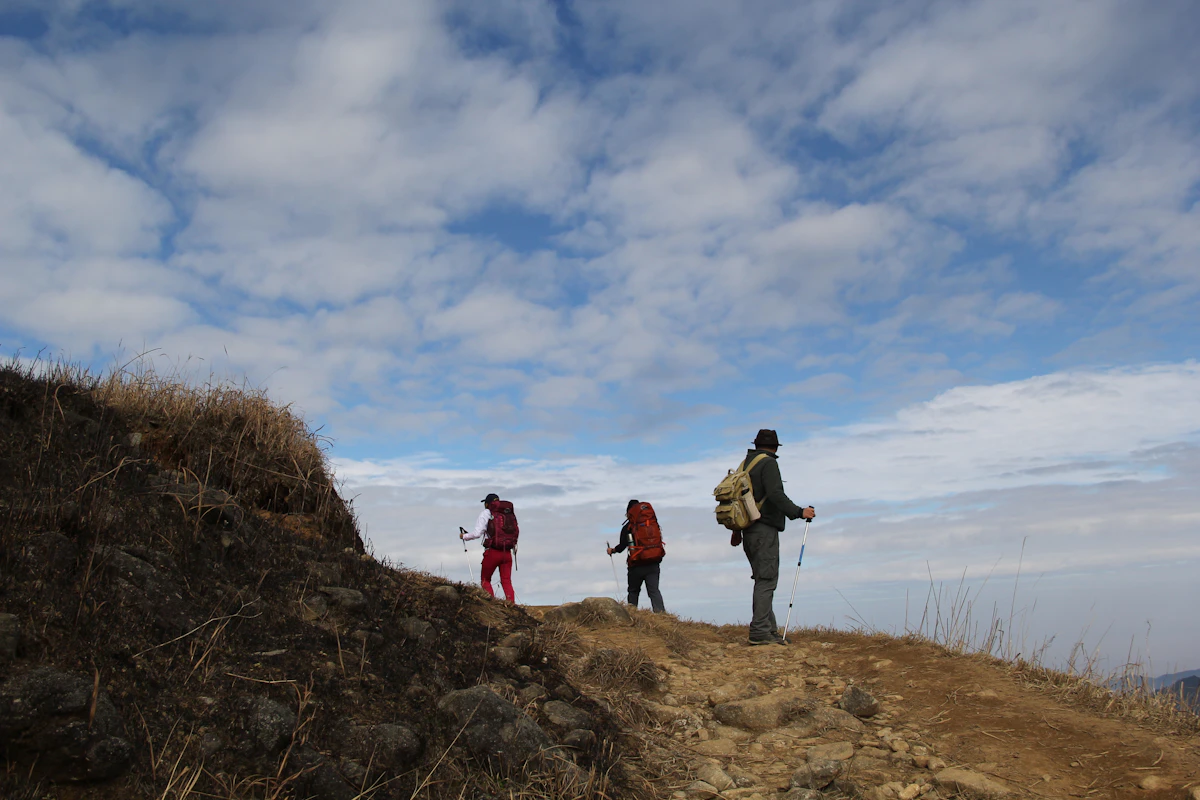
The natural rhythm: plant the pole on the opposite side from your forward foot. Left pole forward when right foot lands; right pole forward when left foot lands. This creates a smooth nordic-walking gait that distributes effort across all four limbs instead of just your legs.
Keep your grip relaxed. The handle should sit loosely in your palm, with the strap doing the work. If your forearm or hand is fatiguing after 30 minutes of hiking, you're gripping too hard or the strap is set wrong.
Step 4-5: Adjusting for Climbs and Descents
Uphill: shorten 5-10 cm
On climbing terrain, shortening the poles keeps your forearms in a power position. Plant the tips slightly ahead of your forward foot and push down — your arms drive you forward and up, taking some load off your quads and glutes. This is especially helpful with a heavy pack on long ascents. Most lever-lock poles allow a 5-second length adjustment without removing the poles from your hands.
Downhill: lengthen 5-10 cm
On descents, lengthen the poles so the tips reach the ground below your feet. Plant tips ahead of where your foot will land, the pole acts as a brake, slowing your forward momentum and absorbing the impact your knees would otherwise take. Peer-reviewed research measures up to 25% reduction in knee compression force on steep descents with proper pole use. For hikers with knee issues, this is the single biggest reason to use poles.
Step 6: Side-Hill and Special Terrain
Traversing side-hill terrain requires asymmetric pole length: shorten the uphill pole and lengthen the downhill pole so both tips touch the ground evenly. This keeps your shoulders square and prevents the high foot from doing all the work. Modern lever-lock poles let you adjust each pole independently in under 30 seconds.
For technical scrambling and rock hopping, collapse and stow the poles. You need both hands free for grabbing rocks and balancing. Most poles fold short enough to fit in side-pocket compression straps; folding Z-poles like the Black Diamond Distance Carbon Z break down to 13-15 inches.
Common Mistakes to Avoid
- Strap on wrong: hand down through loop instead of up. Fix: re-watch the strap section.
- Death-gripping the handle: hand and forearm fatigue. Fix: relax grip, let strap take load.
- Same length all day: shoulders burn on climbs, knees jolt on descents. Fix: adjust 5-10 cm at terrain transitions.
- Planting too far ahead: pole gets in the way of your stride. Fix: plant slightly forward, not way ahead.
- Using one pole: creates asymmetric gait fatigue. Fix: always use two for hiking.
Frequently Asked Questions
What length should my trekking poles be?
How do I attach the wrist strap correctly?
Do trekking poles really save your knees?
Should I use trekking poles uphill?
Why do my hands and forearms hurt from poles?
Do I need two poles or just one?
Related Trekking Pole Guides
How to Choose Trekking Poles
Pillar buying guide — every spec that matters.
Carbon vs Aluminum Poles
Material comparison — weight, durability, cold weather.
Trekking Poles vs No Poles
Decision framework — when poles actually help.
Black Diamond vs Leki Poles
Two dominant brands compared.
Best Trekking Poles 2026
Research-vetted picks across price tiers.
Best Trekking Poles Under $50
Budget picks that still deliver real performance.