
How to Use a Backpacking Stove (2026 Guide)
By Peak Gear Guide Editorial Team · Gear research & fact-checking
The Quick Version
For a canister stove: screw the burner onto the canister, open the valve a quarter turn, light at the burner head, adjust to flame size you need. For liquid fuel: fill bottle, pump 15-20 strokes, prime by burning a small fuel amount in the cup, then open the valve when the generator is hot. Always cook outside the tent, use a windbreak, and let the stove cool before packing. Total time from cold to boiling: about 3 minutes for canister, 5-7 for liquid fuel.
Step 1: Pick a Safe Cooking Site
Site selection prevents 90% of stove accidents. Whatever type of portable stove you run, look for flat, level ground at least 200 feet from your tent and any flammable vegetation. Avoid loose dry grass, pine needle beds, and cliff edges. A flat rock or stove pad works as a stable, fireproof base.
Critical safety rule
Never cook inside a tent. Carbon monoxide poisoning is silent, fast, and deadly. The vestibule is acceptable as wind protection in storms, but the burner should sit outside the inner tent walls with maximum ventilation through the open vestibule.
Step 2-3: Assemble & Pressurize
Canister stove assembly
Screw the burner onto the canister threading. Hand-tight is enough — do not over-torque, which damages the rubber gasket and causes leaks. Listen for any hissing after assembly; a properly seated burner is silent until you open the valve. If you hear a hiss with the valve closed, unscrew and reseat.
Liquid fuel pumping
Fill the fuel bottle to the marked fill line — never above. Screw on the pump tightly. With the valve closed, pump 15-20 strokes until you feel firm resistance. This pressurizes the fuel for delivery to the burner. The pump cup eventually wears and needs replacement; if you pump 30+ strokes without resistance building, the cup is shot.
Step 4: Prime (Liquid Fuel Only)
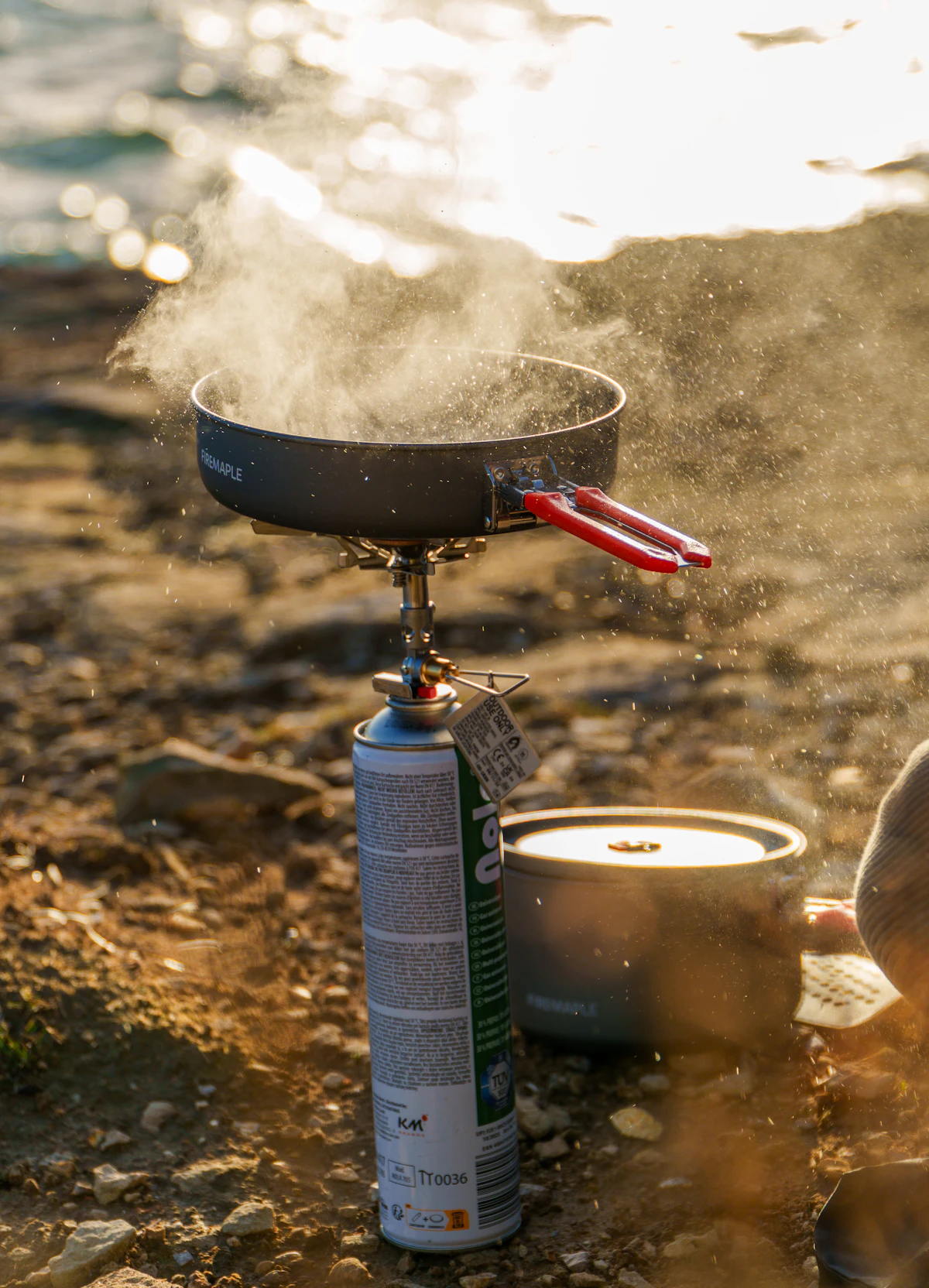
Liquid fuel stoves require priming because cold liquid fuel doesn't vaporize cleanly through the jet, you get yellow, sooty flame and risk a flare-up. The generator (the metal tube above the burner) needs to be hot enough to vaporize fuel before the main burner runs.
Open the valve briefly — about 1 second — to release a small amount of fuel into the priming cup. Close the valve. Light the priming fuel with a lighter or match. The flame heats the generator above. When the priming flame is nearly out, slowly open the main valve, the burner should ignite with a steady blue flame. If you get yellow flame or fireball, close the valve, let everything cool, and re-prime more carefully next time.
Step 5-6: Light & Cook
Lighting the canister stove
Open the valve a quarter turn. You should hear a steady hiss — that's fuel flowing. Hold a lighter at the burner head. Flame should catch instantly and stabilize blue. If the flame is yellow and tall, the canister is cold — warm it in your hands or sleeping bag for 5 minutes and retry. If the canister hisses but won't light, the lighter isn't close enough or the wind is blowing fuel away — try a windproof lighter held closer.
Simmer control
For boiling water, run near full output. For simmering — rice, pasta, slow-cooking foods — turn the valve to roughly 25-30% open. Flame should be smaller but still steady blue, not flickering. If the flame is too small to stay lit, the canister or fuel pressure is too low; either open the valve more or let the canister warm. Simmer rings (Jetboil, MSR Reactor) help maintain consistent low flame on integrated systems.
Wind protection
Even a 5 mph breeze doubles fuel consumption. A simple windbreak (rock, pack, your body) is fine for top-mount canister stoves. Full 360-degree windscreens are dangerous on canister stoves because they trap heat against the canister, which can over-pressurize and explode. Full windscreens are safe with remote-canister and liquid fuel stoves only. Always check manufacturer guidance.
Step 7: Shut Down & Pack
Close the fuel valve fully. The burner will continue to run for a few seconds on residual fuel, this is normal. Wait 5-10 minutes for the burner to cool to touch before disassembly.
Liquid fuel: depressurize the bottle by carefully opening the pump valve until the hiss stops. Disconnect the fuel line, wipe the bottle threads, and store both pieces in their stuff sack. Canister: unscrew the burner from the canister once cool. The burner can go back into your kit; the canister stays sealed by its valve until next use.
Never pack a hot stove. A still-hot burner can melt stuff sacks, scorch sleeping bags, and crack plastic gear in your kit.
Frequently Asked Questions
How do I light a canister stove?
Why does my stove flame keep going yellow?
Can I use a backpacking stove inside my tent?
How do I clean a clogged stove jet?
Do I need a windscreen for my backpacking stove?
What do I do if my stove won't light?
Related Stove Guides
Canister vs Liquid Fuel Stove
Which stove type fits your trip — head-to-head comparison.
How Much Fuel for Backpacking
Calculate canister and liquid fuel for any trip length.
MSR vs Jetboil
Two popular canister stove brands compared.
Best Backpacking Stoves
Research-vetted picks across stove types.
Campfire Cooking for Beginners
When you can't or shouldn't bring a stove.
Backpacking Food Guide
Calorie planning + meal ideas to cook on your stove.