Sleeping Pad Comparison Guide
Foam vs Air Sleeping Pads: 2026 Honest Comparison
By Peak Gear Guide Editorial Team · Gear research & fact-checking
Weight, R-value, comfort, durability, and price compared head-to-head. The real tradeoffs and which type actually wins for your camping style.
Foam or Air Sleeping Pad: Which Is Right for You?
Air pads win on comfort, packed size, and warmth per ounce. Foam pads win on durability, price, and reliability. For most three-season backpackers, an insulated air pad is the right primary choice. For winter, ultralight thru-hikers, or anyone wanting bulletproof reliability, foam wins, or stack both for the best of both worlds.
The foam-vs-air debate gets oversimplified online. Both pad types are good, the question is which tradeoffs match your camping style. This guide breaks down 12 head-to-head comparison points with specific recommendations for backpackers, car campers, and winter users. For the underlying warmth math, see our sleeping pad R-value guide first.
One reason the R-values below are directly comparable: since 2020, nearly every brand reports warmth using ASTM F3340, the standardized sleeping-pad test method, so a NeoAir’s R-4.5 and a Nemo’s R-3.5 are measured the same way. If you want the underlying physics, the R-value (insulation) concept explains why a thin foam pad and a thick air pad can land at the same number.
#Quick Answer by Use Case
- →Weekend backpacker: Insulated air pad (Therm-a-Rest NeoAir XLite NXT or Nemo Tensor Insulated)
- →Thru-hiker / ultralight: Closed-cell foam (Therm-a-Rest Z Lite Sol or Nemo Switchback) — bombproof, doubles as sit pad
- →Car camper: Self-inflating air pad (Therm-a-Rest MondoKing) — comfort trumps weight when you're not carrying it
- →Winter / sub-freezing: Both — foam stacked under air for R-5+ and puncture-failure backup
- →Side sleeper: Air pad with at least 3 inches thickness, period
- →Budget under $50: Closed-cell foam — quality air pads start at $130

Head-to-Head: Every Spec Compared
Twelve direct comparisons across the factors that actually matter when sleeping on the ground. The "winner" column reflects general consensus — your priorities may flip the answer.
| Feature | Foam (Closed-Cell) | Air (Inflatable) | Winner |
|---|---|---|---|
| Weight (regular size) | 9 - 14 oz | 12 - 16 oz | tie |
| Packed size | Large (5 x 20+ in, must strap externally) | Small (4 x 9 in, fits inside pack) | air |
| Cushion thickness | 0.5 - 0.75 in | 2.5 - 4 in | air |
| Max R-value | 2.6 (Z Lite Sol) | 8.0+ (Exped DownMat) | air |
| Lifespan | 8 - 12 years | 3 - 5 years | foam |
| Failure mode | None — no parts to fail | Punctures, valve leaks, seam separation | foam |
| Setup time | Unroll: 5 seconds | Inflate: 60 - 120 seconds | foam |
| Stability on tent floor | Excellent — flat and silent | Wobbles and squeaks against tent floor | foam |
| Side sleeper comfort | Hip and shoulder bottom out | Plush enough for any position | air |
| Doubles as sit pad | Yes — durable enough | No — risk of puncture | foam |
| Cold-weather reliability | Cannot fail | Lithium valves can crack below 10°F | foam |
| Price | $35 - $50 | $130 - $230 | foam |
Score: Foam wins 6, Air wins 5, Tie 1. The split nature is why both pad types remain in production — neither is universally better.
Closed-Cell Foam Pads: The Reliable Workhorse

Closed-cell foam pads are extruded EVA or polyethylene foam, die-cut to shape, and folded or rolled for transport. There is nothing to fail. No valves, no seams, no bladders. They cost $35-50 and last a decade of weekly use.
Where foam wins
- --Indestructibility. Drop it on a cactus, sit on it during breaks, drag it across granite, it doesn't care. The Therm-a-Rest Z Lite Sol is the most-used sleeping pad on the Appalachian Trail because it survives 2,200 miles of abuse.
- --Instant deployment. Unfold it. Done. No 60-second inflation routine when you arrive at camp exhausted.
- --Multi-purpose during the day. Doubles as a sit pad during lunch breaks, an emergency splint, a yoga mat at camp, a rain shelter for gear.
- --Cold-weather backup. When temperatures drop below 14°F, lithium-ion-style valves on premium air pads can crack. Foam pads have nothing to fail.
- --Price. $35-50 for a quality pad vs $130-230 for comparable air pads.
Where foam loses
- --Comfort. 0.75 inches of foam is not enough cushion for side sleepers. Hips and shoulders bottom out against the ground after 2-3 hours.
- --R-value ceiling. Maxes out around R-2.6. Cold-weather use requires stacking with another pad.
- --Packed size. Even folded, takes up significant space. Most thru-hikers strap foam pads to the outside of their packs.
For specific foam-pad picks within budget tiers, see our best sleeping pads under $50 roundup — closed-cell foam dominates that category.
Insulated Air Pads: The Modern Default

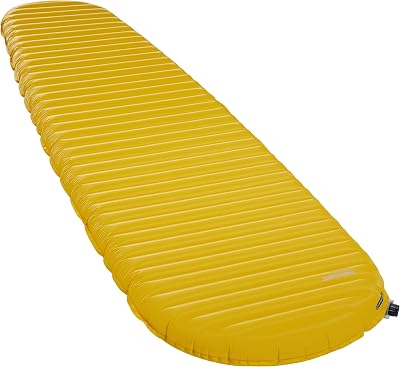
Modern insulated air pads layer reflective films, synthetic insulation, or even down inside an airtight bladder. They pack down to the size of a water bottle, deliver R-values from 3 to 8, and provide 2.5 to 4 inches of cushion. They cost $130-230 and last 3-5 years of regular use.
Where air pads win
- --Comfort. 3 inches of cushion is genuinely comfortable for any sleep position. Side sleepers especially benefit — hips and shoulders no longer bottom out.
- --Warmth-to-weight. The Therm-a-Rest NeoAir XTherm NXT delivers R-value 7.3 at 15 ounces. No foam pad approaches that warmth-to-weight ratio.
- --Packed size. Most insulated air pads pack down to roughly the size of a 1-liter water bottle, fitting inside even small backpacks.
- --Adjustable firmness. You can dial in pressure for personal preference — softer for side sleeping, firmer for back sleeping. Foam pads are stuck at one firmness.
Where air pads lose
- --Failure modes. Punctures from thorns, hot embers, or rocky tent floors. Valve leaks. Seam separation. Most air pad owners have had at least one trip ruined by deflation.
- --Setup time. Inflating takes 60-120 seconds of lung-burning effort. Pump bags help but add weight and complexity.
- --Tent-floor noise. Some air pads (especially older Therm-a-Rest NeoAir models) squeak loudly against silnylon tent floors. Newer designs are quieter but the issue persists.
- --Price. Quality insulated air pads start at $130. Premium models exceed $230.
For tested air-pad picks across price ranges, see our best sleeping pads roundup and the dedicated best backpacking sleeping pads comparison.
The Smart Move: Stack Both
The hidden third option most beginners miss: use both pad types together. R-values are additive, so a closed-cell foam pad (R-2.0) under an insulated air pad (R-3.5) gives you a combined R-value of 5.5 — enough for true winter conditions.
Beyond the R-value math, stacking provides three tactical advantages:
- Puncture-failure backup. If your air pad develops a leak at 2 AM, the foam pad still gives you R-2 of insulation between you and frozen ground instead of zero.
- Versatility across seasons. Use the foam alone in summer (R-2 is plenty), the air pad alone in three-season (R-3.5), and both stacked in winter (R-5.5). One investment covers every scenario.
- Daytime utility. The foam pad becomes your sit pad, gear protector, and emergency splint during the day. The air pad stays packed.
Combined cost: $40 foam + $180 air = $220 total. Compare to a single high-R-value winter pad like the Exped DownMat XP 9 at $300+ — stacking is cheaper AND more versatile.
Specific Recommendations
Best Foam Pads
- Therm-a-Rest Z Lite Sol ($45). R-2.0, 14 oz, the AT/PCT classic
- Nemo Switchback ($55). R-2.0, 14.5 oz, more comfortable foam pattern
- Therm-a-Rest RidgeRest SOLite ($35). R-2.1, 14 oz, budget pick
Best Insulated Air Pads
- Therm-a-Rest NeoAir XLite NXT ($210). R-4.5, 13 oz, the 3-season default
- Nemo Tensor Insulated ($190). R-3.5, 15 oz, quieter on tent floors
- Therm-a-Rest NeoAir XTherm NXT ($240). R-7.3, 15 oz, winter-rated
Frequently Asked Questions
Are foam or air sleeping pads warmer?+
Which is more comfortable: foam or air sleeping pads?+
How long do foam vs air sleeping pads last?+
Are foam sleeping pads cheaper than air pads?+
Can you use a foam pad and air pad together?+
Which sleeping pad type is best for backpacking?+
Related Sleeping Pad Guides
Sleeping Pad R-Value Guide
The full chart for matching pad warmth to camping conditions — read this before buying any pad.
Best Sleeping Pads 2026
Tested picks across both foam and air categories with full spec comparisons.
Best Backpacking Sleeping Pads
Weight-focused picks for thru-hiking and multi-day backpacking trips.
Best Sleeping Pads Under $50
Budget picks where closed-cell foam dominates, the smart beginner buy.