Garmin vs Suunto: Best GPS Watch for Hiking? (2026)
By Peak Gear Guide Editorial Team · Gear research & fact-checking
Quick answer: Garmin wins for mapping, multi-band GPS accuracy, and battery life, with a deeper US trail database and stronger smartphone integration. Suunto wins for physical durability, simpler menu structure, and traditional altimeter accuracy, with better European trail coverage. Choose Garmin for navigation-heavy use and US trips; choose Suunto for rough handling, expedition use, and European objectives.
Garmin and Suunto are the two brands serious outdoor athletes argue about most. Both make watches built for rugged, multi-day use, and both have loyal followings with legitimate reasons for their preference. The gap between them is real but depends almost entirely on what you value most: Garmin wins on navigation capability and training depth; Suunto wins on raw battery endurance and a no-fuss approach to tracking long efforts. This guide breaks down every major category, then gives you specific model matchups to help you decide.
The specs cited throughout this guide are drawn from each manufacturer’s official documentation: Garmin publishes detailed battery and GNSS data for its Fenix and Instinct lines, while Suunto documents the endurance figures behind the 9 Peak series. For independent buying advice on GPS watches, REI’s expert-advice library is a useful neutral reference.
In This Guide

Brand Overview
Garmin was founded in 1989 in Lenexa, Kansas, and later established its headquarters in Olathe, Kansas, with significant engineering operations in Switzerland. The company built its foundation on aviation and marine navigation systems before moving into consumer GPS devices and, eventually, GPS sport watches. Today Garmin dominates the GPS watch market globally, with the Fenix and Epix lines sitting at the top of nearly every serious outdoor athlete's shortlist.
Suunto is a Finnish company founded in 1936, it predates GPS by half a century and made its name building precision compasses and dive computers for professionals. The brand pioneered wrist-worn dive computers in the 1980s and applied that engineering discipline to outdoor watches as GPS became available. Suunto watches carry a distinct Finnish design sensibility — minimal interfaces, endurance-first feature prioritization, and exceptional material quality. The Suunto 9 series remains the benchmark battery life watch in outdoor athletics.
GPS Accuracy and Navigation
Both brands deliver reliable GPS accuracy in open terrain. The meaningful technical differences emerge in challenging conditions — heavy forest canopy, deep canyon slots, or steep valley walls where satellite geometry is compromised.
Garmin's flagship outdoor watches support multi-band GNSS, combining GPS, GLONASS, and Galileo satellite systems simultaneously with dual-frequency L1/L5 reception. This multi-constellation, multi-band approach dramatically improves accuracy in urban canyons and dense forest compared to single-band receivers. The Fenix 7 Pro and Epix Pro record tracks that closely mirror actual terrain geometry even under tree cover, a meaningful real-world advantage for technical trail navigation.
Suunto's FusedTrack technology combines GPS data with the watch's built-in accelerometer to smooth out GPS gaps and maintain accurate distance tracking even when satellite signals are briefly lost. It is a smart algorithmic approach to accuracy rather than a hardware solution. In practice FusedTrack performs well for distance accuracy, but Garmin's multi-band hardware retains an edge for precise position plotting in challenging terrain. For most hikers on established trails, both systems provide more than adequate accuracy. For technical off-trail navigation or dense forest routes, Garmin's hardware advantage becomes relevant. Pair your watch with the best hiking apps for complete navigation coverage.
Battery Life
Battery life is the category where Suunto has built its strongest competitive position. The Suunto 9 Peak Pro delivers up to 120 hours of continuous GPS tracking, a number that covers a 100-mile ultramarathon, a full multi-day traverse, or a week-long backpacking trip with light daily GPS use. This is achieved through Suunto's adaptive GPS sampling mode, which intelligently reduces GPS polling frequency during periods of steady movement to extend runtime without meaningful track degradation.
Garmin counters with the Fenix 7 Solar, which pairs a conventional battery (up to 89 hours GPS) with a solar-charging bezel that extends runtime in direct sun. In real alpine conditions with strong solar exposure, the Fenix 7 Solar can run GPS indefinitely. In overcast conditions or forest hiking where solar input is minimal, the battery advantage shifts back to Suunto.
For backpacking trips with daily GPS tracking over 5-7 days, the Suunto 9 Peak Pro is the more reliable battery choice in the absence of solar. For hikes in sunny, open terrain, the Fenix 7 Solar is competitive and may extend further. For day hikes and weekend trips, battery life is a non-factor for either brand. See our backpacking gear checklist for how to plan power management on multi-day trips.
Maps and Routing
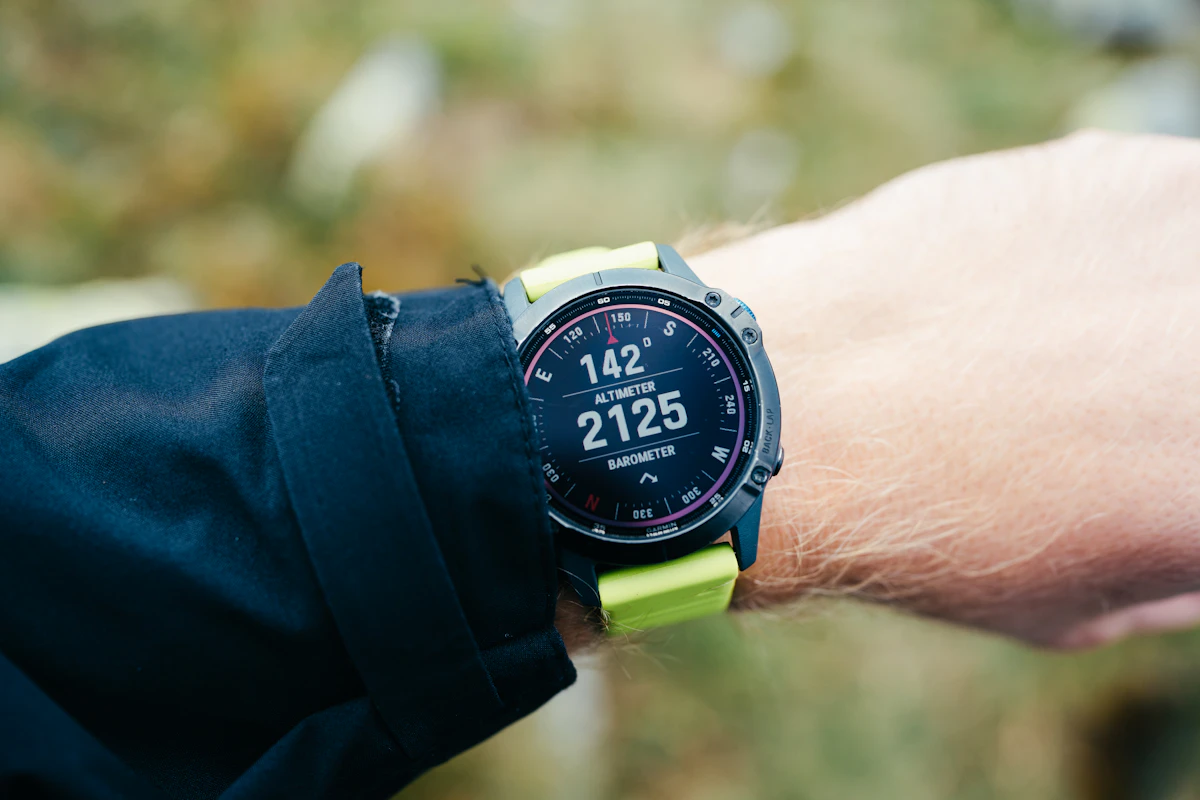
This is Garmin's clearest competitive advantage over Suunto. Garmin Fenix 7, Epix Pro, and several other outdoor-oriented models carry full onboard topographic maps — detailed enough to show contour lines, trail names, water sources, and points of interest directly on the watch display. Navigation includes turn-by-turn directions on-trail and back-to-start routing if you become disoriented. Garmin Connect IQ allows downloading additional map layers, ski resort maps, and city maps. For a hiker who wants to navigate independently without relying on a phone, this capability is significant. Understanding how to read the terrain shown on those maps is covered in our guide to reading topographic maps.
Suunto watches display breadcrumb navigation — your recorded track and pre-loaded routes appear as lines on a simplified map view without topographic detail. Suunto Move and the Suunto app allow route planning and syncing before a hike, and the watch can guide you along that route with on-screen course deviation indicators. This is entirely sufficient for following a known trail. For navigating complex terrain, finding alternative routes on the fly, or identifying terrain features without a phone, Suunto's mapping falls short of Garmin. This gap is the primary reason most professional guides and navigators who use wrist devices choose Garmin.
Training Features
Garmin has built the deepest fitness and training ecosystem of any GPS watch platform. Garmin Connect provides structured workout planning, training load analysis, recovery time recommendations, Body Battery energy monitoring, sleep tracking, VO2 max estimates, race time predictors, and coaching plans for running, cycling, swimming, and multi-sport. Third-party integrations with TrainingPeaks, Strava, and coaching apps extend the platform further. For serious athletes using their GPS watch as a training tool rather than purely a navigation device, Garmin's ecosystem is unmatched.
Suunto's approach is more focused: the platform excels at endurance tracking — heart rate, pace, elevation, GPS track, and presents this data cleanly without the density of Garmin's metrics. Suunto's training analysis covers the fundamentals well, and the watch tracks all standard metrics during a hike or run. What Suunto lacks is the layered coaching ecosystem and the breadth of structured training tools Garmin has built over two decades. For athletes who want their watch to coach them, not just record them. Garmin wins. For athletes who want a clean, simple tracker that stays alive for very long efforts, Suunto's approach is preferable. This matters particularly for ultralight backpacking where simplicity and weight savings extend to your wrist.
Build Quality and Durability
Both brands produce watches built to survive genuine expedition conditions. Both meet MIL-STD-810 military durability standards. Both are rated to 10 ATM water resistance. Neither brand has a meaningful real-world advantage in general durability for hiking and backpacking use.
The differentiation is in material choices. Suunto uses titanium more extensively in its flagship cases and bezels, the Suunto 9 Peak Pro ships with a titanium case as standard rather than as a premium upgrade tier. Titanium is lighter than steel and meaningfully more scratch-resistant over years of trail use. Garmin offers titanium options on the Fenix 7X Sapphire Solar and Epix Pro, but these command significant price premiums over the standard stainless steel or polymer case versions.
Garmin's polymer and fiber-reinforced polymer case options are lighter than Suunto's steel equivalents while maintaining excellent impact resistance. For weight-conscious hikers, the Garmin Instinct 3 in its polymer case version competes favorably on wrist weight with Suunto's slim titanium builds. Sapphire crystal glass is available on both brands' flagship tiers and is the correct choice for any watch seeing regular rock and brush contact on trails.
Head-to-Head Comparison Table
| Category | Garmin | Suunto | Winner |
|---|---|---|---|
| GPS accuracy (open terrain) | Excellent — multi-band GNSS | Excellent. FusedTrack | Tie |
| GPS accuracy (forest/canyon) | Multi-band L1/L5 hardware advantage | FusedTrack algorithmic smoothing | Garmin |
| Battery life (GPS on) | ~89 hrs (Fenix 7 Solar) | Up to 120 hrs (Suunto 9 Peak Pro) | Suunto |
| Onboard topographic maps | Full TopoActive maps, turn-by-turn | Breadcrumb trail only | Garmin |
| Training ecosystem | Garmin Connect — deepest platform | Suunto app — clean, endurance-focused | Garmin |
| App integrations | Connect IQ, TrainingPeaks, Strava | Strava, TrainingPeaks, Komoot | Garmin |
| Titanium availability | Premium upgrade tier on flagship | Standard on Suunto 9 Peak Pro | Suunto |
| Smartwatch features | Payments, music, notifications, maps | Notifications, basic smartwatch | Garmin |
| Price range (flagship) | $599–$800+ | $599–$699 | Suunto (slight) |
| Mid-range options | Strong. Instinct 2, FR955 at $350-$450 | Limited mid-range lineup | Garmin |
Model Matchups
Garmin Fenix 7 vs Suunto 9 Peak Pro. Flagship Outdoor
This is the head-to-head that most serious hikers are actually deciding between. Both are fully premium outdoor watches with titanium options, sapphire glass, and multi-day battery life. The Fenix 7 wins on mapping, training depth, and smartwatch functionality. The Suunto 9 Peak Pro wins on battery endurance and standard titanium construction. If you will be navigating with the watch as your primary map tool, choose the Fenix 7. If you are running long events or multi-day expeditions where charging opportunities are limited, choose the Suunto 9 Peak Pro.
Garmin Fenix 7
- Battery: Up to 89 hrs GPS (Solar)
- Maps: Full TopoActive onboard topo
- GNSS: Multi-band GPS+GLONASS+Galileo
- Case: Steel / titanium / polymer options
- Smartwatch: Music, payments, apps
- Price: ~$599–$799
Suunto 9 Peak Pro
- Battery: Up to 120 hrs GPS
- Maps: Breadcrumb trail navigation
- GNSS: GPS+GLONASS+Galileo
- Case: Titanium standard
- Smartwatch: Notifications only
- Price: ~$599–$699
Verdict: The Garmin Fenix 7 is the better all-around outdoor watch for hikers who want navigation capability. The Suunto 9 Peak Pro is the better choice for endurance athletes and expedition users where maximum battery life is the priority.
Garmin Instinct 3 vs Suunto Core. Rugged Entry
At the rugged, affordable end of each brand's lineup, the Garmin Instinct 3 and Suunto Core target hikers who want a durable GPS watch without flagship pricing. The Instinct 3 brings Garmin's navigation and fitness tracking in a reinforced polymer case at around $299–$349. The Suunto Core is a more elemental outdoor instrument. ABC (altimeter, barometer, compass) watch with basic GPS tracking at a lower price point, designed primarily as an outdoor sensor platform rather than a training watch. These products have increasingly divergent feature sets at comparable prices.
Garmin Instinct 3
- Battery: Up to 40 hrs GPS (Solar)
- GPS: Multi-GNSS with solar
- Training: Full Garmin Connect metrics
- Altimeter/Barometer/Compass: Yes
- Display: MIP transflective
- Price: ~$299–$349
Suunto Core
- Battery: Up to 30 hrs GPS
- GPS: Standard GPS
- Training: Basic activity tracking
- Altimeter/Barometer/Compass: Yes
- Display: Transflective LCD
- Price: ~$249–$299
Verdict: The Garmin Instinct 3 provides more complete GPS and training functionality at a comparable price. The Suunto Core is preferred by hikers who want a simple, light ABC watch and don't need extensive training analytics. If you are buying in this price tier for hiking, the Instinct 3 offers better value unless Suunto's aesthetic is a deciding factor.
Which Brand to Buy
For more help planning your outdoor kit, see our complete backpacking gear checklist.
Frequently Asked Questions
Is Garmin or Suunto better for hiking?▼
Garmin is the stronger choice for navigation-heavy hiking. Its flagship watches carry full onboard topographic maps with turn-by-turn routing, multi-band GNSS support, and a mature ecosystem of downloadable trail maps. Suunto is a better fit for endurance athletes who prioritize battery longevity over mapping depth, the Suunto 9 Peak's 120-hour GPS mode outlasts most Garmin equivalents when solar charging is not a factor. For hikers who use a GPS watch primarily as a breadcrumb tracker and fitness monitor, either brand works well. For hikers who want to navigate confidently without a phone, Garmin wins clearly.
Which GPS watch has the longest battery life?▼
The Suunto 9 Peak holds the endurance record in standard GPS mode — up to 120 hours, which covers multi-day fastpacking or ultra-distance events comfortably. The Garmin Fenix 7 Solar is competitive in multi-GNSS mode (approximately 89 hours) and extends further with solar charging in strong sunlight. In real-world use on a 3-7 day backpacking trip, the Suunto 9 Peak finishes with more charge remaining than the Fenix 7 Solar under the same GPS-on conditions, unless the Garmin benefits from sustained direct sun. For battery-first buyers, Suunto 9 Peak is the benchmark.
Does Suunto have topographic maps?▼
Suunto watches display breadcrumb trail navigation, you can see your recorded track and pre-loaded routes on a simple map view, but they do not carry full onboard topographic maps in the way Garmin does. Garmin's Fenix and Epix lines include detailed TopoActive maps that show contour lines, trails, roads, and points of interest directly on the watch face. Suunto's approach works for following a known route, but if you need to navigate off-trail or read terrain detail on your wrist, Garmin's mapping capability is meaningfully superior. Suunto users typically rely on a phone app for detailed map work.
Which brand is better for trail running?▼
Both brands are used extensively by competitive trail runners, but they serve different runner profiles. Garmin suits runners who want detailed training data — structured workouts, recovery time, VO2 max estimates, race predictor tools, and coaching plans delivered through Garmin Connect. The platform has the deepest training ecosystem of any GPS watch brand. Suunto suits runners who want pure endurance tracking with an exceptional battery that survives 100-mile events without mid-race charging. If training analytics and coaching matter, choose Garmin. If you are running events where the watch must simply stay alive for 20-30+ hours, choose Suunto.
Are Garmin watches waterproof enough for stream crossings?▼
Yes. Most Garmin outdoor watches — including the Fenix, Epix, Instinct, and Forerunner lines — are rated to 10 ATM (100 meters), which is more than adequate for rain, stream crossings, river fords, and swimming. The Garmin Fenix 7 and Epix Pro are also suitable for recreational diving. Suunto outdoor watches carry equivalent or higher water resistance ratings, the Suunto 9 Peak and Suunto Core are both rated to 100 meters. Water resistance is not a differentiating factor between these brands for typical hiking and backpacking use cases.
What is the price difference between Garmin Fenix and Suunto 9?▼
Both brands price their flagship outdoor watches in the $500–$800 range. The Garmin Fenix 7 starts around $599 and the titanium / sapphire variants reach $800+. The Suunto 9 Peak Pro sits around $599–$699 depending on configuration. The meaningful price difference is in the mid-range: Garmin offers more models across the $200–$450 price range (Instinct 2, Forerunner 955) that provide strong hiking capability without flagship pricing. Suunto's lineup is more concentrated at the premium end, with fewer strong mid-range options. Buyers on a budget have more Garmin options to consider.


